


Who was Lady Godiva from the Queen and Velvet Underground songs?

The first two albums by pioneering New York avant-garde psychedelic rock band The Velvet Underground are drenched in the influence of the band’s multi-instrumentalist John Cale. Cale left the band after White Light/White Heat came out in 1968, but nowhere do we hear his impact more profoundly than on the track ‘Lady Godiva’s Operation’.
There, his haunting lead vocals and disturbing studio sound effects create a horrifying picture of bodily mutilation in our mind’s eye. The song’s writer Lou Reed later explained to Circus Magazine in 1973, “Lady Godiva’s Operation’ was about a trans-sexual”.
Either the doctor’s incisions on Godiva’s body described in the lyrics, which cause her “screams” to “echo up the hall”, are part of a sex change operation, or the whole event is a metaphor for society’s attempts to inflict violent repression on the bodies of trans people. The penultimate line depicting how the “doctor removes his blade cagily slow from the brain” even suggests that a frontal-lobe lobotomy is taking place.
Meanwhile, a decade later, the Queen song ‘Don’t Stop Me Now’ unexpectedly makes a passing reference to the very same Lady Godiva from The Velvet Underground song. In his paean to hedonism, Queen frontman Freddie Mercury sings, “I’m a racing car passing by, like Lady Godiva / I’m gonna go, go, go”. Other than the mention of this mysterious lady, the two songs don’t seem to bear any relation to each other.
Who is the woman they’re talking about?
Lady Godiva was a noblewoman in medieval England of Anglo-Saxon ancestry, who managed to keep her land despite the Norman invasion of 1066. She was married to the Anglo-Saxon Earl Leofric of Mercia (today’s central England), whose principal stately home was based in the Midlands town of Coventry.
She took over sole proprietorship of her husband’s estate after he died. She is listed in the Domesday Book census from the year 1086 AD as the only female landowner to have survived the Norman Conquest with her property intact. However, it’s the legend of Lady Godiva rather than her real-life story that caught the attention of Lou Reed and Freddie Mercury.
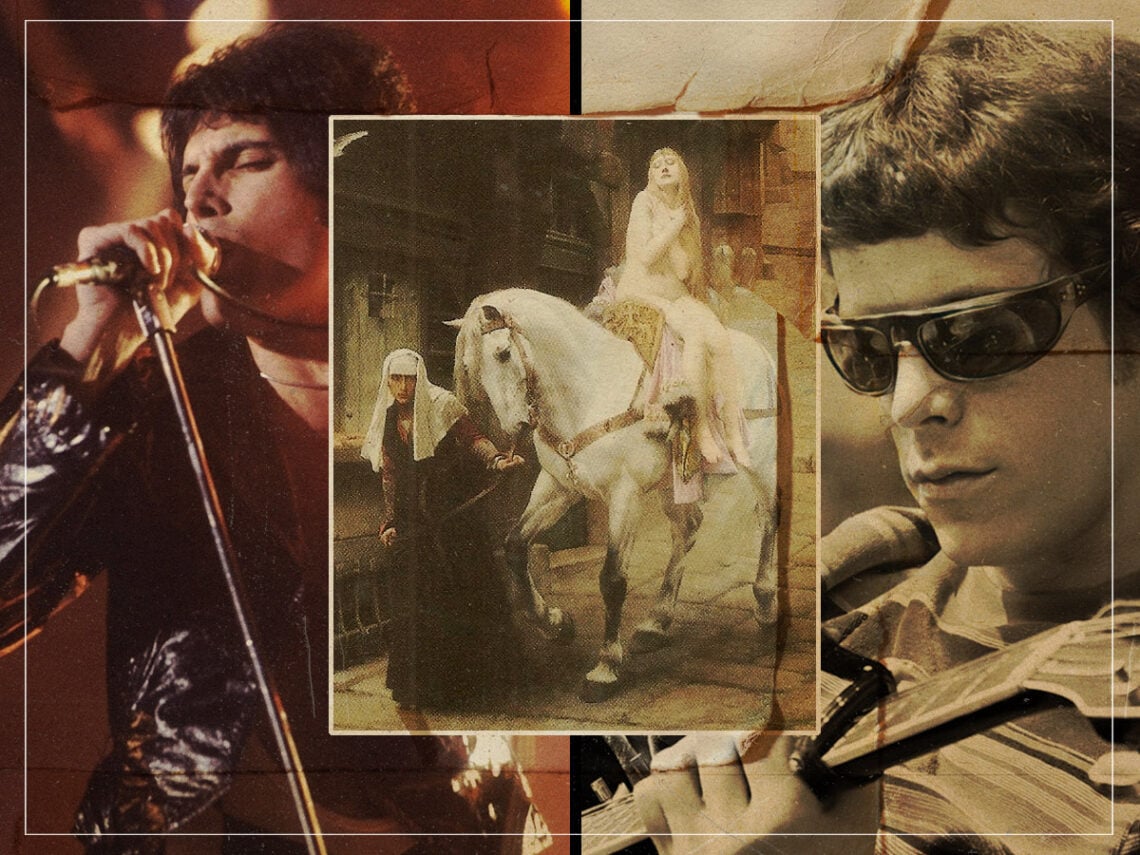
From the 13th century onwards, a myth was perpetuated in medieval history books that Earl Leofric angered his tenants in Mercia by heavily taxing their produce from the land they worked. Lady Godiva sympathised with their anger and repeatedly urged her husband to reduce taxation. After his repeated refusals, she told him that she would ride naked on a horse through the streets of Coventry if he relented. He took her suggestion seriously, and so she kept to her promise, riding through the town on the condition that all the townsfolk stayed inside and closed their windows.
And so, both Reed and Mercury refer to Lady Godiva as a symbol of the nude female body, although each for different purposes. For Reed, the symbolism is reconfigured into a gothic horror scene, in which the unprotected female form lies defenceless on an operating table, there to be preyed upon and torn apart by a sadistic doctor figure. Mercury, on the other hand, is simply invoking the joyful image of riding naked through an empty street without a care in the world, just for the hell of it.
Whether the legend of Lady Godiva is true or not, this Saxon countess could never have imagined that her name would be repurposed in either of these ways. By two of the great exhibitionists of rock and roll, no less. Perhaps that’s only appropriate.
