


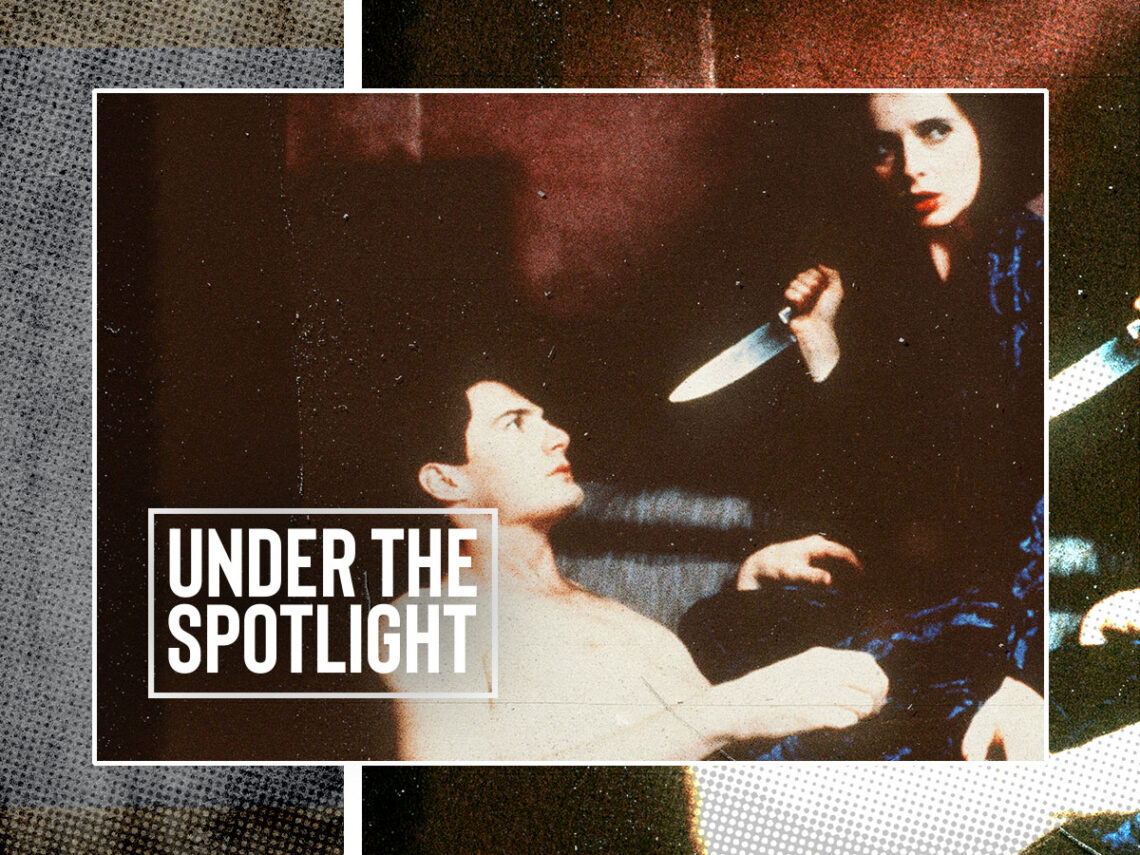
Under the Spotlight: Kyle MacLachlan’s virtuous all-American innocence in ‘Blue Velvet’

All is not what it seems in David Lynch’s iconic 1986 classic Blue Velvet, a film that opens with the picturesque red roses, white picket fences and azure blue skies of Lumberton, North Carolina, colours which reflect the all-American ‘Stars and Stripes’ of the small town. Though a place like any other, Lynch quickly establishes something strange about the humdrum of suburbia where a dormant geyser of depravity is always on-wait to erupt.
Efficiently and economically setting up the director’s surreal tale, the opening scene comes to an end when a man watering his groomed lawn suddenly falls to the floor clutching his neck. Less interested in the man himself and more concerned with the connotations of such drama, Lynch takes the audience down through the undergrowth and into the underbelly of grimy suburbia where black beetles fester. This enigmatic truth becomes the focus of young college student Jeffrey Beaumont (Kyle MacLachlan), the son of the man in the introduction, whose journey of discovery begins with a severed ear found in a field nearby his home.
This gruesome find takes Jeffrey on a wild fever dream of paranoia and surrealism, with the decapitated ear being something of an unearthly ticket into another realm where he can access America’s dark underworld. Specifically picking an ear to be the severed body part of choice, Lynch explained to the New York Times: “It needed to be an opening of a part of the body, a hole into something else…The ear sits on the head and goes right into the mind, so it felt perfect”.
MacLachlan’s Jeffrey henceforth becomes the perfect conduit for Lynch’s tale of innocence lost, with the fresh-faced student navigating the underworld with the same plucky confidence as any stereotypical all-American male. Leaping down the mysterious rabbit hole, Jeffrey tracks down a lounge performer, Dorothy Vallens (Isabella Rossellini), who leads him to a world of crime and surrealism, where gangsters are more like histrionic panto performers with an insidious duality behind their eyes.
Only his second acting credit, following the critical and commercial failure of Dune in 1984, MacLachlan became a regular collaborator of David Lynch, with his strange boy-next-door persona helping to instil an injection of normality into the director’s weird tales. Often compared to being a direct incarnation of Lynch’s own psyche, the filmmaker said of MacLachlan’s performance, “Kyle plays innocents who are interested in the mysteries of life. He’s the person you trust enough to go into a strange world with,” as stated in a 1992 edition of GQ.
Jeffrey is the polar opposite of Dennis Hopper’s Frank Booth, a peculiar antagonistic escort who guides the young man blindly through America’s underworld whilst huffing on a nondescript gas from a portable tanker. With an eerie psyche situated somewhere between childish infatuation and carnal rage, Booth works as a contrasting figure to Jeffrey, displaying all the darkness, fear and anxiety that exists within mankind.
A noble hero of Lynch’s tale that takes us inside the tumultuous American psyche that exists beneath the glamourous surface and out the other side by the film’s conclusion, MacLachlan’s Jeffrey is little different from the virtuous characters of popular cinema who journey into mystery and emerge enlightened. Discovering that modern life is a surreal fantasy where reality and illusion entwine, Jeffrey is a baffled vehicle of Lynch’s tale of discovery, akin to George Lucas’ Luke Skywalker or Lewis Carroll’s Alice Liddell.
