


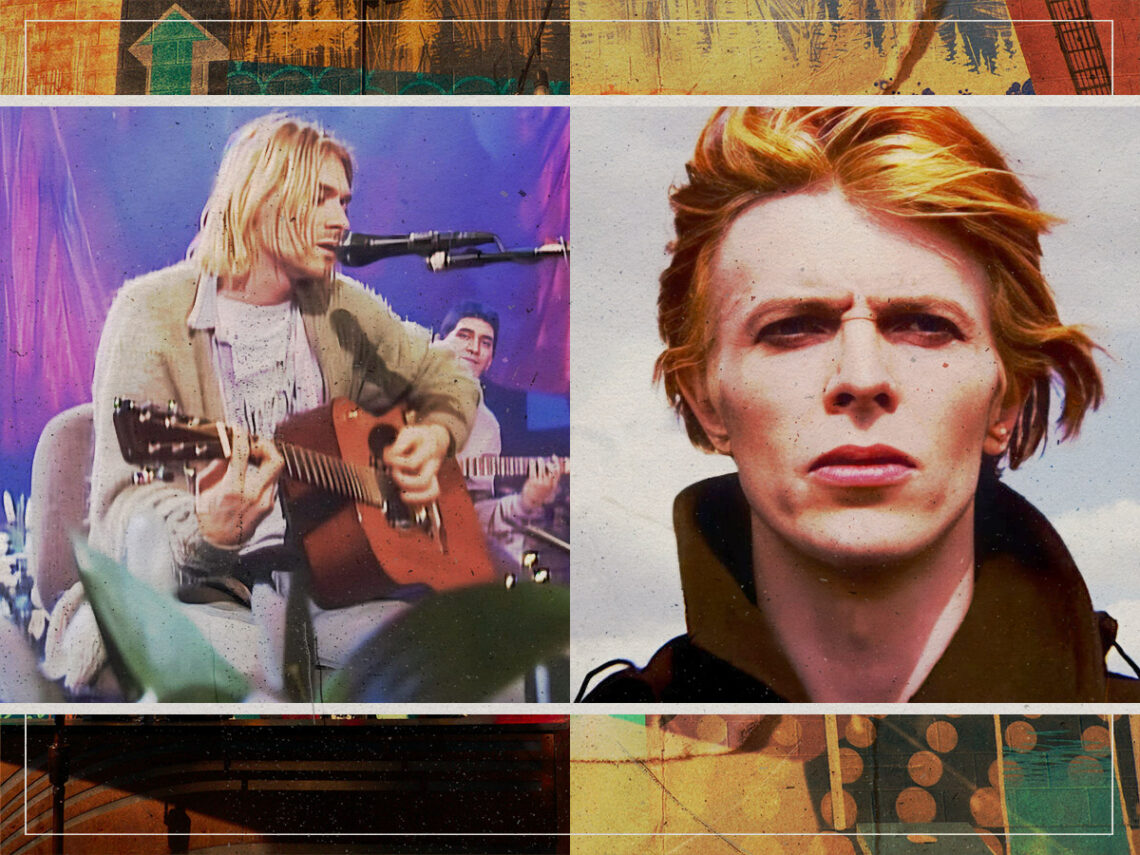
Kurt Cobain once picked his favourite David Bowie album

From his glam-rock origins, through the acclaimed oddities of the Berlin Trilogy to his danceable “Phil Collins years” thereafter, David Bowie led a career of unrivalled scope and influence. Shuffling through several quirky personas, the Starman left very few sonic stones unturned, thus influencing almost all musicians who came after him, whether directly or indirectly. Although Nirvana shared little in common with Bowie’s associative rock styles, he and Kurt Cobain were kindred spirits.
Bowie set out with an uneven debut album in 1967. At the time, psychedelic rock was all the rage, but London’s zany youth wasn’t quite ready for David Jones’ bizarre theatrical lyrics. After restructuring, Bowie finally made a breakthrough in 1969 with ‘Space Oddity’, which led to a staircase of success into the glam-rock era with Hunky Dory and The Rise and Fall of Ziggy Stardust and the Spiders From Mars.
While Bowie’s eclecticism earns him many titles, proto-punk is more readily attributed to artists like Iggy Pop and Lou Reed. Yet, as a collaborator of both and an inspiration to so many, Bowie was undoubtedly among the most important icons on the road to the punk rock explosion in the late 1970s. The glam wave he helped define influenced bands like Sex Pistols and The Damned. Subsequently, his work in Berlin with Iggy Pop seemed to trigger post-punk before punk had even had its day in the sun.
In the early 1980s, Bowie embraced synth-pop, starting with his popular album Let’s Dance. Although his material tapered off at this point, his job was all but done. Almost every synth-pop group of the 1980s, from Depeche Mode to The Human League, would cite Bowie as a key luminary. Uniquely, Bowie was also a hero to many of the guitar-centric groups who sought to distract from the synth-pop craze during this period, from Sonic Youth to The Jesus and Mary Chain.
Towards the end of the 1980s, Cobain joined the Seattle-based rock scene that would soon define grunge. The punchy, unrefined style led directly from the sound of hardcore punk groups like Black Flag and Big Black and alt-rock groups like Pixies and Sonic Youth. Bowie and Cobain were both particularly fond of the latter two bands. In the early 1990s, Cobain listed Pixies’ Surfer Rosa and Sonic Youth’s Daydream Nation among his 50 favourite albums. Likewise, Bowie admired Pixies so much that he covered their song ‘Cactus’ on his album Heathen and described them and Sonic Youth as the most important rock groups of the 1980s.
Fittingly, David Bowie produced The Stooges’ 1973 album Raw Power, which is often regarded as a blueprint for punk and grunge. Impressed by Bowie and Iggy’s masterful work on the guitar-heavy record, Cobain placed it at the very top of his top 50 albums list, just above Surfer Rosa.
Several rungs below, in 45th place, Cobain listed his favourite Bowie album, The Man Who Sold the World. The 1970 record followed the breakthrough of ‘Space Oddity’ but failed to garner critical and commercial attention on the level of Bowie’s following two albums. Today, the album is remembered most for the punky guitar jabs of ‘The WWidth of a Circle’ and the poignant title track, which Cobain introduced to a new audience in 1993 during Nirvana’s landmark MTV Unplugged performance.
Naturally, Bowie was a huge fan of Cobain’s acoustic grunge rendition of the song. “I was simply blown away when I found that Kurt Cobain liked my work, and have always wanted to talk to him about his reasons for covering ‘The Man Who Sold the World’,” Bowie reflected in Kurt St. Thomas’ book Nirvana: The Chosen Rejects. Adding, “It was a good straightforward rendition and sounded somehow very honest. It would have been nice to have worked with him, but just talking with him would have been real cool.”
Tragically, Cobain took his own life in April 1994, around seven months before the seminal MTV Unplugged album hit the shelves. Cobain’s haunting cover of ‘The Man Who Sold the World’ continues to inspire rock musicians to this day and seems to have irrevocably united both late musicians’ fanbases.
