


‘Knock At The Cabin’ Review: A tense reminder of M. Night Shyamalan’s skill

When you walk into a production by M. Night Shyamalan, you take a second look at almost every frame. The director, famed for his unique storytelling and unfettered dalliances with cinematic twists, has taught his audience to expect the unexpected and inspect the un-inspected. So as the curtains were drawn for the screening of his latest tension-filled blockbuster Knock At The Cabin my eyes were firmly focused on the myriad of stories that could unfold from a simple knock at the door.
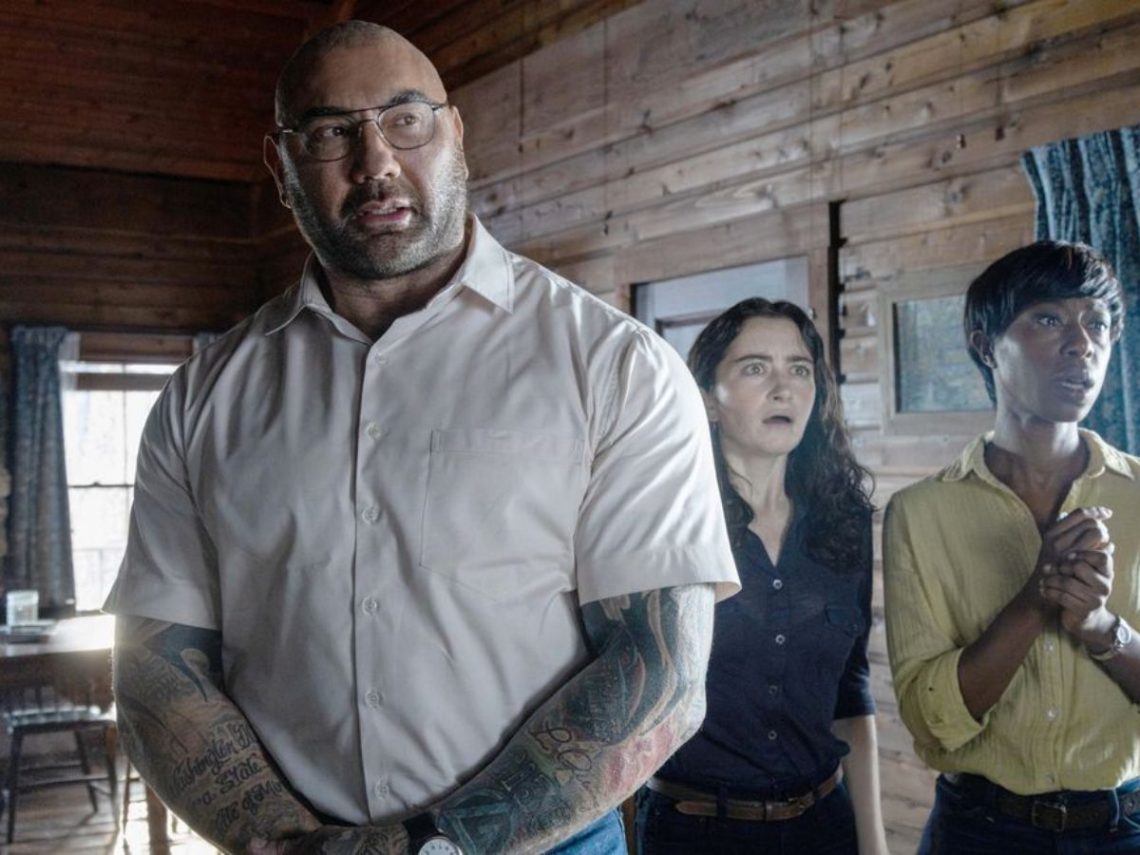
The premise, it would seem, is a simple one. A young girl and her parents are vacationing at a remote cabin surrounded by inescapable beauty and the kind of idyllic scenes that make memories for a lifetime. Introduced to our cast through the humble hobby of grasshopper collecting, we first meet Wen, played with inch-perfect innocence by Kristen Cui, who appears to embody all that is right in the world. A gentle curiosity, an appetite for saving the environment and the kind of life-giving lack of judgment that can make a grown man weep. It makes the introduction of the imposing figure of Leonard, played by Dave Bautista, all the more unsettling.
As Leonard looms on the horizon, approaching with friendly caution, the audience’s hackles are rightly up. Despite his gentle-giant nature, Leonard’s physique in itself poses a serious risk to anyone, when he notes that his friends will also arrive soon, the danger becomes all too real, and Wen seeks the comfort of her fathers, Eric (Jonathan Groff) and Andrew (Ben Aldrige). Leonard and his friends are not here to play games; they are here with weapons in their hands and murder on their minds. A simple horror movie, then, it would seem? Not so.
Aside from the affable nature of Leonard’s crew, aside from Rupert Grint’s unnervingly hostile performance as Redmond, the nursing skills of Sabrina, performed by Nikki Amuka-Bird or the caring vitality of Abby Quinn as Ardiane, the group are here not to mindlessly slaughter the happy family — but to save the world. The group will try to do so by forcing the family to make a simply unthinkable choice, all with the aim of avoiding the apocalypse. Adapted from Paul Tremblay’s award-winning novel, The Cabin at the End of the World, the movie lifts off from this gargantuan assertion and dives into the mystery of the human condition.
It is at this point that things get interesting. M. Night Shyamalan’s use of narrative is completely captivating as the audience, alongside the tied-up Eric and Andrew, must attempt to decipher whether the group’s claims are real or simply a plot to enact revenge on their family. His use of tension is a taut lesson in filmmaking, allowing elegant storylines to weave within fantastic performances and produce a film capable of enthralling our base human rhythms while provoking thought for the future of our planet.
Bautista deserves special mention for his most humane performance yet, while Groff delivers effortless emotional class, and Cui picks herself out as a future star. In truth, there isn’t really a bad performance between the group. All players grab their spotlight with grace and hold on to it only as long as necessary. In fact, their performances allow some of the movie’s more ludicrous moments — something which, with such a premise, are almost unavoidable — to pass by without much distress.
The truth is, for Knock at the Cabin, if you cannot buy into the idea that four seemingly unconnected members of the public could be the four horsemen of the apocalypse, then the rest of the movie will fall flat and its clunky moments will clang on into the darkness of the theatre. M. Night Shyamalan often requires a sense of spiritual disbelief for his pictures, and this one is no different.
If you’re looking for what exactly the ‘big twist’ may be this time around, then I’ll let the fact a tear rolled down my cheek as we closed out the credits be the only clue.
