


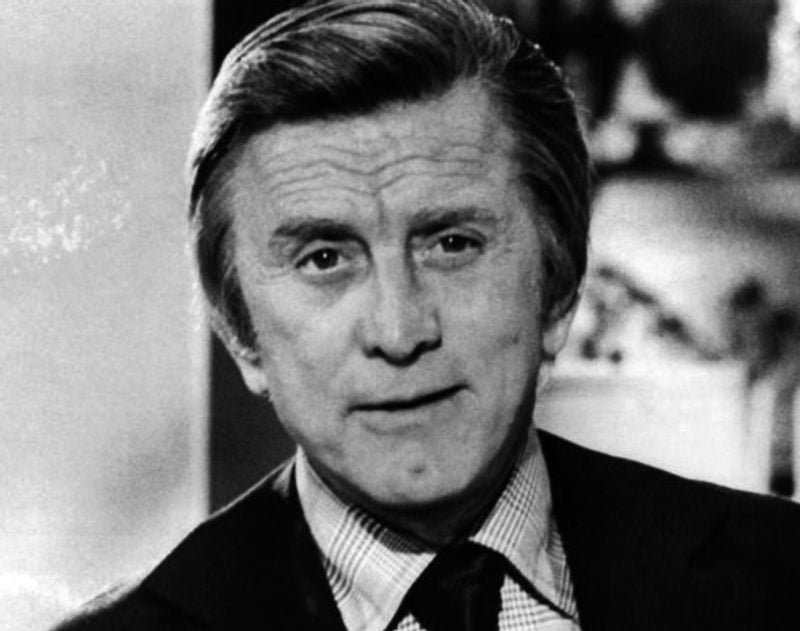
Kirk Douglas once picked the proudest moment of his career

Born the son of Russian-Jewish immigrants, Kirk Douglas, whose real name was Issur Danielovitch, went from living in extreme poverty to becoming one of Hollywood’s biggest stars. Unable to afford college tuition, Douglas managed to talk his way into St. Lawrence University, from which he graduated in 1939.
His acting talents were subsequently noticed by the American Academy of Dramatic Arts, which offered Douglas a scholarship. Here he met Lauren Bacall, who played an important role in launching Douglas’ career. Despite originally performing in stage productions and doing radio work, Bacall recommended Douglas to producer Hal B. Wallis, who gave the young actor his first screen role in The Strange Love of Martha Ivers.
Critics were impressed with Douglas’ talents, and he began to acquire more film roles. By the time he had starred as boxer ‘Midge’ Kelly in the 1949 film Champion, his on-screen persona as a tough guy had been established, inspiring Douglas to continue performing intense roles. The 1950s and 1960s saw Douglas appear in some of Hollywood’s biggest hits, often opposite the industry’s most popular female stars, such as Bacall, Lana Turner, and Doris Day.
However, during the mid-1950s, Douglas established his own production company called Bryna Productions, named after his mother. He was forced to break ties with Warner Bros but did so in order to create and star in more challenging films.
The first film that the company produced was 1955’s The Indian Fighter, but by 1957 Bryna Productions co-produced one of their most significant films – Stanley Kubrick‘s anti-war epic Paths of Glory. Starring Douglas as the lead character, Colonel Dax, the film was originally controversial upon its release due to its pacifist tone, which led to government censorship.
Paths of Glory has since been recognised as one of the greatest anti-war films of all time. Douglas decided to collaborate with Kubrick for a second time by asking him to direct Spartacus, in which the actor would play the leading role of the titular character.
Douglas’ role as a producer allowed him to make very important decisions, and one of these helped to shape Hollywood forever. The screenplay for Spartacus was written by Dalton Trumbo, who had been blacklisted from Hollywood due to his Communist leanings. Trumbo was part of the Hollywood Ten, a group of American filmmakers and screenwriters who appeared before Joseph McCarthy’s House Un-American Activities Committee.
None of the members would give away information about other suspected Communists or deny their political affiliations. Trumbo was sentenced to almost a year in prison, and upon his release, was blacklisted from the industry. This led him to write under various pseudonyms, including the name ‘Robert Rich’, for which he won an Oscar for his screenplay The Brave One.
Intending to use the pseudonym ‘Sam Jackson’, Trumbo wrote his incredible screenplay for Spartacus. Recalling a conversation between him and Kubrick, Douglas claimed that the director attempted to take credit for the screenplay himself. Douglas did not agree with this. Instead, Douglas decided to risk being labelled as a ‘communist sympathiser’, which could have gotten him blacklisted too, and give Trumbo full credit for his work. He hoped that his star power and influence would protect himself and the project, and he was right.
Reflecting on his decision, Douglas said: “I went home that night and I thought, ‘The hell with it, I’m going to put Dalton Trumbo [in the credits].’ People thought I was crazy. I said, ‘No. What can happen?’ So, I invited Dalton Trumbo to come to the studio — the first time he had been in a studio for ten years. I will never forget. He had tears in his eyes. He said, ‘Kirk, thank you for giving me back my name.'”
Douglas refers to the story as the proudest moment of his career, believing he had helped to break the shameful blacklist. Although Douglas wasn’t entirely responsible for bringing Trumbo out of the shadows – Otto Preminger gave the screenwriter full credit for writing Exodus the same year – it speaks volumes about Douglas that such a selfless act was the proudest moment of his career.
