


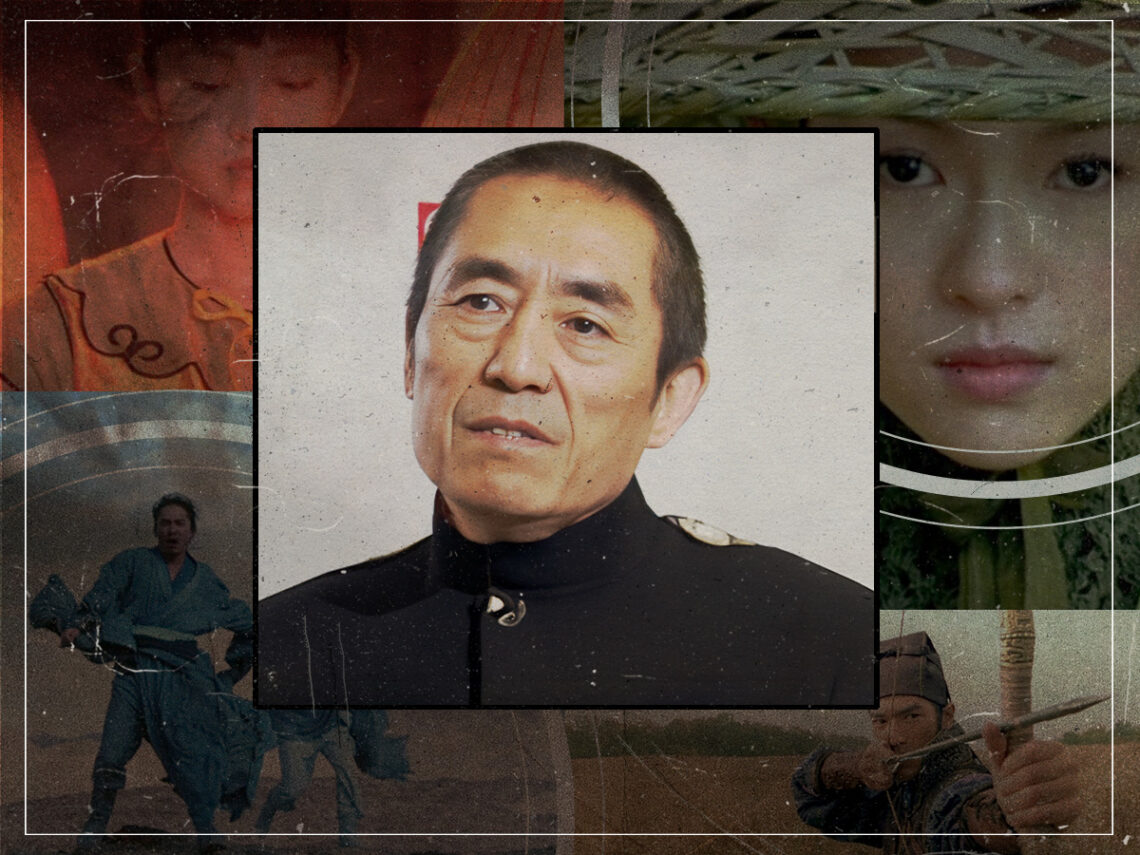
“I chose to yell, you chose to whisper”: the key difference between Zhang Yimou and Jia Zhangke

Despite their shared status as two heavyweights of Chinese cinema, it should probably go without saying that there are fundamental differences between the styles of Zhang Yimou and Jia Zhangke.
It’s hardly a revelation to say so, but it’s fascinating to hear the filmmakers themselves explain those differences. Yimou and Zhangke have made monumental impacts on their local industry in completely opposite ways, but they’re each among the defining auteurs of their generation.
Separated in age by 20 years, Yimou is famed for the opulent and operatic aesthetic that’s seen him adopt colour as one of his defining motifs, whether it’s the red hues of his loosely connected trilogy comprised of Red Sorghum, Ju Dou, and Raise the Red Lantern, or the warm golden glow of Curse of the Golden Flower.
He’s also proven himself adept at sweeping spectacle and blockbuster-sized action sequences through Hero and House of Flying Daggers, but the less said about The Great Wall, the better. On a budgetary, scope, and scale level, he exists on a plane above Zhangke, but on a granular one, they both favour the same broad, overarching strokes of storytelling.
Applying his own distinctive flourish to the tenets of the Italian neorealism movement, Zhangke focuses on more intimate tales, but the commonality between the director and Yimou is that their focus, more often than not, tends to fall on the overlooked and marginalised aspects of Chinese society, spotlighting the travails of the everyday person, regardless of when and where their films are set.
Of course, no aspiring filmmaker born in China during the 1970s was able to resist the lure of Yimou’s work, and the feeling was reciprocated. “I loved the film,” Yimou said of Zhangke’s 1997 effort Pickpocket, per Filmmaker. “But there is the whole idea, I mean, the difference between us. I chose to yell. You chose to whisper. Both films reveal who we are; it has the same effect.”
To illustrate his point, Zhang recalls making his first film, Red Sorghum, and his desire to add more trumpets to the soundtrack, with the solo trumpet already playing the melody. As the film’s composer warned Zhang, “It will be too noisy, too overwhelming.”
Zhang responded, “Noisy? Overwhelming? Perfect. Let’s do it.”
It never makes more sense than when it comes from the horse’s mouth, and Yimou perfectly captured the key differences and overt similarities between the directors. They both utilise the same themes in many of their films, but whereas Yimou prefers the more grandiose and extravagant element of cinema to make a point, Zhangke keeps his focus trained entirely on a level of tangible realism that adds added weight and heft to his narratives.
