


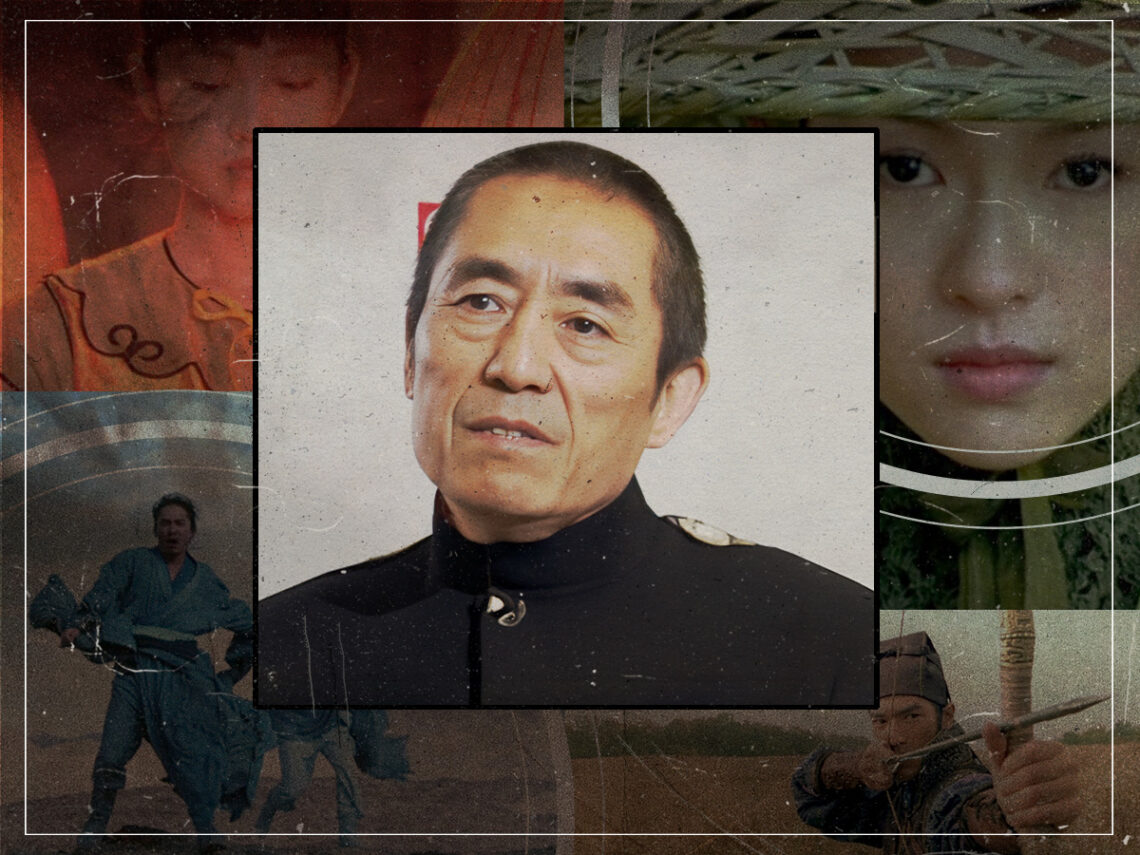
The grand visual style of Zhang Yimou

Virtually every high-profile director becomes the subject of a seduction attempt from the blockbuster machine eventually, and it’s telling that the closest thing Zhang Yimou has ever made to star-powered crowd-pleasers stands out as two of the weakest efforts in a storied filmography.
Recruiting Christian Bale for the historical wartime drama The Flowers of War did nothing to prevent it from being received tepidly and bombing at the box office. Meanwhile, The Great Wall roped in Matt Damon, Willem Dafoe, and Pedro Pascal for a fantasy epic that saw Yimou attempt to play Hollywood at its own game. Although the latter retained his authorship through its inventive staging and dynamic camerawork, it still lost an estimated $75million despite being the highest-grossing movie of his career at the time.
The point is that painting on a canvas designed to reach the widest possible audience isn’t something that’s guaranteed to deliver a crossover smash hit, and Yimou’s work had already long spoken for itself without having to make a concerted play to sell the most tickets. There are a multitude of good reasons why he’s been celebrated as one of the most exciting, innovative, and dynamic filmmakers in world cinema, and having Damon fight CGI monsters in a ponytail isn’t one of them.
Since making his feature-length debut on 1988’s Red Sorghum, Yimou has told visually dazzling and thematically rich stories rooted firmly in Chinese history and culture, developing a signature style that’s regularly been imitated without ever being bettered. Every auteur has certain tricks, tells, and signatures they repeatedly fall back on across their working life, but rarely have such a set of established traits been as beautifully realised as they have been in Yimou’s case.
Colour has always been one of his most important visual motifs, with Yimou’s use of the most vibrant reds underscoring his loosely connected trilogy of the aforementioned Red Sorghum, Ju Dou, and Raise the Red Lantern. Used to signify masculinity, the sanctity of marriage, blood, and fire, it hasn’t been lost on anyone that the colour is also closely associated with China at large, lending it additional heft through the filmmaker’s often-controversial work, at least as it pertained to local censors.
It sounds like an obvious technique to utilise red in a movie called Raise the Red Lantern or deploy the liberal use of gold-hued imagery in one titled Curse of the Golden Flower, but it’s always apparent how Yimou is colour-coding his work to further much more than the story. Each carefully curated palette enhances both the aesthetic and narrative undercurrents, whether he’s telling intimate character-driven stories or indulging in a sweeping martial arts epic, which has regularly been separated by centuries.
Yimou has tackled taboos and incited the wrath of the authorities as a result, but regardless of whether it’s depictions of on-screen intimacy and sexuality, the archaic role of the patriarchy in an ever-evolving society, or his opinions on the Chinese legal system and Cultural Revolution, rarely has the distinct viewpoint of a filmmaker been so breath-taking to look at on-screen.

After all, this is somebody who has seen their movies banned by the local government and was still hired to oversee the opening ceremony to the 2008 Olympic games, underlining that no matter how far he’s willing to push the boundaries of what’s deemed acceptable in mainstream Chinese cinema, the most powerful office-holders in the land have made it clear they’re just as enthralled by his captivating means of using the artform to its fullest potential as the standard cinemagoing patron.
House of the Flying Daggers arguably encapsulates another running thread of Yimou’s career better than most, given that it zeroes in on the minor arguments of a societal subsection against the beauty of China’s landscape. His films may narrow their scope to a select band of characters and their dynamics, but his reverential framing and admiration of his homeland is always at the forefront of his thinking. He’s told stories spanning history and flirted with countless different subgenres of cinema, but Yimou’s almost awestruck admiration for natural beauty will shine through in one way or another, exquisitely photographed and brought to the screen.
A vocal opponent of what he calls “uninspired, overcautious popular filmmaking”, Yimou encapsulated his philosophy by musing that “motion without thoughts can only be dead actions”. It’s a coda he’s lived by and thrived under, blending his ideological stance with the narrative structures of his film to create a body of work comparable to any of cinema’s modern greats, defined by his mastery of colour, choreography, and staging.
Those elements are keenly felt everywhere, from the understated drama of Raise the Red Lantern to the societally-derived humour of The Story of Qiu Ju via the cultural upheaval that defined To Live, which carried through to his international success stories Hero and House of Flying Daggers. Four features that couldn’t be more different story-wise, but are entirely representative of their director’s inimitably opulent and unmistakably homegrown visual style.
