


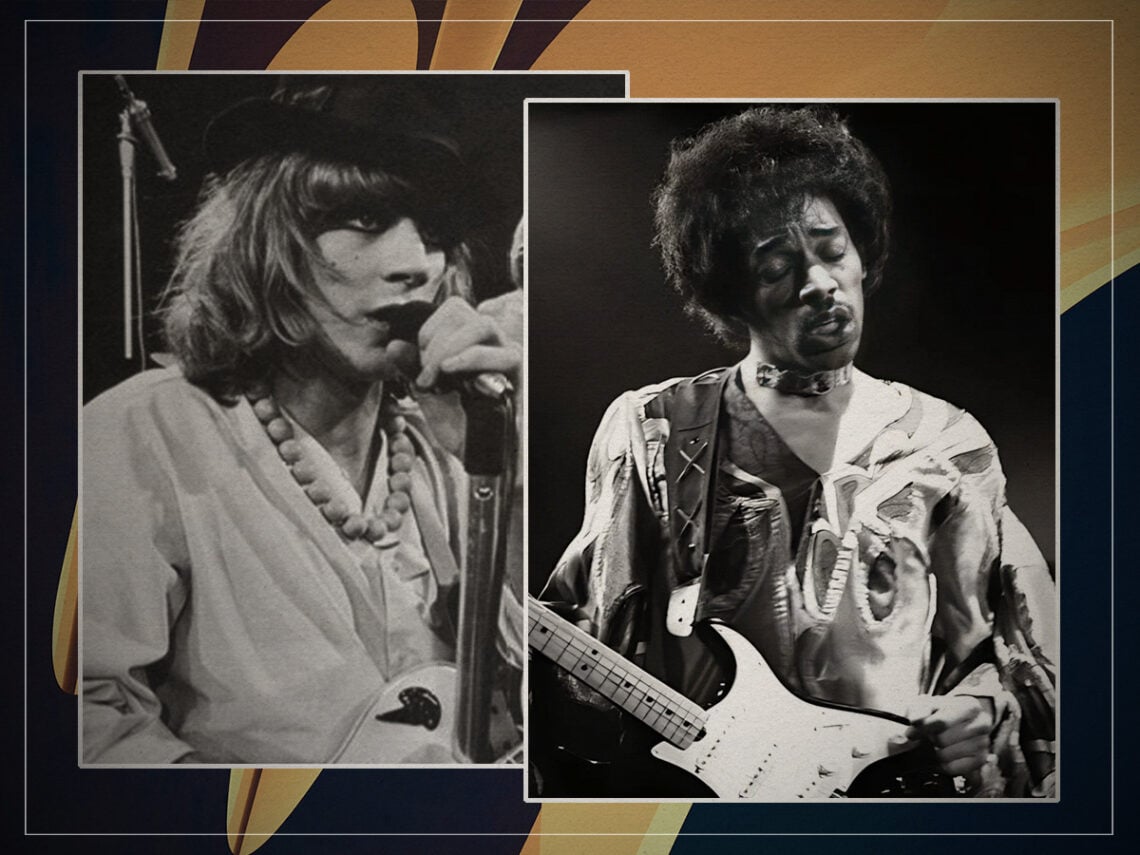
“His disillusionment did me a favour”: Kevin Ayers’ sobering tour with Jimi Hendrix

At the epicentre of the psychedelic rock revolution that seized the UK’s 1960s counterculture, Kevin Ayers and his Soft Machine found themselves right in its zenith.
Formed as one of the key groups in the Canterbury scene in the aftermath of local pop stars Wilde Flowers, Ayers and drummer Robert Wyatt would found the jazz-rock fusion Soft Machine and swiftly find themselves becoming residents of London’s famed UFO Club along with interstellar garage mages Pink Floyd. Favouring extended jams and free-form explorations, Soft Machine would prove influential on the progressive rock wave that was awaiting around the corner.
Like a lightning bolt, Seattle’s Jimi Hendrix landed in London in late 1966 and turned everyone’s heads, fellow guitar maestros and Yardbirds alumni Eric Clapton, Jeff Beck, and Jimmy Page all expressing astonishment at his inventive virtuosity. Forming his Experience trio, Hendrix headlined the Roundhouse in February 1967 with Soft Machine supporting, and brought the Canterbury jazz-prog outfit with him when embarking on an American tour late the following year.
Splitting supporting duties with Eric Burdon and sharing bills with the likes of Todd Rundgren and MC5, Ayers’ first time in the USA was surely an eye-opener, playing with the day’s underground titans and exposed to a new realm of backstage hedonism unseen back home. Wyatt, too, would get stuck in, developing his fierce appetite for alcohol during these years touring with Hendrix.
“We socialised a lot,” Ayers recalled to Classic Rock in 2008, reminiscing on the camaraderie between him and Hendrix. “We dined together frequently, and we lived in the Chelsea Hotel in New York on the same floor. It was just glorious watching him from the wings. He liked us ‘cos we were weird and not pop, and no threat.”

Adding, “He was a lovely guy, much abused by management and the music business. Plus, his so-called friends stole everything he had, including his soul. The tour was a guns and briefcases affair. Everything was paid in cash, which made one an instant target.”
While the tour proved to be great fun, Ayers began noticing the music business’s pressure take its toll on the guitar maverick: spontaneous stunts such as sexual thrusting with his amps or masturbation mimicry with his guitar were captivatingly unscripted. Such acts became expected by the audience and even reportedly written into contracts by promoters and legal ghouls.
“I could see his face, how he’d grit his teeth at the pain of what he’d become,” Ayers confessed. “He’d have three roadies behind the amps to hold them up, and afterwards he’d come off and say: ‘Man, this is so sick. What have I become? Why am I doing this shit?’”
Such joy-quashing clauses and performing seal indignities accelerated the demise of The Jimi Hendrix Experience, emboldening Ayers to decamp from Soft Machine shortly after: “It was an eye-opener seeing all the money slosh around while Jimi was being ripped off. His disillusionment did me a favour. I didn’t like the party.” Selling his white Fender Jazz Bass to the Experience’s Noel Redding, Ayers escaped the music business with Soft Machine guitarist Daevid Allen and sketched the majority of his debut solo effort Joy of a Toy.
Forging a successful career post-Soft Machine, Ayers’ tour with Hendrix proved formative. It revealed the unglamorous side of the 1960s rock business and ensured a creative path forward on his terms with unwavering, artistic certitude.
