


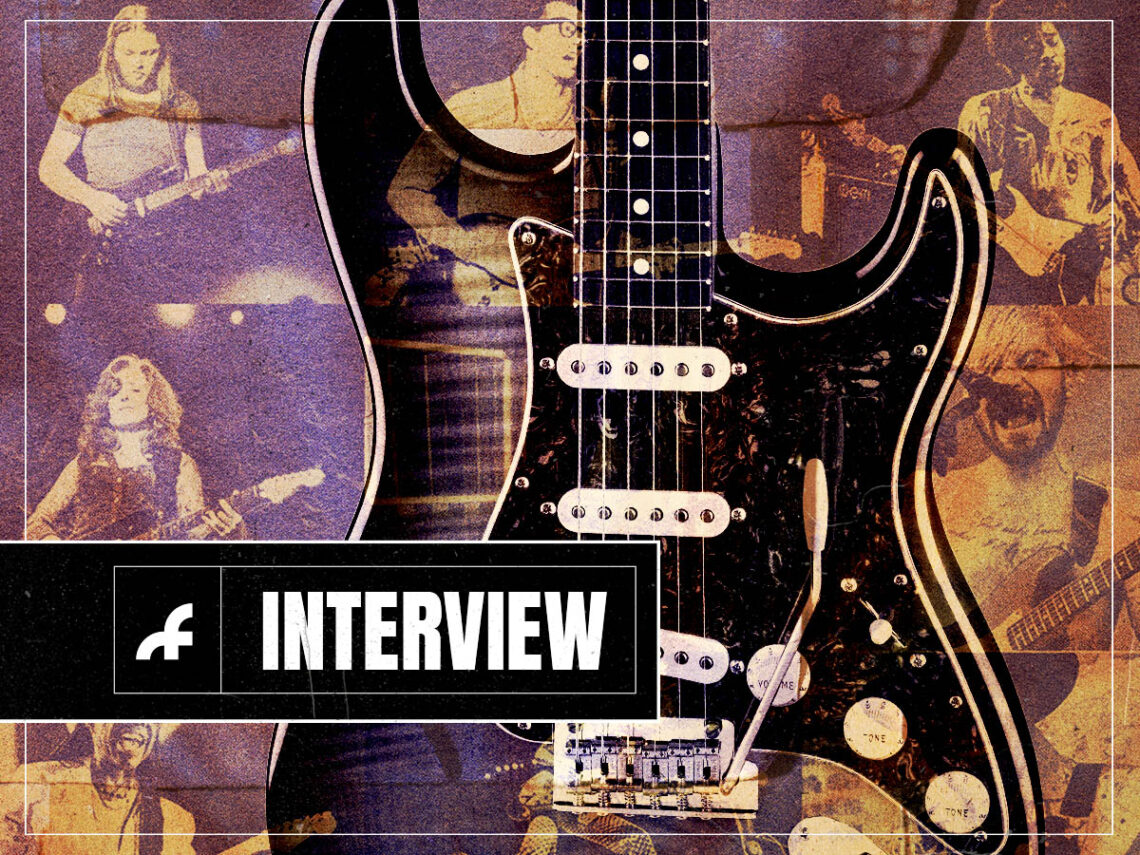
70 years of the Stratocaster: Fender’s Justin Norvell on the inherent appeal of the world’s most popular guitar

This year, the Fender Stratocaster turns 70. Undoubtedly the world’s most popular electric guitar model, this rendering is synonymous with the very essence of rock music and modernity. From the moment Buddy Holly first showcased it on The Ed Sullivan Show in 1957, it gradually became the weapon of choice for many innovators who shaped and continue to affect the cultural landscape.
Whether it be Bob Dylan choosing it as his weapon to bat off the hordes of angry folkies when he controversially went electric in 1965, Jimi Hendrix setting his on fire at Montreux in a symbol of countercultural rebellion, or even Alex Turner using its clean twang on Arctic Monkeys’ era-defining debut, there has been no other guitar that has made such an impact on culture as we know it. While it has continued to move with the times and has many different versions for all players from across the musical spectrum, it is the ultimate postmodern artistic vehicle, allowing for many sounds and players to blur lines, push back against tradition and create history.
To get a better sense of what makes the Stratocaster so crucial in such a milestone year, I sat down with the Executive Vice President Of Fender Products, Justin Norvell. He offered more insight into the origins of the guitar and what has technically and spiritually made it the tool for a more extensive list of greats than any other.
Commencing with a salient point, Norvell states: “There are not many things that look like they did 70 years ago. Everything is much more evolved if you think about automobiles and house appliances. But underneath the hood, it’s never stopped evolving. When the ’54 Strat came out, we made just 200 of them. It changed by ’57; it was made out of different wood, and it had different shapes and different pickups. By ’59, it was different again. It’s always adapted to its current environment.”
He continues: “It retains the iconography and the beauty of the form and the shape, but we like to say, ‘We colour inside the lines’. You can change the electronics, the shape, the neck, the field, the materials, everything, but it’s still a Stratocaster.”
The long list of notable players says it all about the timeless appeal of the model and its incredible sonic scope. It also allows people to sound like themselves, Norvell maintains, noting that it’s not a relic of the past that people play old-style music on but a blank canvas on which the player is very much the artist in control, choosing their brushes, strokes and paints to fit personal contexts.

While Leo Fender had no conception of the futuristic effects such as delay and reverb that would later become ubiquitous in music, somehow, there was a “kismet” for the Stratocaster that has allowed it to develop alongside technology and life itself. Some guitars from long ago weren’t constructed to be put through distortion or expansive effects units such as U2’s The Edge does, but the Strat can handle it. Norvell reveals that he once played the U2 man’s old Strat, and while the clamour it produced through his rig was tremendous, it made one thing very clear: “The Stratocaster can be past, present or future.”
What marked the Strat out from the traditional bodies popular when it emerged was that Leo Fender was a “hyper-pragmatist” and a radio repairman by trade. This meant he brought much more of a Ford-esque manufacturing approach to it, as opposed to the drawn-out luthiery-styled practice that existed in guitar-making. Championing serviceability and functionality, the solid slabs of wood that he started the Stratocaster with were born out of his original model, the Telecaster, and the flaws players found with it.
From the relatively small spectrum of sound – which saw the third pickup materialise on the Strat – to the Tele digging into people’s ribs because it was squared off, which gave way to the curved body of its successor, the blueprint was established out of necessity. Furthermore, Norvell describes the Strat as arising from a “very utilitarian approach” as people around Fender helped him refine the design. As a result, it was more straightforward, dynamic, and futuristic than the other guitar models of the day.
Importantly, it also captured the zeitgeist. As most of the guitars back then were cumbersome hollow bodies, the modern invention appealed to the new generation, who rejected the music and iconography of their parents.
Demonstrating how things have changed, today, we automatically think of the Strat when thinking of an electric guitar, but that wasn’t the case in 1954. A highly mid-century, design-inspired manifestation, even the name evoked the Stratosphere and the space race, with Hank Marvin and Jeff Beck both commenting that it looked like it came from a different planet. The sounds it produced were another matter entirely.
Commenting on the unique, treble-heavy single coils, Norvell suggests, “I think construction-wise there’s a soulfulness to the single coil pickups. There’s an expressiveness in playing a Strat.” He says they also had “more brightness and attack” than anything on the market, which, on a holistic level, saw the guitar move from being a background instrument to demanding attention simply by making more noise. Because it was solid, it could be played louder and without the troublesome feedback that had been plaguing players for years.

Of the vital feature of the tone knob, he continues: “The tone knob allows you to EQ and vary your sound, so, if there are five positions of sounds on a Stratocaster, then with the tone knobs in the ten different positions, you can get into exponentially different sonic areas with it.”
Interestingly, it is the pickup selection which Norvell thinks defines a Strat. Although it started as a three-way switch, some players figured out that if they could jam the switch to stick in the in-between positions, they could use two other “really unique” profiles. That, he says, is the sound of everything from ‘Sultans of Swing’ to Pearl Jam’s ‘Yellow Leadbetter’. Hendrix was also a fan.
A distillation of the model’s inherent dynamism, “position two and four really came to be what a Strat was.” The five-way switch wouldn’t emerge for the first 20 years of its life, though, and was a secret that only the most inquisitive musicians knew about. Ironically, Norvell says, “The guitar was out on the market and sold not even understanding 40% of its sonic capabilities or value.”
The Strat is a happy accident, in a way, thanks to musicians being sonic explorers who invariably seek to create an individual sound. As “nothing’s more than a few screws away,” guitarists can modify it as they see fit to achieve this end. For instance, Iron Maiden’s Dave Murray played Paul Kossoff’s from Free’s Stratocaster from the late ’70s, which had a humbucker and single coil. However, Fender weren’t making humbuckers back then.
Touching on the guitar’s futuristic nature and inherent adaptability, he says: “This is a vessel we gave to the world. Artists started reinterpreting it themselves with chisels, screwdrivers and soldering guns. It’s the early equivalent of what we would call crowdsourcing now. Fender didn’t put a full humbucker on a Strat until the ’90s. It was something that people did to our instruments. I would argue that the Stratocaster with two single coils and one humbucker is hands down the most versatile electric guitar configuration.”
The synchronised tremolo also had a significant impact on popular music. It was another happy accident. Initially built to “lightly flutter and simulate” the minute nuances of the tremolo effect as heard in Flamenco, to the point that the first Stratocaster was dubbed a Spanish guitar. It was certainly not meant for the music that became popular on it: “Leo Fender was not standing there going, ‘Rock and roll is gonna happen, I’m gonna build this thing.'”
Thanks to the likes of Jimi Hendrix, with the noise he got from the tremolo arm and bridge, and Ritchie Blackmore with his dive bombs, people started experimenting with the sounds they could get out of it. Even the floating tremolo weaponised by My Bloody Valentine’s Kevin Shields would not have existed without the Strat trem, nor would the Floyd Rose that Eddie Van Halen took to the masses with his searing approach. “There was the Bigsby before it, but the Strat trem really did open up a whole different world far outside any expectation and changed what that music was forever,” Norvell explains.
Regarding this brilliantly individualistic paradox fitting of modernity, Norvell concludes: “Leo Fender said, ‘If I have $100 to build something, I will spend 99 making it work and 1 making it pretty.’ That was the best-spent dollar ever because these utilitarian approaches led to something astounding, visually, aesthetically and ergonomically.”
