


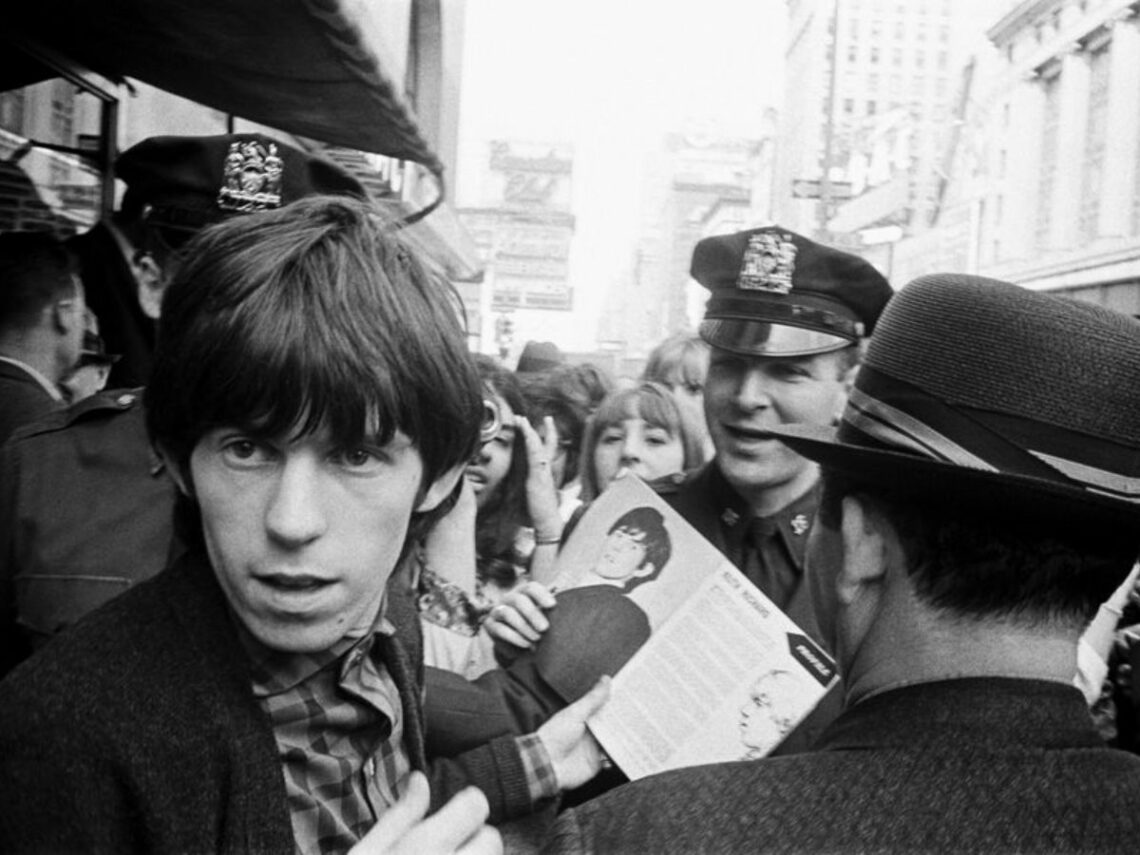
The reason Keith Richards was “envious” of The Beatles

Andrew Loog Oldham’s cunning business regime may have cast the “bad boy” Rolling Stones against the goody-two-shoes grain of The Beatles’ comparatively affable visage for a slice of the market share, but the two bands were never true rivals. Much like fans of Blur and Oasis in the Britpop wars of the 1990s, in the ’60s, Beatles and Stones fans could often be heard arguing over whose favourite was better, but beyond a little media magnification, it was just peace and love – such were the times.
Commenting on the positive relationship between the two bands on Ask Keith in 2004, the Stones’ guitarist Keith Richards explained how the two bands would actually time their releases so as not to step on each others’ feet. “When [The Beatles had a] new single, we always made sure we didn’t clash because, in those days, it was like every two months you had to have a new single,” he recalled.
The Beatles rose to prominence in 1963 after releasing their early singles, and by the spring of 1964, they were a global phenomenon after taking their first trip to the USA. The Rolling Stones’ rise to global fame came slightly later, and as they followed in the Beatles’ footsteps, they were given a helping hand from ahead.
In March 1964, Lennon and McCartney permitted the Stones to record one of their songs, ‘I Wanna Be Your Man’. “We knew [the Beatles] by then, and we were rehearsing, and Andrew [Oldham] brought Paul and John down to the rehearsal,” Jagger recalled in 1968. “They said they had this tune; they were really hustlers then. I mean, the way they used to hustle tunes was great: ‘Hey Mick, we’ve got this great song.’
“So they played it, and we thought it sounded pretty commercial,” the guitarist continued, “Which is what we were looking for, so we did it like Elmore James or something. I haven’t heard it for ages, but it must be pretty freaky ’cause nobody really produced it. It was completely crackers, but it was a hit and sounded great onstage.”
Anyone hoping for a gang war between the two bands would have been sorely disappointed. “We were friends with them, and I just thought ‘I Wanna Be Your Man’ would be good for them,” McCartney told Rolling Stone in 2016. “I knew they did Bo Diddley stuff. And they made a good job of it.”
Despite the friendship, The Rolling Stones were all too aware of an older brother dynamic between the two bands. During the second episode of the recent BBC documentary, My Life As A Rolling Stone, Richards and Mick Jagger admitted to feeling jealous of The Beatles during their rise to prominence in the mid-60s.
The Stones’ manager, Oldham, famously encouraged Richards and Jagger to write their own music after their early success as a blues cover group. However, the pair were also motivated by their envy of Lennon and McCartney’s pop success. “We were working the clubs in London, and The Beatles just came out and had a hit, ‘Love Me Do’… And we said, ‘Oh man, what a great record,'” Richards reflected in My Life as a Rolling Stone. “Our job [at the time] was to be like the premier rhythm and blues band in London, and we managed that! But we had no idea of progressing beyond that stage [until then].”
“We were just envious, too, man,” he added. “I mean, they’re doing what we wanted – they got it! They could make records. The Holy Grail was to make records, to be able to get into a studio. […] You’d think it was a gold mine, which in a way it was, you know what I mean? You’d think you were invading Fort Knox just to make a record.”
“The Beatles suddenly explode, and there you are going, ‘Oh, yeah, but we’re a blues band!’ The Beatles changed this whole thing,” Jagger added. “Keith, he’d play The Beatles all the time [and] it’d drive me absolutely batty! Why he was playing The Beatles wasn’t because he didn’t want to listen to anything else; [it was because] Keith wanted to write these pop songs. We [were] undeniably the blues band, but we knew we had to be a pop band.”
Watch the trailer for My Life as a Rolling Stone below.

Never Miss A Beat
The Far Out Beatles Newsletter
All the latest stories about The Beatles from the independent voice of culture.
Straight to your inbox.