


How Kate Bush made ‘Wuthering Heights’ a fixture of pop culture without even reading the book

In case you’ve been living in a remote cottage away from the buzz of entertainment news for the past year, Emily Brontë’s 1847 novel Wuthering Heights has been made into a film directed by the controversial Emerald Fennell of Saltburn fame.
The film, pointedly titled “Wuthering Heights” in quotation marks to signal how far it strays from the novel, turns the story into a raunchy romp across the Yorkshire moors. Considering that Brontë’s original is less of a romp and more a gruelling marathon of Victorian trauma, Fennell had her work cut out. When I tried to read the book for my English Literature class, I felt ready to send myself to an early grave, too.
The difficulty of the text doesn’t just come from the 19th-century prose but mostly from Brontë’s sadistic insistence on recycling the same four names for every single character. Set across two generations, it’s a genealogical nightmare of Catherines, Lintons, and men whose names begin with the letter H that makes you feel like you’re trapped in a hall of mirrors. Symbolically, it’s a clever examination of cycles of trauma, class, and inheritance, but it does also leave you needing a minor emotional support system just to work out who’s currently ruining whose life.
This linguistic logjam of names has meant many attempts to dramatise the book have fallen rather flat, as Far Out writer Lucy Habron recalled of a theatrical adaptation she saw a few years back: “I attended a production of Wuthering Heights that was so poorly executed that people actually walked out,” she wrote. “During the interval, the bar was filled with loud conversations from the remaining audience members, all wondering what had gone so wrong.”
Because the novel is such a dense thicket to navigate, our collective understanding of it can, in many ways, be attributed to Kate Bush. “Out on the wily, windy moors / We’d roll and fall in green / You had a temper like my jealousy / Too hot, too greedy / How could you leave me / When I needed to possess you? / I hated you, I loved you, too,” she sings on her 1978 hit, the obsessive, jagged heart of the novel captured in just 41 words.
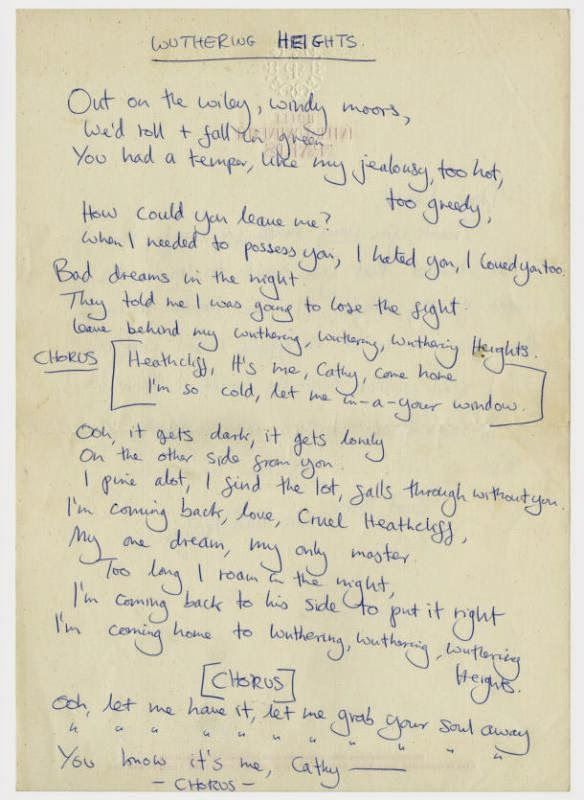
“Heathcliff, it’s me, I’m Cathy / I’ve come home, I’m so cold / Let me in-a-your window,” she continues, conveying Catherine’s desperate need, even from beyond the grave, to be united with Heathcliff, yet incredibly, when she wrote the song, Kate had never read the book. The story goes that she wrote the track within the space of a few hours after seeing the last ten minutes of the 1967 BBC mini-series, before whacking in some key quotes for good measure.
“I felt a particular want to write it, and had wanted to write it for quite a while,” she told fans in KB Club magazine in 1979, “I remember my brother John talking about the story, but I couldn’t relate to it enough. So I borrowed the book and read a few pages, picking out a few lines. So I actually wrote the song before I had read the book right through. The name Cathy helped, and made it easier to project my own feelings of want for someone so much that you hate them. I could understand how Cathy felt.”
Engineer Jon Kelly recalled Bush’s recording of the song in the book Classic Tracks: The Real Stories Behind 68 Seminal Recordings by Richard Buskin: “She was imitating this witch, the mad lady from the Yorkshire Moors, and she was very theatrical about it. She was such a mesmerising performer; she threw her heart and soul into everything she did that it was difficult to ever fault her or say, ‘You could do better’.”
She certainly threw her heart and soul into the track’s music video, which sees her float and dance around in a fabulous white dress, miming the ghost knocking on the window. It’s nearly as famous as the song itself and currently sits, at the time of writing, at 64 million views on YouTube, with one recent comment left below it arguing, “Kate Bush at 19 with a spotlight and a fog machine made a song more tonally faithful to Wuthering Heights than a full-length movie production”.
Perhaps Fennell’s tonal infidelity isn’t a betrayal of the source material, but a tribute to the ‘vibes first’, atmosphere-before-plot Kate Bush method, but whether her film will manage to usurp Bush as our enduring cultural memory of the moors, or whether it will just be a stylish flash in the pan, remains to be seen. Fennell might be bringing the scandal, but Bush gave us the ghost.
