


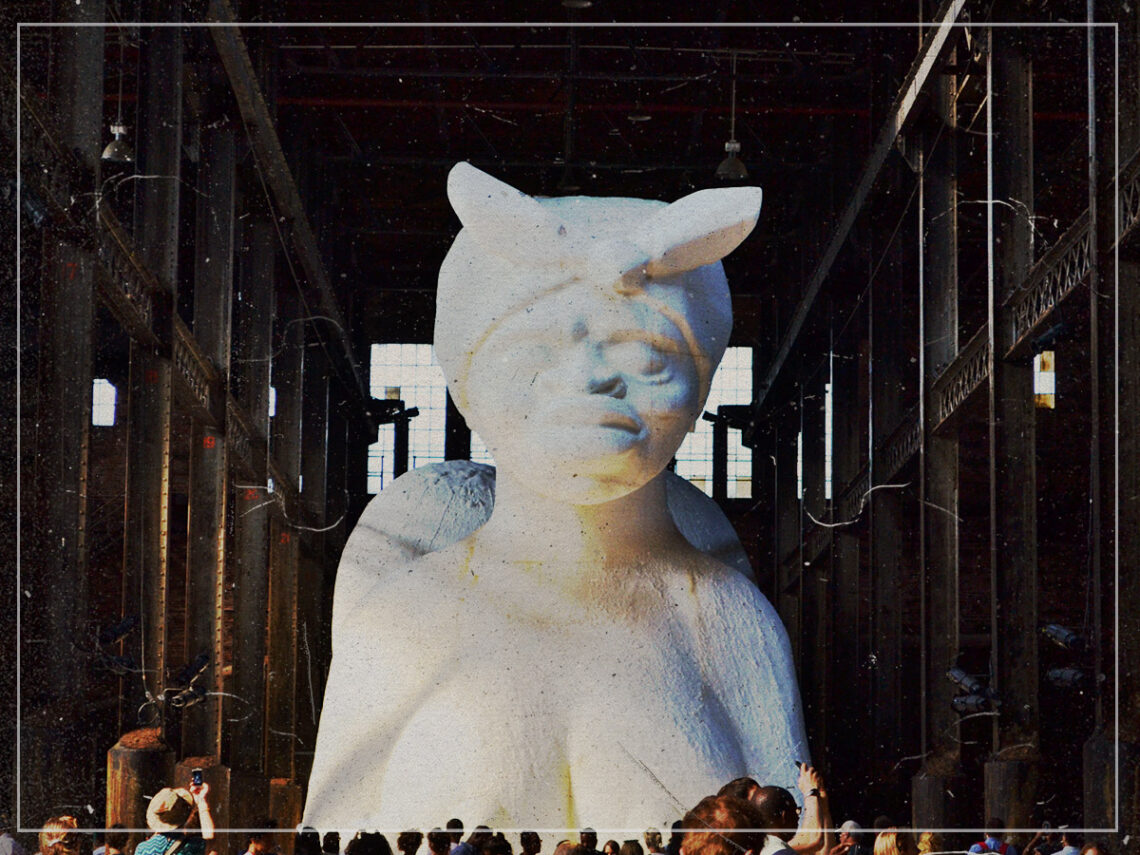
‘A Subtlety’: How Kara Walker divided audiences

Kara Walker’s 2014 installation piece can be called three things. Formally named A Subtlety, the work was also known as The Marvelous Sugar Baby – subtitled: Homage to the unpaid and overworked Artisans who have refined our Sweet tastes from the cane fields to the Kitchens of the New World on the Occasion of the demolition of the Domino Sugar Refining Plant. In her titles and in the work itself, Walker is piercingly blunt, addressing America‘s twisted relationship with race and capital.
A Subtlety was incredibly divisive, a testament to Walker’s singular voice but also to how an audience can interfere with an artist’s core message.
The artwork came about after Walker was commissioned by Creative Time and was installed in Brooklyn’s empty Domino Sugar Refinery. Walker liked the fact there was still evidence of the factory’s history left – the thick smell of the sugar and the molasses lining the walls. Before visitors even walked through the doors, troubled conversations were had about the gentrification of Brooklyn and what it meant to have this piece there.
The central figure was a 35-foot-tall sphinx, evoking a caricature of a naked mammy. Throughout American history, from slavery through to the Jim Crow era, that caricature had been used as some kind of proof that black women were content while they were enslaved. Walker’s sphinx is covered in what she called “blood sugar”, which took 30 tons of sugar to do. It made the sphinx a dazzling shade of white.
At the foot of the sphinx are the Banana Boys. Each was 60 inches tall, made up of a resin mould, and coated in molasses. Some held banana baskets in front of them, others on their backs. Sugar is an evocative way of starting conversations about America’s racist history, and it meant Walker herself was horrified by her initial sketches of the piece.
“[My sketch] came to embody something I would never want to see, something that was about slavery and industry and sugar and fat and wastelessness,” she told Vice. “It was a kind of finger-wagging gloom-and-doom kind of sketch that embodied all of the themes about industrialization that the space contains: post-industrial America, the grandiose gesture of the industrialists, and sugar as the first kind of agro-business.”
A lot of the negative reception surrounding the piece had nothing to do with Walker’s involvement but more with how white people were interacting with the space. The sphinx sat nude on all fours, and rather than take this as an implicit comment on the prolific sexual abuse of enslaved women – people were taking photos of her naked form. As sugar dripped from the antebellum figures of the Banana Boys, people still didn’t seem to grasp that Walker was highlighting, with painful precision, how black labour had been stolen for profit.
When Nicholas Powers went to see the exhibit with a friend, he wrote that “the physical weight of all that sugar, a symbol of the pain and profit wrung from our ancestors, our black bodies, fell on us hard. All those lives destroyed, I thought, all that death”. As he was processing what Walker had depicted, he saw “a white couple goofily posed in front of the Mammy sphinx’s breasts”, entirely missing the point of Walker’s imagery and ruining the experience for those who did.
