


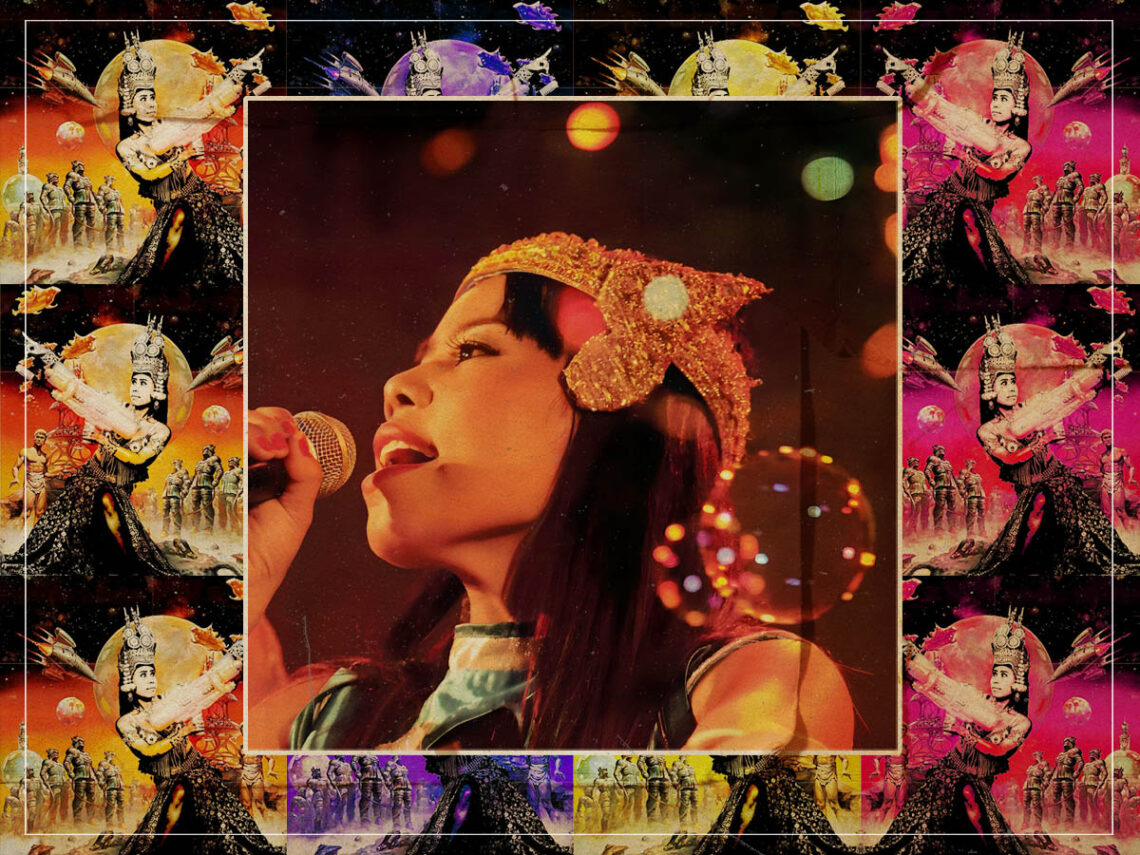
Kak Channthy: The ‘barefoot diva’ who revived Cambodian culture

In Phnom Penh’s sweltering heat, the world is reduced to a manic kaleidoscope. The melee is not unlike being trapped inside a beehive. The swarming buzz of motorbikes and half-conked-out minibuses fills the air with a deafening rattle. Neon flickers from yesteryear, and amid the aged modernity, monolithic pagodas from an even older yesteryear rise. The atmosphere is one of a post-war city healing its wounds—rediscovering its once-thriving culture.
For 20 years, from the late 1950s onwards, Cambodia assimilated music from all over the world into a mixed-up milieu that represented a cultural zenith in South Asian music. Everything from everywhere seemed to be happening all at once—until suddenly, it wasn’t. After years of packing out dancefloors with a menagerie of distilled scenes from all over the globe, the brutalist Khmer Rouge regime seemingly snuffed it out overnight.
Musicians disappeared without a word. Dancehalls feel silent in fear. During Pol Pot’s rule, it is estimated that between 1.5 and two million Cambodians died of either starvation, execution, disease or overwork. During the reign of the Khmer Rouge, musicians and artists were exterminated. They were seen as brutes as culture and civilization were actively destroyed by armed forces.
In an instant, life for Cambodians polarised from paradise to perdition. The country had been abuzz with revolutionary culture, all of which was seen as against the Khmer Rouge when they snatched power from the public. When the regime finally fell, the minister for information and culture who followed, Chheng Peon, declared, “The genocidal Pol Pot-Ieng Sary-Khieu Samphan regime destroyed our national culture almost completely and killed almost 80% of our male and female performers.” In the 1989 report that followed that statement, the figure was reassessed to around 90%.
One of the key figures, Kak Channthy – whose name has been revived by The Cambodian Space Project, an Aussie-Asian band and organisation which looks to “sing back to life the lost divas & rock legends of Cambodia’s golden age of music” – did everything she could to rejuvenate culture in the scarred country. Her nickname tells you a lot of what you need to know about her: ‘The barefoot diva of the Cambodian rice fields’.
“I’m small bird from Prey Veng,” she would explain. This was a town beset by war when she was young. Her own father was a tank driver. But she saw music as a salvation, even if it was a sanctity under great threat. So, when the regime was toppled, she was one of the first few to start rebuilding what was once bountiful. This led her on a path to the Australian musician Julien Poulson, who writes: “When we first met, her world and her words were a mystery to me, but she sung and I listened nonetheless.”
He continues, “[She] exuded grace and charm and had a way of expressing her thoughts and feelings through her songs. Seeing her sing her early songs along with her gentle swaying and Khmer dance style stays with me, resonating in her way, a way of great beauty coming straight from the heart and soul”. Moved by the alchemical magic of her performance, the beginnings of not only a band were flickering but also a romance that would lead to marriage.
Together, Poulson, Channthy and the musicians of The Cambodian Space Project would preach and perform a revival into practice. Alongside her own songs, the band would perform the classics that the Khmer Rouge couldn’t kill off. As Pouslon explains: “These were the songs of Ros Sereysothea, Pan Ron, Houy Meas, Sinn Sisamouth… songs of Cambodia’s great golden era artists – the artists who were all murdered by the genocidal Khmer Rouge. So this is the music we began with and where I started wondering about the meaning and language of these songs as much as I began to understand what they meant to Channthy. This was music as her solace, songs of survival and hope”.
A wealth of bands rose up in their wake. The songs of old broke free from the castigation that the old regime had tried to enforce. And Cambodia found its feet as a great melting pop of music from all over the world once more.
Tragically, Kak Channthy was killed in a vehicular accident in 2018 at the age of 38, but her music lives on—as does the music of the many artists who she helped to reclaim.
