


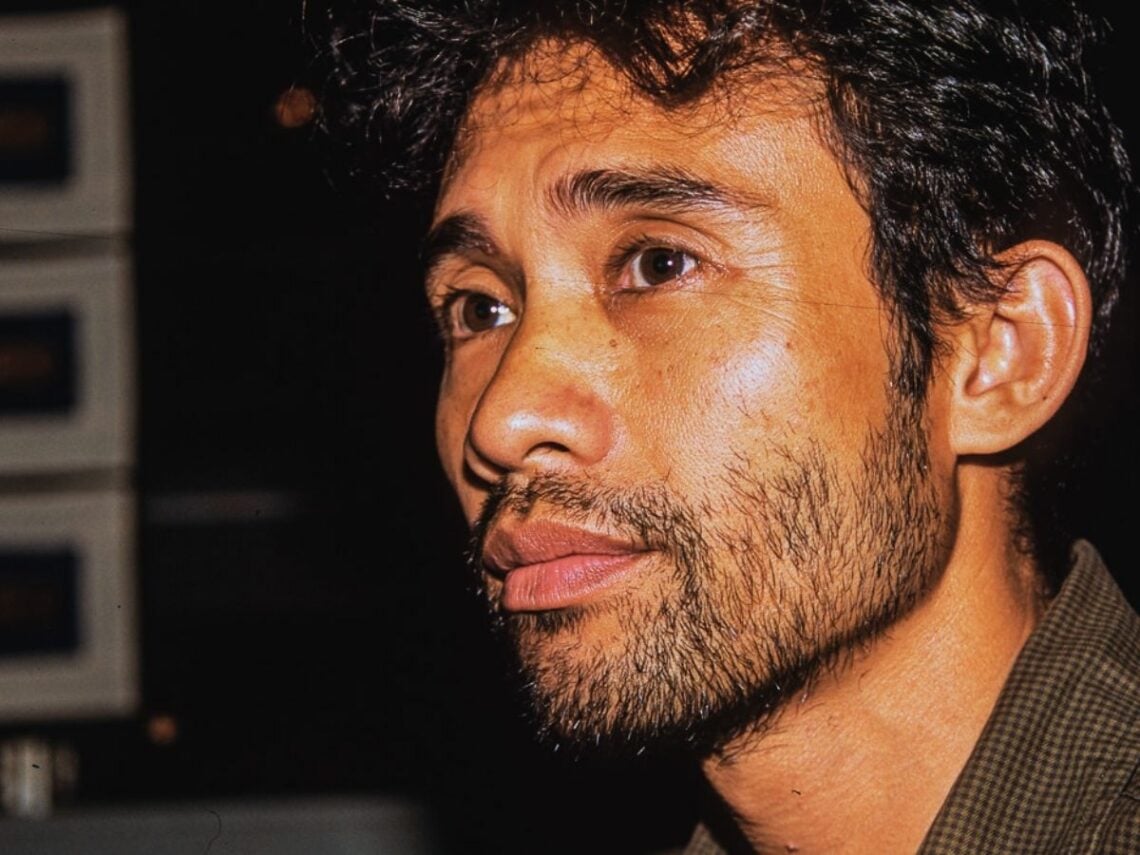
Arn Chorn-Pond: the musician who survived the killing fields of the Khmer Rouge

Under Pol Pot’s Khmer Rouge, the brutal regime took the lives of an estimated 2million Cambodian people. Musician Arn Chorn-Pond survived, miraculously, by entertaining soldiers as he played the flute. The sound was the only thing that could drown out the screams at the children’s labour camp he was sent to.
Chorn-Pond was only 11 years old when the Khmer Rouge came to power in 1975. He came from a family of performers who owned a small theatre in Battambang. Both his father’s and grandfather’s performances were legendary, and the family travelled across the company to perform at temples and opera houses. He often played the role of a baby because he could cry on command. Almost overnight, that knack for performing on cue was replaced by a seismically darker survival instinct.
He was separated from his family and forced into a labour camp. In the time it took to walk there, he realised people were dying everywhere he looked. His childlike perspective was that they fell and never got up. As he told Vandaluna Media, over and over on that horrific walk, he told himself one thing: “Never fall down.”
The camp was a converted temple that the Khmer Rouge used to force hundreds of children to work from 5 am to midnight with no food. The violence those children were subject to defies humanity. They became soldiers, forced to watch routine killings and push the bodies into the orange groves. In a bizarre twist of cruelty, the Khmer Rogue wanted to teach the children to play propaganda songs. Chorn-Pond raised his hand with five other children who offered to learn how to play the flute, “because I knew if I became a musician, they might give me more food, and I knew I had a special skill”.
He learned faster than the others. Chorn-Pond had only five days with his teacher and didn’t have time to learn his name before he was killed too. At the same time as being given a flute, he was handed a gun. “We were used as human shields,” he said. “I was in that war, full-blown war, probably for about a year, and then I ran away into the jungle of Cambodia and across the border to Thailand.”
He woke up in a bush, starving and bordering on death. Carried to a nearby refugee camp in Thailand, the musician met Reverend Peter Pond, a minister and aid worker who eventually adopted Chorn-Pond. In 1980, they travelled to America, where Chorn-Pond went on to attend Brown University. He withdrew to co-found the Children of War organisation, a cause dedicated to helping young people overcome the trauma of war and poverty.
He became one of the few surviving Cambodians to return to refugee camps sat on the Thai-Cambodian border, spending his summer in the late ’80s teaching there, mentoring children displaced by war. Returning to the place he saw unimaginable violence and murder took immense courage, but he did it again in 1989 in a bid to find his surviving family. Instead, he found one of his old music teachers, Yoeun Mek, on the side of a road. They wept when they saw each other. Mek had taught him music, and Chorn-Pond had risked his life to steal him food, and as he saw it, they kept each other alive.
“Mek begged me to find him some way to use his art again,” he said. “I didn’t want Mek and others to die thinking their music had been lost.”
