


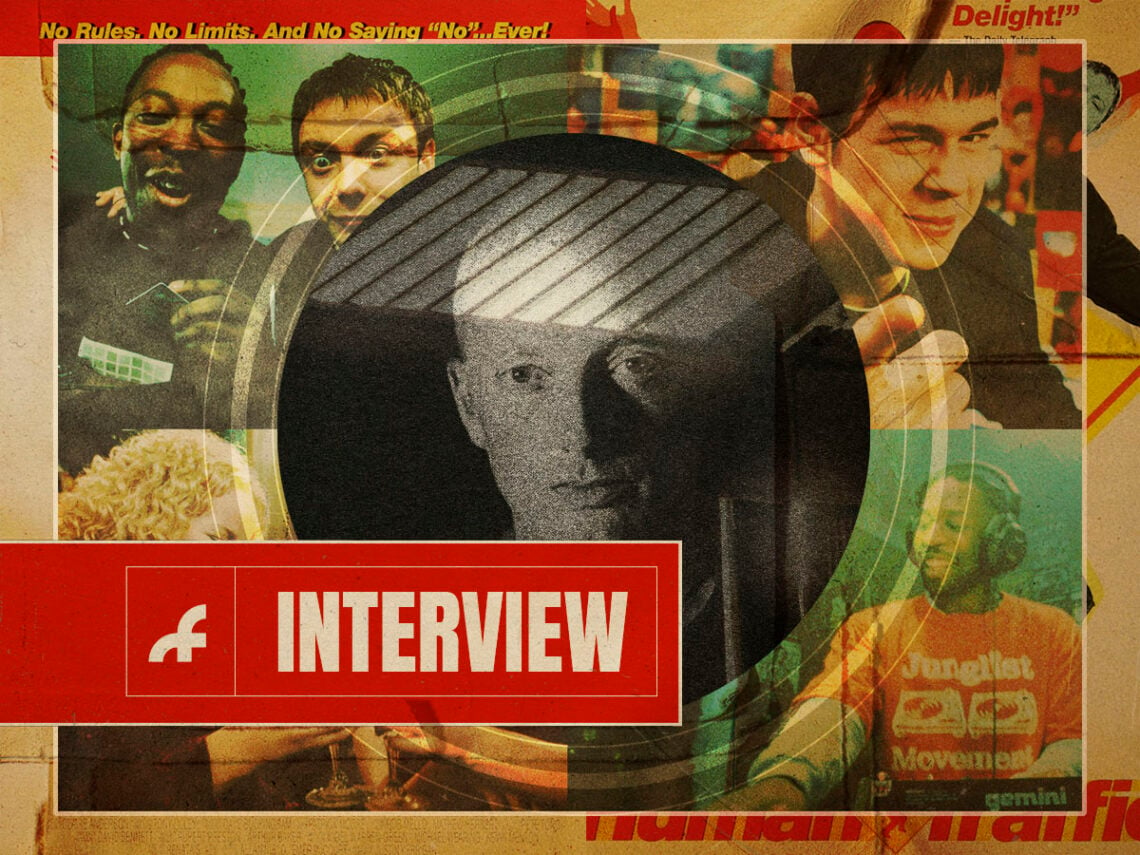
“We had to nail the feeling of ecstasy”: Justin Kerrigan talks youth and rebellion as ‘Human Traffic’ turns 25

One moment, you’re sitting in your pants trying to get over a hangover that seemingly has the potential to destroy your entire life and the next, you’re staring at a troublesome stain in your oakwood table, wondering if the bastard will ever come out. Youth is, indeed, ephemeral. Yet, cinema has long struggled to reflect its brief exuberance, with stuffy coming-of-age films being helmed by middle-aged filmmakers who believe they’re still young because they use an iPhone and stay up past midnight.
1999’s Human Traffic is certainly an exception to this normality, however, with Justin Kerrigan, then a 25-year-old student, helming a tale of youthful exhilaration that felt like a protest against the contemporary establishment. “I was conscious there was no other film out there that represented our culture at the time. I drew from memory, personal experiences I had, and things I saw,” the now 51-year-old director told Far Out in a retrospective of the film, which this year celebrates its 25th anniversary.
A celebration of the present and a rejection of the responsibilities of the seemingly distant future, Human Traffic is a direct product of its 1990s context, with Kerrigan taking us on a luscious tour of the decade’s flamboyant energy. Set in the rarely cinematically-trodden soil of the Welsh capital, the film drags us to buddy up with a group of five friends for one singular night of debauchery worlds away from the humdrum of the everyday.
Leaving behind dead-end part-time jobs, inarticulate families and penis problems, the group, which includes the romantically inept Jip (John Simm), professionally despondent Nina (Nicola Reynolds) and perpetual nihilist Moff (Danny Dyer), each agree to reject the mounting responsibilities of adulthood for one more night of recreational liberation. Feeling a responsibility to match the eclectic nature of the decade, Kerrigan went about being as accurate as possible, from the self-sourced jungle music that makes up much of the movie’s soundtrack to the authenticity of club culture itself.
“We had to nail the feeling of ecstasy, or we were doomed,” he remarked, making reference to the drug that commanded the tempo of raves in the 1990s, “I was really strict with myself. I made sure there were no scenes where we see the characters taking ecstasy. I felt if I had to show someone literally dropping a pill, then I was not the director to direct this film. It was important to me to be able to communicate the feeling of ecstasy through every other possible way as a director, but just not showing them putting a pill in their mouth. I felt like that was cheating.”

Wishing to translate the vibrancy of the era through performance and creative style, Kerrigan turned to American cinema, citing “Brain De Palma’s club scenes in Scarface and Carlito’s Way” as two unlikely touchstones of influence. “The authenticity of the cocaine representation was what I was aiming for in the performances of the young ravers on ecstasy,” he explained, “as there were no films that captured the rave scene to reference at that time.”
Gifted with the charisma of a leading cast who would later go on to shine in various echelons of British entertainment, Kerrigan’s reflection of the spirited energy of the era feels entirely organic, with his bravery behind the camera going far to translate this. Wiring up the adolescent brain to the screen, Kerrigan opts for regular skits that expressively reflect the ingenuity of youth, from a recital of a crude reworked national anthem to a frank breakdown of ‘spliff politics’ performed by none other than Mr. Nice.
Totally unsullied by institutional influence, few films feel as earnest as Human Traffic, proudly baring its identity so much so that you can whiff its B.O. and taste its cigarette smog. Indeed, despite decades having passed and its style having inevitably dated, the film’s spirit still resonates with adolescents to this day thanks to its impassioned sincerity that alienates the establishment and summons the youth.
“The people who are a part of club culture will get it. And those who were not a part of our culture will not get it,” Kerrigan expresses, claiming that his film inspires communion much like how ecstasy brought people together in the raves of the ‘90s. “Human Traffic is a pro-people film. It’s anti-corporate. And unfiltered. It wants you to realise we are all together, all in the same boat, with the same fears and thoughts, and for some, it resonates. That deep down, in some strange way, we are all connected.”
Kerrigan still feels fueled by the spirit of his youth and, indeed, of his 1999 film, and he certainly isn’t the only one, with ardent lovers of the seminal British movie often expressing their love on social media as they drum up support for the long-promised sequel. “People feel the truth. It feels right. It’s just not very popular these days,” the director says of the film’s fearlessness, “Everything in this world is telling us the opposite, as more labels and issues are created to divide us through the media so the powers that be can run amok with our world.”
Clearly despondent at the texture of modern culture, Kerrigan adds, “I’m glad I did my clubbing in the ’90s because I couldn’t have handled anyone taking photos of me in the club when I was off my head. That would be my worst nightmare.” There is, indeed, a certain purity in the raves of yesteryear, with old video clips from the era, some of which are present in Kerrigan’s film, demonstrating an authenticity that is becoming increasingly difficult to conjure in the modern world where social media dominates the dancefloor.

“People are more scared now, frightened that some idiot might call them a cunt on social network and the excruciating public humiliation of all that,” Kerrigan complains, “Social network makes you paranoid. The phone gives you anxiety. We need to drop both, really.” Coming across as less of a private protest and more of a rallying cry, he adds: “The propaganda running through the corporate media has never been so hardcore. People have been scared to death, scared of other people, of themselves, of what they might think or say that’s not in line with the narrative. New labels invented constantly dividing society more and more to turn us against each other so we won’t realise that we have the ultimate power together as one race – the human race.”
His words reflect the pervasive attitude of Human Traffic, which was proudly nonconformist in its essence, translated during one moment when Jip, who opposes the stuffiness of his department store job, shouts, “We spend nine hours a day, five days a week incarcerated in this wanky fucking store having to act like C-3PO to any twat that wants to condescend to us” to his colleague. Ever defiant in the face of the establishment, it seems little has changed for Kerrigan since 1999, with the director aptly perceiving the alienation that has long pervaded youth.
“Young people identify with the characters of the film. They see themselves, their friends, and people they know. They relate to the characters,” he says of Human Traffic, promoting the virtues of the independent film space, “You can’t relate to a superhero. It gives you nothing. Leaves you cold when the film ends.” It’s difficult not to see the truth in his passion, too, with the world of cinema desperately needing working-class directors to tell authentic human stories and unite young people once more with the power of cinematic representation.
So rarely is this subsection of disaffected youth so proudly represented in contemporary British cinema, with few films managing to be anywhere near as liberating, organic and clear-minded as Human Traffic. A celebratory embrace of ‘90s ideals, Kerrigan’s film feels like a gateway into another time and place entirely when youth was your greatest asset, and your only wish was to live life euphorically.
