


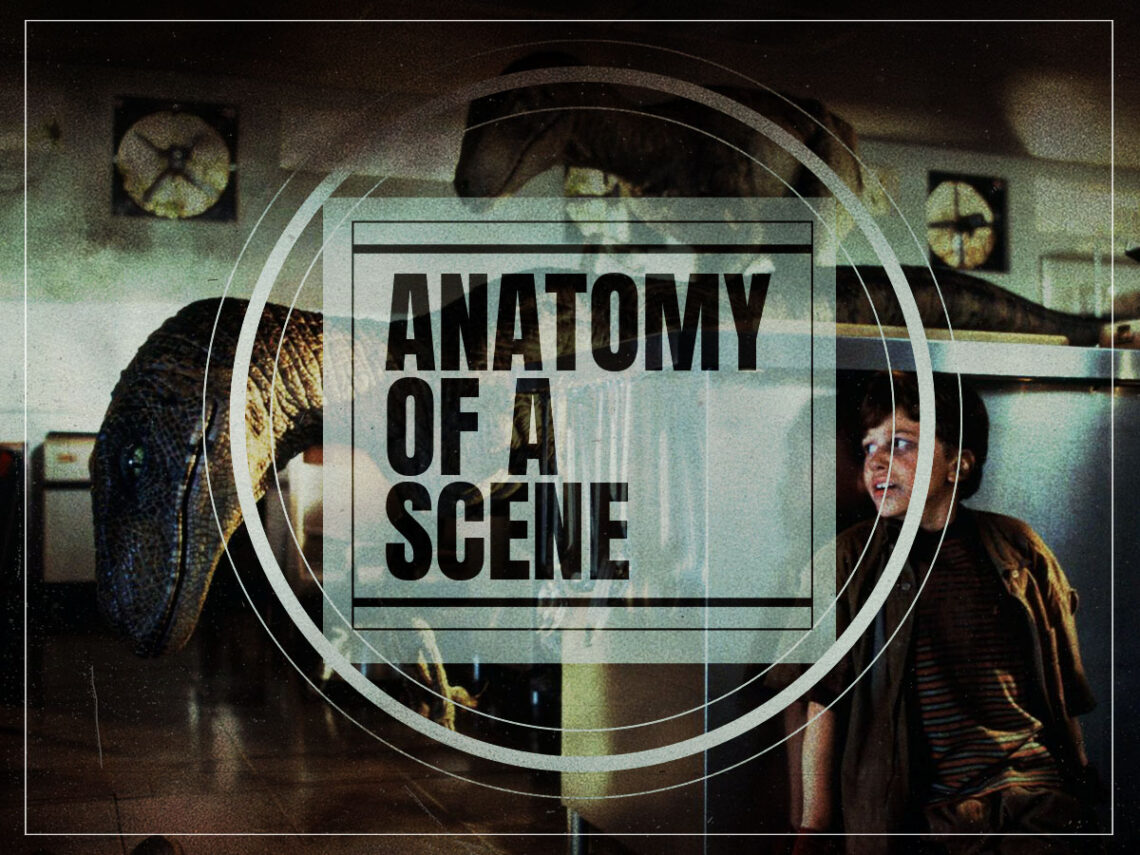
Anatomy of a Scene: The sneaking fear of Jurassic Park’s raptors in the kitchen

It would have been so easy for Steven Spielberg to make the Tyrannosaurus Rex the biggest villain of the original Jurassic Park. Big, scary, and instantly recognisable, the T-Rex was ready-made for Hollywood superstardom. Instead, he made a much more intelligent choice. He hinged the film’s final act on a different dinosaur, a smaller, more canny reptile: the Velociraptor.
The scene in which these pint-sized predators really come into their own is the legendary kitchen encounter with Tim and Lex. Immediately, the raptors establish themselves as a unique threat by managing to open a door, a sign of their incredible brain power. What follows is a deadly game of hide and seek as the two children scuttle around the floor, trying to avoid the two creatures’ gaze to the soundtrack of John Williams’ subtle score and the raptor’s fiendish hunting calls. The tension is unbearable throughout, especially when Lex is spotted attempting to hide in an oven, only for the raptor to go after her reflection instead.
This incredible slice of horror-infused filmmaking took two weeks to shoot on Stage 24 of the Universal lot. While the many glistening reflective surfaces of the kitchen would play a crucial part in the scene, they also presented a logistical nightmare for the crew, who needed to ensure every inch of the set was lit in a way that the audience wouldn’t catch a glimpse of a camera or crew member. This nearly worked. If you look closely during the shot in which Lex asks Tim what’s happening, you can see a distinctly human hand steadying one of the raptors’ tails. So close.
Unlike the animatronics used in other parts of the film (or the dubious CGI of later Jurassic World instalments), the raptors in this scene were played by people inside custom-made suits. Special effects legend Stan Winston created the staggeringly realistic costumes, which required the unfortunate wearer to be bent at a 90-degree angle the entire time while operating the dinosaur’s head with a rod. Their eyes and claws were operated remotely and weren’t always easy to control. Just ask Joseph Mazzello, the actor who played Tim, who was smashed in the head by an errant claw during filming.
The decision to set the action in such a domestic setting was a deliberate one. Spielberg wanted the juxtaposition of dinosaurs “in the world of the familiar” to make the scene more relatable. No one watching Jurassic Park had ever seen a velociraptor in real life, but they had been in a kitchen, so it was easier for them to imagine what it would be like to be in the kids’ position. As well as traumatising millions of viewers worldwide, the scene also profoundly affected one of its actors. Arianna Richards, who gives an incredible performance as Lex in this segment of the film, called it “one of the standout moments” of her time on set. “And to watch it after the film was complete,” she said, “It still gave me chills.”
Considering how memorable and impactful this scene is, it’s shocking to find out that the raptors could have had a bigger role in Jurassic Park. In Michael Crichton’s original novel, they serve as the main antagonists, forming a huge pack and attempting to escape their island prison. Dr Alan Grant has to confront them head-on, killing most of them with a batch of poisoned eggs. Spielberg clearly wanted to employ a similar formula to the one that had made Jaws such a success two decades previously.
By keeping the raptors’ involvement to a minimum, every time they appeared on screen, they felt special. While the T-Rex was the big showy centrepiece of the movie, the raptors were the real threat, silently plotting out of sight until the moment was just right.
