


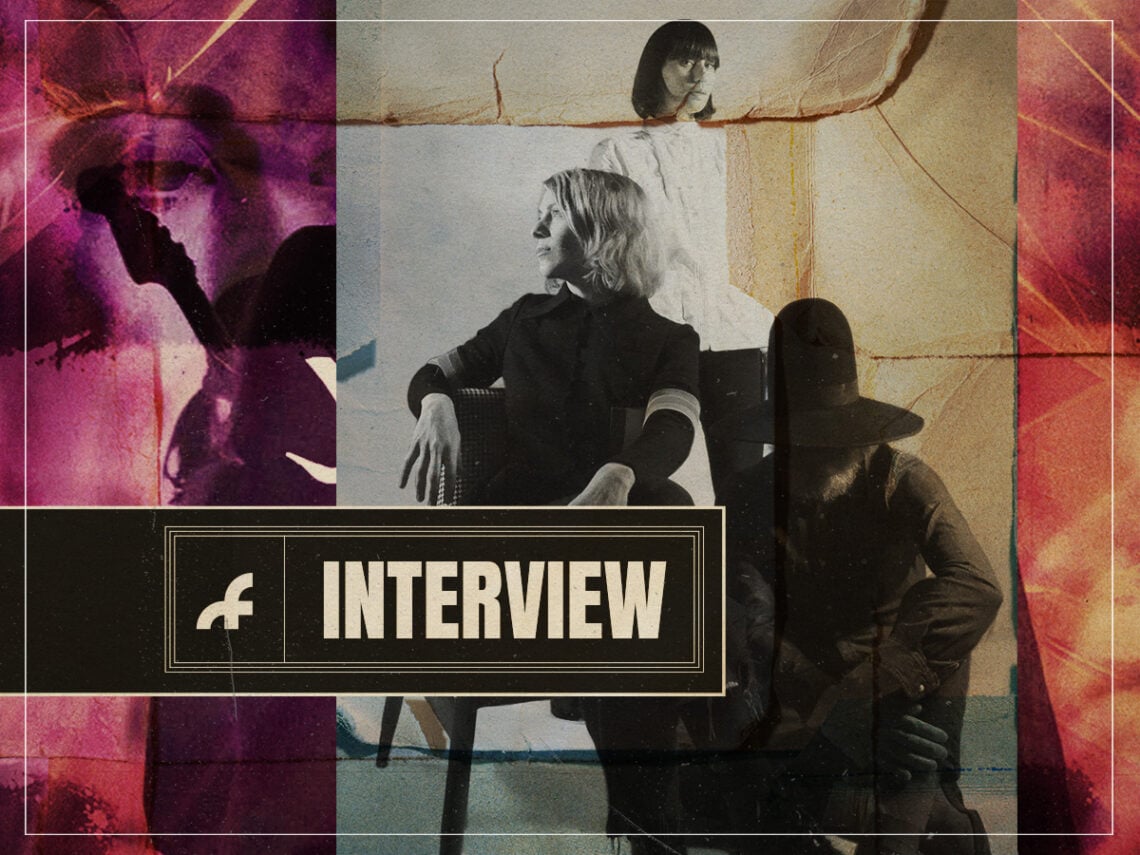
Juniore’s Anna Jean: “We made a soundtrack to our own imaginary films”

France‘s cultural output has consistently dwarfed that of its European neighbours, particularly in the fields of film, literature, and, of course, music. Nevertheless, perceptions of typical ‘French music’ are still largely stuck in the past, overly concerned with the ‘golden age’ period of the 1960s. However, groups like the Parisian trio Juniore are poised to change that perception with their own distinctive sound that celebrates France’s musical past while pushing it into new and interesting directions.
Juniore first formed back in 2013, during a time when Paris was experiencing a particularly vibrant indie-pop movement. Years later, during my adolescent obsession with Jean-Luc Godard films and Jacques Dutronc records, I first became alerted to the compelling sounds of the band through their stunningly moody single ‘Panique’. At the time, I remember constructing a mental image of what the band might look like, having never seen a photograph of the trio. You can imagine my gleeful surprise, therefore, when the band’s leader, Anna Jean, appeared on my computer screen to chat about all things Juniore.
Jean was refreshingly candid in her approach to the interview, starkly contrasting the aloof and intimidating coolness that my teenage self had attached to her imaginary image. Of course, a large part of the singer’s enthusiasm came from her innate excitement surrounding the release of a new Juniore album, Trois, Deux, Un, due to hit the shelves of record stores just as autumn gets rolling. The album is the band’s first in four years, and according to the songwriter, the struggles that the band members have faced during that period have all contributed to the overarching feeling of the record.
When looking back over the past four years, the influence of Covid is virtually unavoidable, so it makes sense that Jean devoted a considerable amount of our interview time to discussing the impact that it has had upon Juniore and the Parisian music scene as a whole. “Covid was a very strange time,” she shared, “I think everybody sort of imagined that it could be possible at some point, but in a strange sci-fi B-movie, not in real life, not right away, anyway.”

Although lockdown is, at this point, firmly in the past, Trois, Deux, Un still bears its marks. “I think it affected the album in the sense that we all had to deal with imagining what the new record would be without being with each other,” the songwriter revealed. “We had been travelling for the last, I think, five or six years, almost constantly. We were living together and sleeping on sofas and travelling. All of that stopped very suddenly.” As a result, the bare bones of many tracks on the upcoming album were constructed while the respective members of the band were isolated from one another.
Even after the reunification of Juniore, it seems as though the upcoming LP was still fraught with difficulty when it came time to record. “We recorded it when Covid was over,” Jean told me, “But we all had day jobs. Our day jobs took more of our time, and so we continued to work from a distance, simply because it was the new rhythm that we were forced into because of Covid.”
However, Covid was not the only relic of the past that influenced the construction of Juniore’s new record. Jean’s 1990s childhood, during which she spent a lot of time in the United States, has always impacted her musical output. During our discussion, I noticed that the songwriter would often link whatever she was talking about back to the world of film and television, something that she said was an integral part of her upbringing. “Being a kid in the ’90s, I think we grew up watching a lot of TV,” she said. “I think our parents didn’t have babysitters; they just had a television, so we watched a lot of films.” This fact should come as no surprise to anybody who has listened to Juniore, as their work has always maintained a certain cinematic quality.
Explaining this innate tenet to Juniore’s discography, Anna Jean theorised, “I think we grew up thinking that our lives were like films. So everything was very romanticised. We made a soundtrack to our own imaginary films where we were losers but with charm. You know, charming losers. I think that’s how we make music. It’s as if it were the soundtrack to our very obscure loser films.”
In addition to the world of 1990s television, Juniore also holds a lot of love and appreciation for the French yé-yé music scene of the 1960s, with the late great Françoise Hardy a particular favourite. For Jean, Hardy’s music had been a part of life from a very young age, but it was the singer’s attitude which really endeared her towards the Juniore songwriter, “For us, and I think for a lot of people, it’s not necessarily just her music. I think it’s the person that she was in the way that she carried herself.”
Expanding upon the enduring impact of Hardy, the singer continued, “She arrived in the ‘60s where women were wearing big hair, very strong makeup and very flashy clothes. And suddenly she arrived, this skinny girl who had no idea how beautiful she was and didn’t really care much.”

It is that sense of defiant nonchalance that Juniore are carrying on in the modern age, regularly paying homage to the pioneering work of the ‘Le Temps De L’Amour’ singer. “She was very proud of writing her own songs,” Jean continued, “Which I think was very rare. In the ‘60s, women were muses, but they were very rarely their own songwriters. So I think that’s the reason why she became such an icon and still is to this day.”
In contrast to Hardy’s lasting legacy, Anna Jean expressed a certain level of disappointment at the state of modern Parisian music, saying, “I don’t think there’s much music today that I feel close to in France.” However, she also noted that the resurgence of the French language in music was very inspiring, citing La Femme as a pioneer in the field.
“Between 2002 and 2010, maybe, people in France were singing in English,” the singer pondered, “La Femme, I think, was one of the first to start singing in French again, which was wonderful. We were so happy that they were paving the way for us to be able to make music.” La Femme seems like a natural influence on Juniore, not only linguistically but also in reviving post-punk and psychedelia, both of which the trio draw upon very regularly.
Of course, not all of Juniore’s influences are of French nationality; Anna Jean was keen to highlight her formative years spent in America and how the rock scene of the USA helped to mould her musical mind. “Having grown up listening to Sonic Youth, Pixies and Nirvana, of course, I think we have that flowing through our veins,” she shared, “even though we don’t necessarily talk about it as much.”
They might not talk about their love of American alternative rock as much as their fascination with figures like Françoise Hardy, but the remnants of all of those figures are certainly present within much of the band’s work, particularly their more recent efforts. If the singles released from Trois, Deux, Un thus far are any indication, then the upcoming record is set to be a firm highlight within Juniore’s already admirable discography.
Few groups currently in operation are capable of blending original sounds and modern influences with the attitude and energy of a vintage movement like the yé-yé scene of the 1960s, a testament to the uncompromising artistry of both Anna Jean and Juniore as a whole.

Never Miss A Beat
The Far Out New Music Newsletter
All the latest New Music from the independent voice of culture.
Straight to your inbox.