


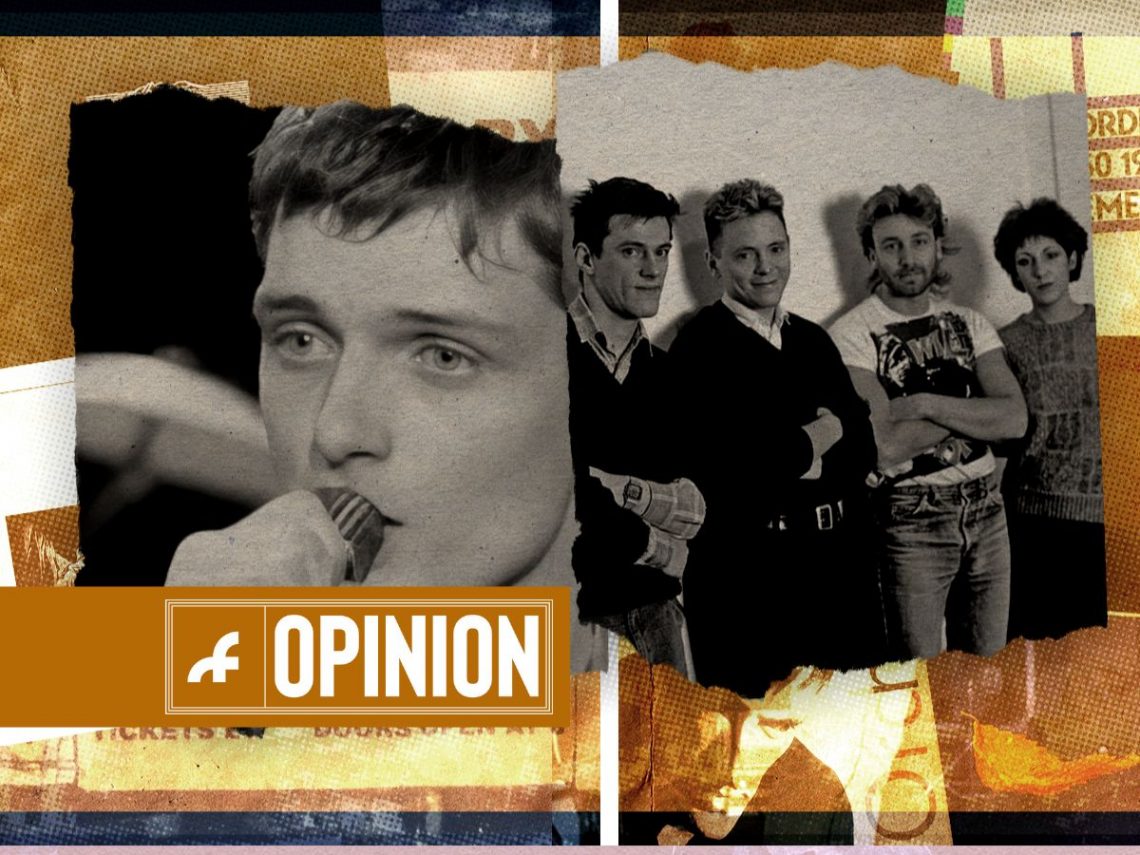
Hear Me Out: Joy Division and New Order deserve separate Rock and Roll Hall of Fame nominations

Today, the Rock and Roll Hall of Fame announced its nominees for the induction class of 2023. Among the worthy names floating around the list were first-timers like The White Stripes and Missy Elliott, plus long-time snubs like Soundgarden and Kate Bush. There were even some surprises on the list, including country great Willie Nelson and the wonderfully sly singer-songwriter Warren Zevon.
But the biggest surprise from the 2023 nominations was that legendary British groups Joy Divison and New Order were given one shared nomination. It’s worth stating that the Rock and Roll Hall of Fame is an arbitrary institution and its canon is not the official class of rock greatness, but any credibility that the esteemed club is struggling to maintain seems to get undermined every year by decisions like these.
Having two bands share a single nomination isn’t unprecedented. Funk acts Parliament and Funkadelic were inducted together through the shared leadership of George Clinton. But there’s another pair of acts that probably doomed Joy Division and New Order into sharing a single nomination.
Back in 2012, the Hall of Fame decided to nominate and induct The Small Faces and The Faces as one artist. Like the Joy Divison/New Order case, The Small Faces turned into The Faces when they lost a singer. Guitarist/singer Steve Marriott left the group in 1969, so members Ronnie Lane, Kenney Jones, and Ian McLagen replaced him with two ringers: Rod Stewart and Ronnie Wood from the Jeff Beck Group.
But the specific difference in these cases is obvious: Marriott left The Small Faces on his own accord and the band followed on in a similar vein without him, while Joy Division lead singer Ian Curtis took his own life in 1980, just ahead of the band’s first tour of the United States and they were forced to reinvent themselves. The Hall of Fame claims that Joy Division and New Order are “two bands that share a single story”, but their decision to give them a collective nomination only undermines the influence of both acts.
New Order took great care not to let the ghost of Curtis define them. Instead of continuing down the post-punk path that Joy Division helped forge in the late 1970s, New Order embraced new wave and electronica. That new sound would prove to be the foundation on which British indie music flourished in the 1980s and beyond, directly helping to set the stage for acts like The Smiths, The Happy Mondays, The Stone Roses, Primal Scream, and Blur. Their reputation as one of the most important bands from the city of Manchester, and their key role in helping to popularize the Hacienda Club, also make them one of the most important names in British music history.
The figures who were there to witness Joy Divison’s sad death and New Order’s stunning rebirth certainly considered the groups two separate entities. “Obviously, the death of Ian Cutis sort of mythologised them to a degree to which I think the surviving members of the band must have found very difficult to cope with,” disc jockey and producer John Peel observed.
“A very melancholy thing to have to live with,” Peel added. “I still get demo tapes from America and from Europe by bands who are quite clearly influenced by nothing as much as they’re influenced by Joy Division. You get a bit fed up with it, really.”
Poet and close friend John Cooper Clarke shared a similar view of the two distinct entities in his book I Wanna Be Yours. “After Ian’s death, the rest of the band had reinvented themselves out of necessity, throwing themselves headlong into the construction of their new corporate identity… as a band, New Order made it happen: they went from nobodies to somebody to somebody else, quite effortlessly, really.”
By combining the separate influential careers of Joy Division and New Order, the Rock and Roll Hall of Fame is purposefully diminishing and trivializing the work of people like Curtis and New Order keyboardist Gillian Gilbert. Of course, this is still the Rock and Roll Hall of Fame: trivializing the careers and influence of artists is basically their entire function as an organisation. However, on this occasion, it seems frankly offensive.
