


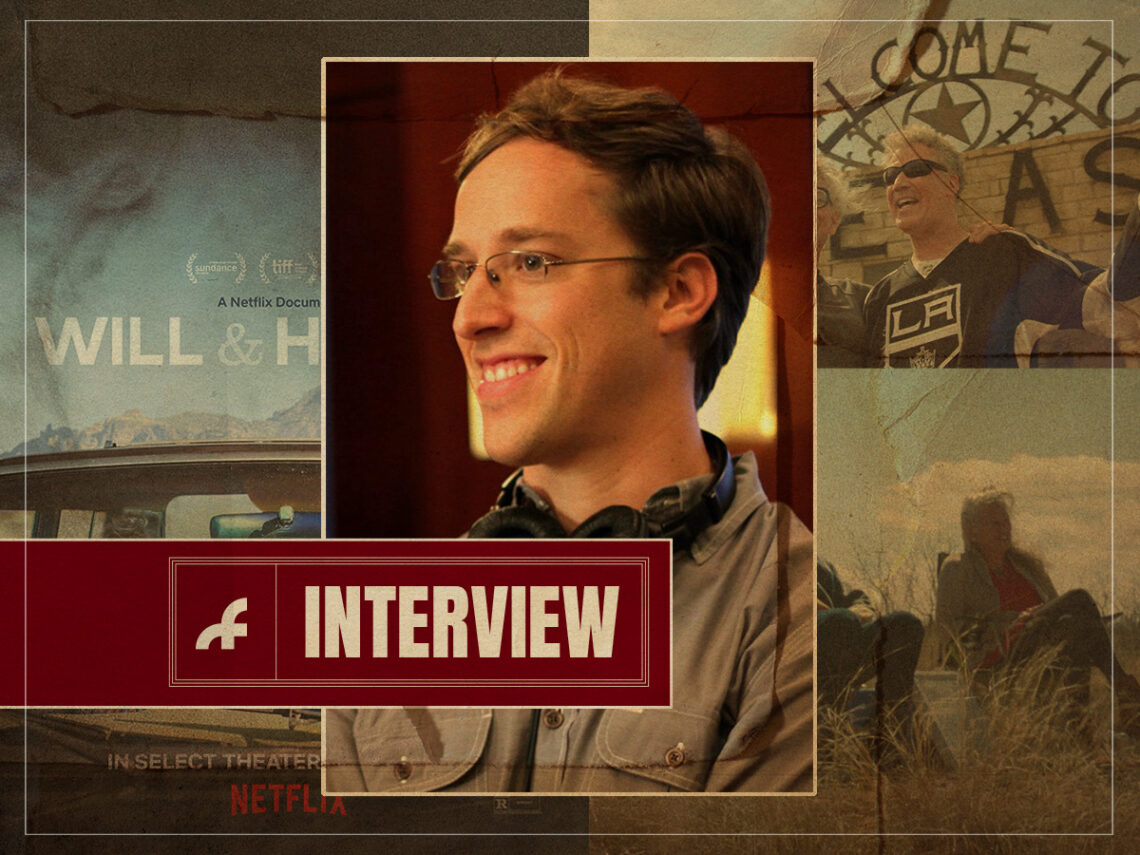
“It’s hard hating up close”: Josh Greenbaum on ‘Will & Harper’, a 240-hour emotional odyssey

Will Ferrell and Harper Steele sit in the boot of their car off a freeway on the outskirts of Illinois. Here, they ring Kristen Wiig and ask her to put together a theme song for the road trip they’re taking together. In a comedic back and forth, they pitch Kristen something fun, upbeat, but not too upbeat, jazzy and a bit country, but also something that stops you in your tracks and brings a tear to your eye. It’s during this moment the two longtime friends and collaborators unintentionally describe what would become the documentary they’re making, as this back road and intimate insight into living as a trans person in America is one of the funniest and most moving movies made in recent times.
The premise is simple. The circumstances leading up to it, less so. Harper Steele was born a man, Andrew Steele, who she lived as for 60 years. Finally, after acting against her own natural impulses for decades, she decided to transition, telling the majority of her friends and family in separate emails. “Instead of being an arsehole, I’ll be a bitch,” she writes to Will, who reads out the email in the film’s opening.
Harper prefaces the documentary by reflecting on the road trips she had previously taken as Andrew, driving up and down America, drinking at dive bars, going to sports events and rubbing shoulders with strangers. She confesses while all of those activities still appeal to her, she is worried about going back to certain areas as a trans woman. “I love this country so much,” she says, “I just don’t know if it loves me back right now.”
Here is our entry point: the moment the bulk of the story starts up, and we are permitted to enter the car and embark on a road trip with Will and Harper. On the journey, the two comedic icons explore this new chapter of their friendship, while Harper also tries to determine how others will receive her transition. Holding the car door open for us is director Josh Greenbaum, who was tasked with capturing the relationship between two old friends going through this unprecedented moment, while also highlighting the plight that trans people in the US (and worldwide) often face.
“That was the intention from the start,” says Greenbaum, “Just zeroing in on their relationship, their friendship, and their conversations as they navigate through this stage of their friendship, and Will unpacks her story. One of the huge benefits for me on this film was that I actually had a prior relationship with both of them, which goes a long way. One of the most important things when I’m making a documentary […] is having a level of trust with my subjects. That takes time, it takes experience, and sometimes you have to figure out how to manufacture and create that trust as quickly as possible […] Having that background of being friends, knowing one another, having a kind of base level of trust to start with, I think helped a tonne.”

The benefit of that intimate connection came across from the word go. Stunning cinematography aside, you could be convinced that Will and Harper simply took some cameras on a road trip and filmed this documentary themselves. As they navigate America, going from the steps of the White House to the most tucked-away dive bars, each conversation, joke, and confession feels authentic, as if we’re eavesdropping in on a conversation between two friends who don’t know we’re there.
“Once we hit the road I tried to create as organic and authentic a space as possible,” admitted Greenbaum, “I kind of chased them round with cameras, mounted cameras on the hood of their car, tried to capture as much as I could. And then I return to the edit room to deal with the 240 hours of footage and the task of turning it into a watchable film.”
Those hours are made up of a multitude of experiences that explore the furthest ranges of human emotion. Compassion, friendship and love exist on one end of the spectrum, while loneliness, fear and sadness reside on the other. Each of these feelings is a pit stop on the two’s journey across America; whether it’s joking in a car park about buying too many Pringles, or Harper taking Will to a small, run-down house she purchased before transitioning where she could be alone and dress as a woman in peace. We get access to every facet of this physical and emotional journey.
“Will and Harper and I all talked that we didn’t want to make a quote-unquote ‘political film’,” said Greenbaum, “I didn’t want to tell a story with any agenda; I wanted to tell the very human story of these two people and their relationship. But at the same time, we all knew the story would be pulled into the political sphere; it’s just the nature of it, it’s the nature of where we are with trans rights and transpeople in our culture right now.”
He continued, “Even as a small example, when we went to Washington DC, we could have gone to speak to politicians, and we could have tried to talk to the president, which Will made a joke about saying he was going to get to see the president because of his face, his money maker. But we also just didn’t want to do that. For unfortunate reasons, the second Joe Biden shows up on screen, I think half the people tune out. Or any politician, whoever it is. And too many times, they’re telling the stories. Let’s take that back; let’s tell our own stories and not let the politicians and the media tell [them].”

And that’s what happens. From the moment the engine starts, Will and Harper control the narrative. That means there are sections where Harper reads from her journals about failed therapy sessions, where Will Ferrell gets angry about the fact they’re not stopping at Dunkin Donuts, or they call their celebrity friends and ask them to write songs for the documentary.
“I think my breakthrough in terms of the process was, they’re so funny so often […] it is a big part of the film. But, what I realised was, ‘Oh, they’re funny all the time, and that’s a given’, and so if I let go of that and all of my favourite jokes and my favourite bits and just focus on the dramatic beats of the story of their own self-discovery, of periods of growth, of pain, of struggle,” Greenbaum explained. ”If I focus on that and go into the film first and foremost with that in mind, I am confident I can refold in, remix in, all of the comedy and the jokes. That was the breakthrough. Let me start there.”
He continued, “This film, it can’t just be jokes. Obviously, it’s certainly not what the story was. But on the flip side of that, if it didn’t have all the comedy that Will and Harper bring, it would be totally disingenuous to who they are. They’re comedians, and they’re two of the best comedians we have in America. They’re incredible, so I had to make sure we found the right balance.”
The recurring moments where this balance is struck is in the car, when Will asks Harper common questions that cis-gendered people might have for trans people. These cover the feeling of being misgendered, whether she is interested in dating and what’s it like having boobs all of a sudden. However, one of the most important questions comes outside of the car at a racetrack when a man on a day out with his son asks Harper the only thing that should matter when discussing trans people: “Are you happy?”
“I loved that guy. He was a Dad, he was there with his kid,” recalled Greenbaum, “That prompted, for me, one of the most powerful moments of the film, both as a filmmaker but also as a friend of Harper. When she said, ‘I’m realising I’m not afraid of these people hating me, I’m afraid of hating myself’. And it’s a really powerful moment and also a universal thing. I think we can relate to that feeling that there are parts of ourselves that we don’t love or try to hide. It’s also a very specific feeling for trans people who have grown up in a culture where they’re the butt of a joke […] That was really a hard moment for me to witness.”

The theme of acting against natural instinct resonates throughout this movie. Harper did it for decades before she finally transitioned, but it extends to behind the camera. In those heartfelt moments, Greenbaum had to try to disassociate himself from the friend who he wanted to comfort and keep his director’s hat on.
“It’s very hard […] I’ve never experienced it,” he said, “I certainly grow in my docs to know and love my subjects, but having known her prior added a whole other layer, and it’s really difficult. You force yourself to let the moments play out organically as best they can. I remember at the racetrack, she said that line about hating herself. I was broken. They were crying in the car, and I knew we had to film, and they pulled away, and I was just shaking uncontrollably. Finally, I knew they had a walkie-talkie, and I said, ‘Okay, we’re gonna cut the camera, and I’m gonna come over and give you a hug and come see you’. So, there were moments.”
He continued, “I think maybe another layer […] It’s so important to listen to your natural instinct and let the natural instinct play out […] One of the things I’m so grateful for is witnessing what Harper and many of the trans community taught me, of a term called ‘Trans joy’. Which is once she kind of shed the part of her identity that felt totally fabricated and manufactured, she opened herself up to connection and I think her courage has encouraged so many others now.”
When the movie ends, it doesn’t feel as though you have watched a documentary; rather, you have been on the journey, too, and you’re exiting the car saying bye to two new friends. The film’s agenda-less, human nature could be a turning point for many people who have preconceived ideas about the trans community (hopefully).
“It’s hard hating up close,” Greenbaum concludes, “And I think part of what this film can do is, you know, remind people that we should be seeing each other a lot more as human beings. We’ve sort of lost that nature of being up close and having the civility of treating each other as human beings, as simple as that sounds.”
