


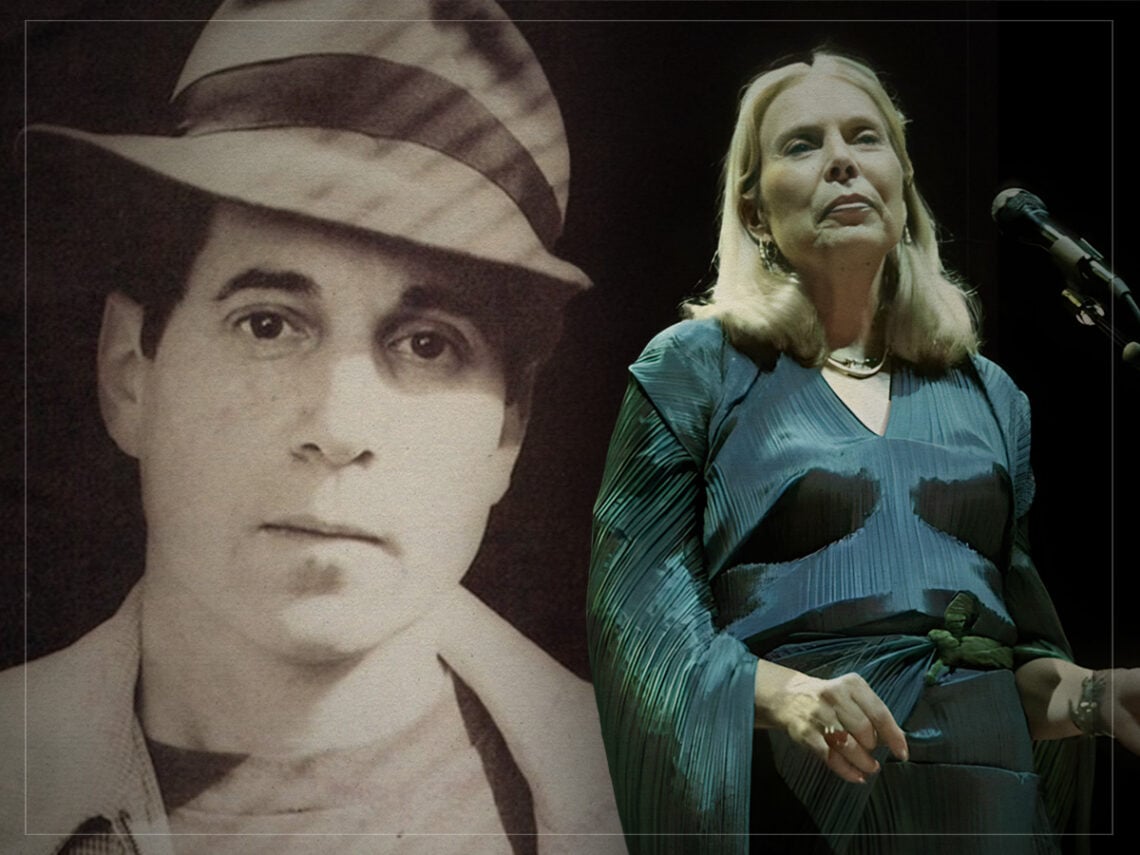
Joni Mitchell’s scathing critique of Paul Simon’s one fatal songwriting flaw: “I better cut that out”

There was a period when Greenwich Village was full of beat replicants: a gingham shirt, On The Road peaking casually but calculatedly out of a top pocket, a dog-eared guitar case, and the same 12 songs as everybody else stowed away in the dusty, dive-bar repertoire.
The scene abided by the age-old mantra: if it was never new and it never gets old, then it’s a folk song. But then that all changed, as Joni Mitchell even admits, when Bob Dylan had the gall to write progressively.
He kept the timelessness intact, but expanded the future-gazing frontier of folk. This proved to be a huge inspiration for the ‘Both Sides Now Singer’. “I have this need for originality,” she told Joe Jackson.
Continuing, “It’s actually in my stars. I was born on the Day of the Discoverer and that, I believe, had a profound influence on this need to be original. And also, because I’ve always been a painter, there is the painter’s need to discover a new voice.”
In a musical sense, she pins it to an equally direct instance. “Whereas musicians go into a tradition, with no need for discovery,” she claimed. “But there came a point when I heard a Dylan song called ‘Positively Fourth Street’ and I thought, ‘Oh my God, you can write about anything in songs’. It was like a revelation to me.”
So, Mitchell quickly followed him down this path of originality. “My early work is kind of fantasy, which is why I sort of rejected it,” she told Arista Records founder Clive Davis. “I started scraping my own soul more and more and got more humanity in it.”
This meant being honest about her experiences, and that unsettled the close-knit scene. “It scared the singer-songwriters around me; the men seemed to be nervous about it, almost like [Bob] Dylan plugging in and going electric. Like, ‘Does this mean we have to do this now?’ But over time, I think it did make an influence. It encouraged people to write more from their own experience,” she added.
And so, Mitchell claims she steadily began to see her influence flourish, and seeing her style mirrored often led to her picking fault with it. While many would recognise Paul Simon as a master of the songwriting craft, Mitchell felt that he illuminated a flaw that she was quick to shed from her own songbook.
When discussing how she brought about a greater chordal complexity to counterculture, Elvis Costello asked her, “Do you ever recognise that you have been a lyrical influence, even when it’s abused?”
To which Mitchell replied: “No. Paul Simon started piling up a lot of words, more than the bar could handle, and I stopped!” she declared with a laugh. “If that’s what it sounds like. I better cut that out. [Further laughter erupts from Mitchell and Costello alike]”.
While this does seem immensely harsh on her fellow folk star who was penning some of the finest lyrics ever put to song in the 1960s, even Simon himself claims that he developed a more naturalistic approach in later years, edging away from a more literary style into something that coupled fine prose with the joy of street pronouncements – pretty much the definition of beat poetry in songwriting terms.
“The language starts to get more interesting in Hearts and Bones,” he told SongTalk in 1990. “The imagery started to get a little interesting. What I was trying to learn to do was to be able to write vernacular speech and then intersperse it with enriched language. And then go back to vernacular.” In essence, only cramming half the bars with a heavy cluster of words.
He concluded: “So, the thing would go along smoothly and then some image would come out that was interesting and then it would go back to this very smooth, conversational thing. By the time I got to Graceland, I was trying to let that kind of enriched language flow naturally, so that you wouldn’t really notice it as much. I think in Hearts and Bones you could feel it, that it was coming.”
Mitchell, however, seemingly didn’t quite make it to that point. But then again, she’s also dismissed her first divine inspiration, Dylan, as unoriginal in the years that have followed. So, maybe her striving search for originality applies to contrarian views too – a desire to ditch heroes in a bid to find new ones, revelling in the next inspiration that lies ahead, and leaving the bad-breathed bastards of the past behind.
