


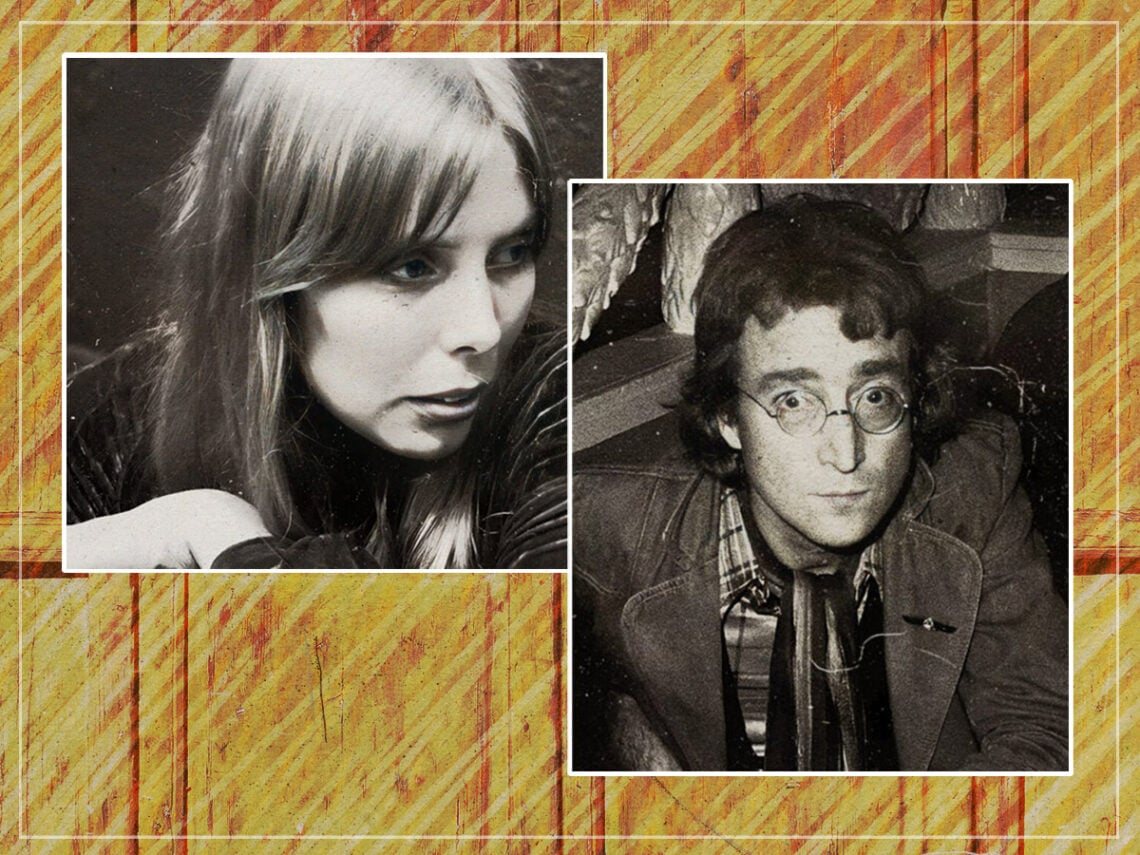
Joni Mitchell’s horrible first meeting with John Lennon

John Lennon was never known for being easygoing, and the same could be said of Joni Mitchell. Both were unflinchingly direct, expressing their emotions with blunt honesty and wearing their feelings openly. So, when these two formidable forces of nature crossed paths, it was bound to be anything but smooth sailing.
While some of the strongest friendships can arise from initial hostility, this wasn’t the case for Lennon and Mitchell. Despite their shared passion for music, which had initially brought them together, their vastly different worlds created a divide too significant for them to bridge.
While they didn’t move in the same circles or spend much time together, Mitchell left their first encounter certain they would never be friends. Musically, there is little to criticise about the Canadian—she is, after all, one of the most gifted songwriters the world has ever seen. Yet, during their initial meeting, Lennon felt the need to critique her work and offer unsolicited advice, setting the tone for their strained dynamic.
Although Lennon’s songwriting was forever altered by his love of Bob Dylan, he was less than complimentary about Dylan’s female folk peers. In addition to his perceived ill feelings towards Mitchell, he once disparagingly labelled Joan Baez and Judy Collins as “fruity”.
Admittedly, Lennon was enduring a difficult moment in his personal life when he met Mitchell for the first time during his fabled ‘Lost Weekend’. A tumultuous 18-month period in which he and Yoko Ono separated and began having an affair with their assistant, May Pang. He was drinking to excess under the tutelage of Harry Nilsson and abusing drugs, leaving the former Beatle as a shell of his former self.
His behaviour towards Mitchell was an indictment of his current state of affairs. In contrast, Mitchell was thriving and in the middle of making her masterpiece, Court and Spark, in the same studio that Lennon was using. “When I met John Lennon, it was during his lost year in LA y’know, and he came up to me to say, ‘Oh it’s all a product of overeducation, you want a hit, don’t you?'” she later says in her best Scouse impression.
“I was cutting Court and Spark; he was cutting across the hall, so I played him something from Court and Spark. He said, ‘You want a hit, don’t you? Put some fiddles on it! Why do you always let other people have your hits for you, y’know?'” Lennon referred to Mitchell allowing Collins to record a version of ‘Be Here Now’ before the original was released. However, unlike Lennon, Mitchell never cared for chasing the next hit and instead preferred to focus on creating her next song.
Years later, during an interview with Maclean’s Magazine in 2014, Mitchell claimed that she believed her middle-class upbringing made Lennon combative towards her. “That’s a class difficulty he had. He’s a working-class lad,” Mitchell explained. “I’m sure he had that same fight with George Martin because he was afraid that he was betraying his class. I know I’m going to get into hot water if I get into this but I have controversial opinions about him.”
“I watched this [English film], which was a roundup of the best musicians of the 20th century,” Mitchell continued. “As soon as it hit my era, the intelligence of it dropped considerably. When it came to me, this guy folded his arms and crossed his feet and said, ‘I never liked Joni Mitchell—she’s too twee.’ Well, that’s what John Lennon was like. It was that fear working-class people have of middle-class people.”
Growing up in post-war Liverpool gave Lennon an underdog spirit, whereas he believed Mitchell had been handed everything on a silver platter. Yet, he didn’t know her whole story and the pain she suffered that made her the artist she became. Whether it’s her life-threatening battle with polio as a child or being forced to put her baby up for adoption to give it a better life, Mitchell’s life hasn’t been utopian.
