


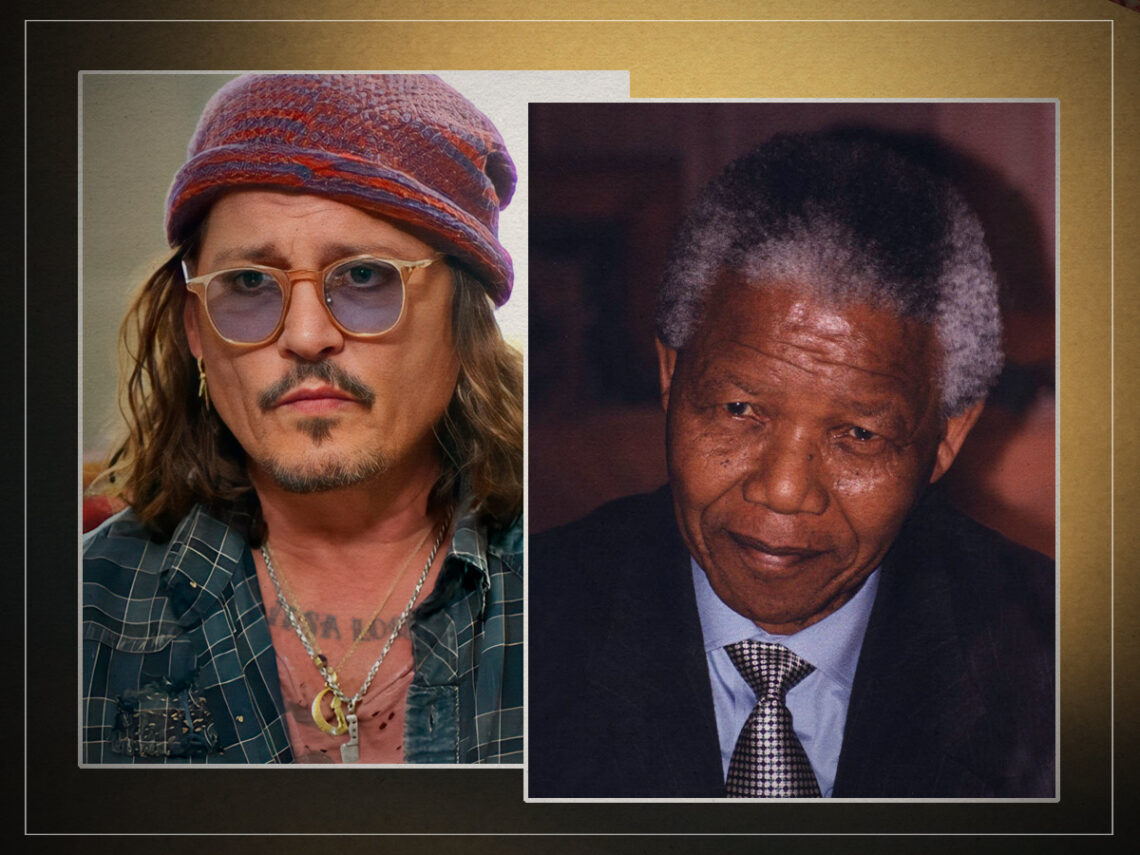
“Everything got bright”: Why on earth did Johnny Depp compare himself to Nelson Mandela?

Every successful actor requires a decent-sized ego to make it to the top of the industry, but Johnny Depp invoking Nelson Mandela’s name as a comparison to a pivotal moment in his career is nothing if not a head-scratcher.
In one corner, there’s the guy who made his feature debut in Wes Craven’s A Nightmare on Elm Street, segued into unwanted teen heartthrob status on 21 Jump Street, and became Hollywood’s favourite lovable weirdo when he struck up a fruitful creative partnership with Tim Burton.
In the other corner, there’s one of the most important figures of the 20th century, who spent 27 years in prison before being released to play an instrumental role in dismantling the apartheid movement and becoming the first Black president of his native South Africa.
Needless to say, there’s nothing in common between Depp and Mandela, besides the fact that they’ve both worked with Morgan Freeman. And yet, having extricated himself from a particularly miserable professional situation, the deposed Pirates of the Caribbean headliner saw him as a kindred spirit.
Admittedly, there’s more than a hint of youthful hubris about Depp’s declaration, which he made in a 1993 interview with Details. He was on top of the world, having freed himself from 21 Jump Street and made an instant splash in cinema with Edward Scissorhands, which is hardly Mandela-esque.
When he initially agreed to play Tom Hanson, he eagerly signed a six-year contract without giving it a second thought. However, as the show became more popular and turned him into an object of desire among the younger demographic, Depp grew to despise his breakthrough role.
He lobbied hard to be released early from his deal, and his wish was granted on the set of Burton’s gothic fable. “My posture changed,” he recalled, explaining that it was as if a weight had instantly been lifted from his shoulders. “Suddenly, everything got bright. It was like Nelson Mandela, man.”
Not quite, Mr Depp, not quite. Hopefully, only one person has ever compared the star being allowed to depart 21 Jump Street two years ahead of schedule to Mandela being freed after almost three decades behind bars. His fans definitely wouldn’t, seeing as they were devastated when the show’s resident sex symbol revealed he was heading off to pastures new.
Working with Burton and John Waters on Cry-Baby made for a memorable introduction to the post-Jump Street world, but again, it wasn’t exactly on a par with Mandela becoming his country’s president. Of course, it was merely a statement of exuberance, with Depp illustrating just how important it was to finally be rid of the leather jacket-wearing albatross around his neck.
Still, Mandela? That’s a bit much. Edward Scissorhands started shooting in March 1990, a little over a month after Mandela was freed to a massive global television audience. Who knows, maybe if the timelines were better aligned, the latter’s first comments post-release might have found him saying he felt like Johnny Depp being let out of his 21 Jump Street contract.
