


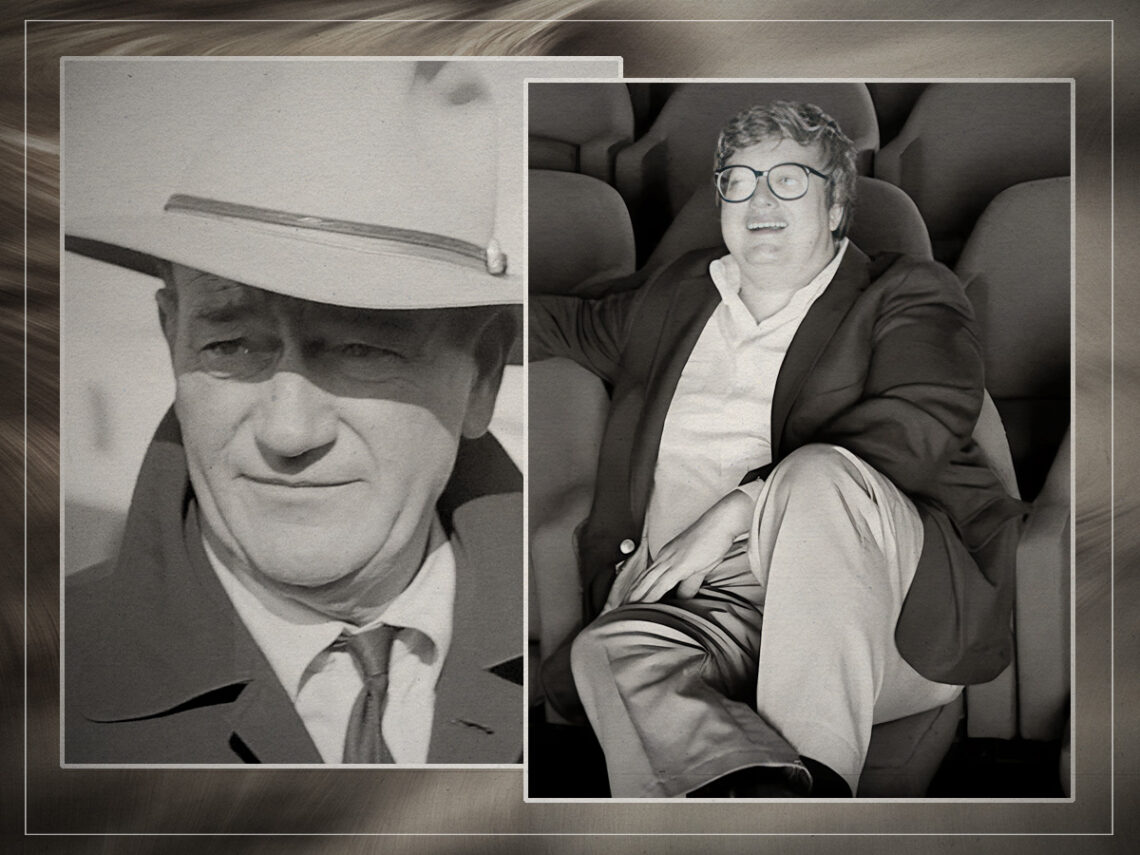
The John Wayne movie that Roger Ebert called flawless: “There is not a shot that is wrong”

Film critic Roger Ebert was not predisposed to love all John Wayne movies. He only started reviewing films in the mid-60s, long after the Duke became a star. He was also a champion of a brand new generation of unorthodox directors, including Werner Herzog and Spike Lee, and was writing reviews at a time when the western genre was shifting from the veneration of American expansionism toward a rougher, more complicated world of violent antiheroes.
Ebert never pulled his punches with anyone, including Wayne. He tore apart his 1968 film The Green Berets, calling it “cruel and dishonest and unworthy,” and accused it of dishonouring the soldiers in the Vietnam War. He was almost as unimpressed with his next film, Hellfighters, though he was more dismissive than outraged.
There was, however, one John Wayne film that Ebert praised to the heavens, a film so beautifully constructed that the critic said there was not a single shot that was out of place. It was the Howard Hawks western Rio Bravo, which Ebert reviewed in 2009, 50 years after it was released.
Set in the Old West, it follows Sheriff John T Chance (Wayne), who arrests the brother of a powerful local rancher for committing murder in front of a saloon full of witnesses. As the rancher’s hired hands descend on the town to break the man out of the jailhouse, the sheriff teams up with his alcoholic former deputy Dude, peg-legged ageing deputy Stumpy, and a young cowboy named Colorado to keep them out until the federal marshal arrives six days later.
The plot is beautifully simple and is so full of dramatic potential that Hawks made two more variations of it – 1966’s El Dorado and 1970’s Rio Lobo. Even John Carpenter was impressed, using it as a template for his breakout 1976 film Assault on Precinct 13. Tension hangs over nearly every minute of the film, both from a plot perspective and from tangential throughlines. Dude trembles and sweats his way through alcohol withdrawal. The band in the saloon repeatedly plays “El Degüello,” a song that the Mexican army played at the Battle of the Alamo to signal that they would show no mercy.
Most of the tension is derived from the constant waiting, which allows for plenty of character development. As Dude, singer Dean Martin is full of jittery self-loathing. Walter Brennan as Stumpy provides the usual comic relief, but never becomes a caricature of himself. Colorado is played by Ricky Nelson, who, like Dean, was primarily known as a singer. He brings a youthful swagger to the role, but maintains a canniness beyond his years that adds nuance. And as Chance, Wayne provides one of his most developed performances. He isn’t playing an icon. In fact, the Sheriff can be unreasonably cruel to his friends. During several scenes, he also allows the other actors to command the spotlight, making the film more balanced than many of Wayne’s movies.
In one key scene when the men are whiling away time and trying to distract themselves from the tension that grips the town, Hawks puts the musical skills of his cast to good use. The duet between Dean and Nelson is short and sung softly, but it’s one of the most powerful moments in the whole movie.
“To watch Rio Bravo is to see a master craftsman at work,” Ebert wrote in his review, giving the movie four out of four stars. “The film is seamless. There is not a shot that is wrong.”
