


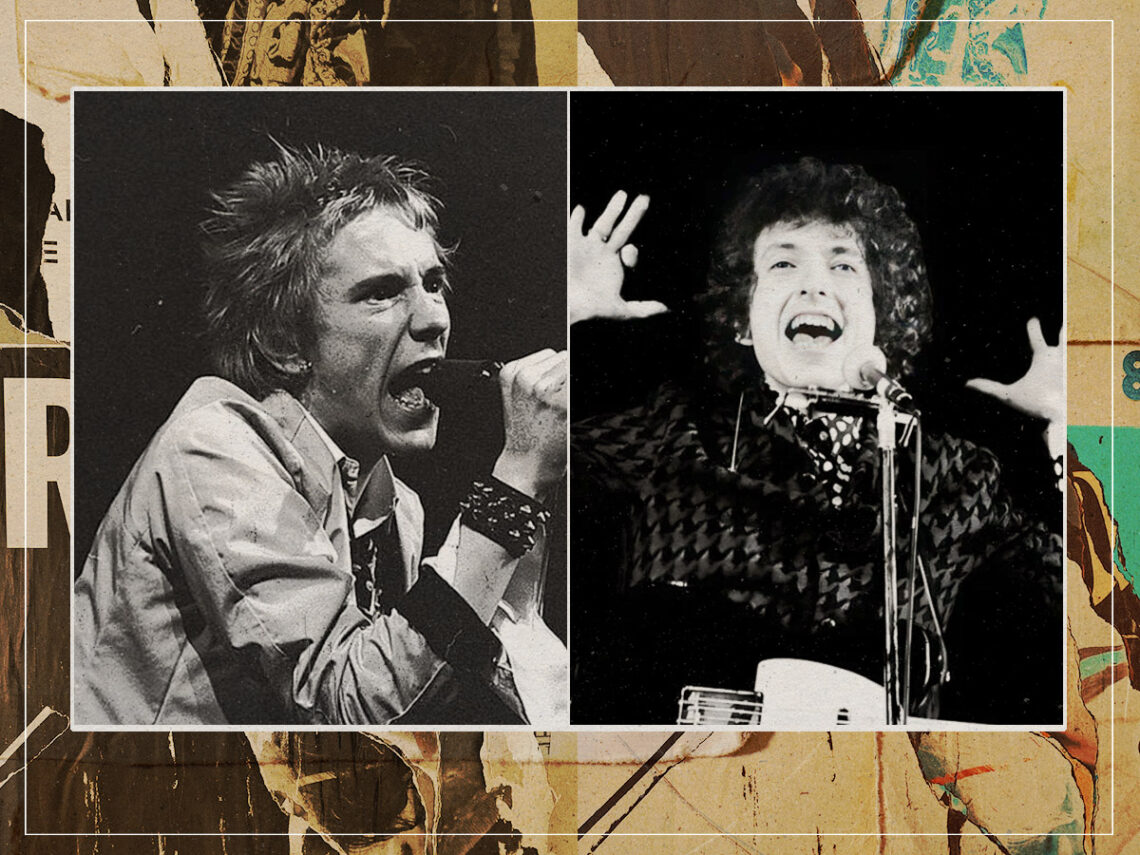
John Lydon’s answer to Bob Dylan’s ‘Blowin’ in the Wind’: “But with less of the farting”

As John Lydon made clear in a chat with Far Out last year, any youthful interest he took in Bob Dylan was inspired mainly by the latter’s punk-like decision to go electric and break with the folk establishment in 1965. The earlier stuff, by comparison, was “just a waggon driven by horses kind of music. It wasn’t my scene.” Even so, Lydon has confessed in the past to finding at least one of Dylan’s early anthems worthy of a direct musical response of his own.
In a 2018 interview with Bill Kopp’s Musoscribe, Lydon discussed the unusual circumstances of recording Public Image Ltd.’s 1986 LP Album, a sort of secret supergroup project that included an unlikely roster of Steve Vai on guitar, Ryuichi Sakamoto on keys, and Ginger Baker and Tony Williams splitting drumming duties.
One song that emerged from those sessions, the six-minute-long ‘Rise’, became arguably PiL’s biggest hit. But it was another less remembered track from Album that was apparently Lydon’s direct nod to folky Dylan. “I mean, on the Album album, there’s ‘Round’. That’s my answer to Bob Dylan’s ‘Blowin’ in the Wind’. But with less of the farting,” he told Kopp.
Yes, Lydon has repeatedly stated that the “wind” in question in Dylan’s 1962 classic always made him think of flatulence. And yes, when talking with Far Out last year, he mistakenly described the Dylan original as a “cover” of a Peter, Paul & Mary song while also criticising early Dylan albums as “a pale imitation of something Arlo-Guthrie-ish” rather than Woody Guthrie.
Still, as a child of the ‘60s, the cultural impact of ‘Blowin’ in the Wind’ wasn’t lost on Lydon. In-between squeals of Vai’s guitar, ‘Round’ does seem to touch on some similar, if cryptic, themes to the Dylan song: “Well, of course/ We’ve always had it in us/ For a million years/ Sleeping hali’osis/ Deaf ears provide/ Perfect pure protection“.
Replacing the tumult of the Civil Rights movements with the dark days of Thatcherism, Lydon’s message in the song again seems to be a call to find an “answer” by opening one’s eyes to the injustices of the world: “You seem to say to say/ Nothing can be something/ Ignorance now/ Dominates the season/ How many of you have seen a factory?/ As the boss held high/ And the children die/ Don’t lecture here/ Don’t spit on my life”.
Most of the words in the song involve variations of the expression “round and around,” which fits in with another songwriting approach Lydon discussed with Kopp. “I love to dabble with terminologies like clichés. I love to see how I could turn them upside down and spin them around, and somehow formulate a sense of irony in them. You say one thing, but really, you mean something else, and hopefully, that would be clearly understood. Didn’t always, of course.”
In line with the PiL ethos, the legendary guests on ‘Round’ and the Album sessions weren’t promoted as part of the record’s release, and as Lydon explained, there were never thoughts of taking that line-up on the road, either. “I couldn’t afford that for starts,” he said, “and secondly, to go out, it would end up as some kind of supergroup. And that’s not where I’m at. I’d much rather go back into the shadows and re-think it all and do something completely different.”

Never Miss A Tale
The Far Out Bob Dylan Newsletter
All the latest stories about Bob Dylan from the independent voice of culture.
Straight to your inbox.