


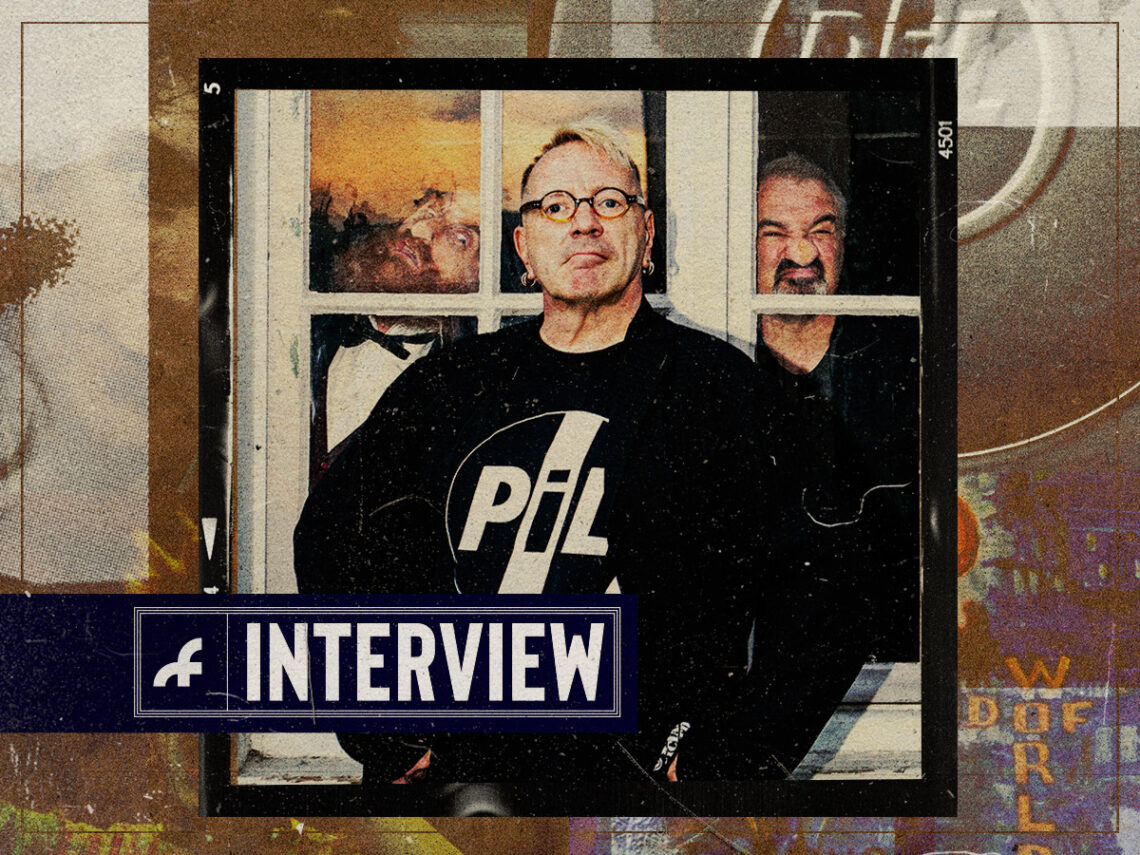
John Lydon on pouring the meaning of life, grief and punk into Public Image Ltd’s new album

He’s had so many spats, tiffs and plaintiffs over the years that assuming John Lydon is angry simply saves time. It seems as soundly probable as the presumption that Dolly Parton sleeps on her back. His snotty asocial wit makes his stock disposition seem a foregone conclusion. But that is not what I found when I came electronic interface to electronic interface with the punk legend. And, despite its seemingly damning title, his latest album with Public Image Ltd, End of World, is equally as emotively spectral beneath its snarling exterior. Indeed, he might be angry by and large, but there is plenty of probable cause for that, and Lydon’s unique brand of fury is far from subsuming enough for him to lose hold of his mantra: “See humour in all things”.
That seamless blend of emotions might define Lydon as a person, but it is also the core tenet of PiL as a band. Their sound is unique and implacable; the reason for this is that they invite four separate energies to the fore. Do that with anything, and you’ll have something singular. However, it is often the case that bands ‘angle’ for originality in a unified way and simply end up conflating noticeable influences in a forced bid to be ‘different’. PiL are proudly not like that, and that is apparent on End of World. Sure, you might be able to pick out a bluesy vocal line, Afrobeat rhythm and Mud-inspired riff, but these arrive as idiosyncratic avenues of expression rather than appropriations of influence.
“This is a solid four-piece with four people really contributing. And that’s vital to the energy of it,” Lydon cheerily agrees, leering towards the camera during our Zoom call. While the news surrounding camp Lydon might frequently seem to suggest that wrestling the spotlight away from him is foolhardy and that surely he would be the dominant input in the gabble of PiL, he preemptively eschews that with the self-aware assertion, “All of us really could do with a slap on the back of the head at times for being pompous and arrogant. And we’re able to do that. There’s a great, great sense of camaraderie and fun in PiL.” Further dismissing the notion of creative dictatorship, he reasserts his collaborative bent by adding: “That’s the way I’ve always tried to maintain it.”
Alas, this is often not the case in modern music, and Lydon, naturally, has an opinion on that. “Corporate thinking,” he instantly explains. “Record labels are very much a death by committee. They have their little committee meetings or rather BIG committee meetings, and they decide what blah-blah-band should be doing for the next ‘hit’ single, right? This is a dangerous world to be trying to navigate through. I’ve always been accused of being ‘difficult to work with’. Yes, of course, I am!” he proudly exclaims, almost headbutting the camera on this particular leer.
“I will not be dictated to, or my fellow cohorts in PiL now,” Lydon adds. “This is our life’s experience. And we’re not going to have somebody misinterpret that on our behalf without our say. It’s a stupid trap. The promise, of course, is instantaneous wealth, fame and fortune. Well, I preferred infamy right from the start. And I found it the easier road to travel. Because I wake up in the morning knowing I haven’t lied to anyone. It’s fantastic.”
Even in a literal sense, Lydon has now escaped that world. PiL currently operates under their own record label—a pariah band of brothers. “It’s just the four of us responsible to each other,” he says before repeating his catchphrase: “It’s fantastic”.
That celebrated sense of camaraderie was even more vital on this occasion. In April, Lydon lost his wife, Nora Foster, who he married back in 1979. He talks about her continually throughout our chat; his willingness to embrace something so solemn and so openly is indicative of both the need he feels to discuss her, but also his desire to share life lessons and experiences. With kindness and wholesomeness, he often glares at me as though fatherly imparting caring advice to a younger man. These moments are obfuscated by both the surreal fact it is bloody punk legend Johnny freaking Rotten doing it, and also they are sandwiched between wild remarks like “Donald Trump is the Sex Pistols of politics” and his love for walls that “keep the fucking wolves out”.
“They locked us up for two years,” he says, recounting the profound life events that circulated around the recording of End of World. “In many ways, that was very torturous because it meant if anybody came to visit Nora, a very gregarious and outgoing person, it was hell, because not only was she not understanding her illness, but everybody coming in in face masks was absolutely terrifying her. She could not understand or get to grips with that. So it was torturous for her. But on the good side, me and her became even, if at all possible, closer than ever. And so I can say, although the day she died was very painful for her, she died, with all practical sense, laughing. That’s the best way to go: happy.”
The bittersweet mix of happiness and sadness existing side by side is something that proves poignant on the album, but never more so than on ‘Hawaii’. “It is based on all of those experiences, both good and bad, combined,” Lydon tells me. “I think that a keyword in this song is ‘Aloha’, which means both hello and goodbye”. The musicology also begins to reflect this, morphing over the course of lockdown and all that went on between the recording sessions. “Originally, it would have been a far, far different song,” he continues.
“As the gaps between us grew, and my 24/7 care of Nora, it became very, very poignant to me to notice this situation accurately,” he adds. “And so I did, and I chose my words carefully, as I do in all songs, but in this one in particular, to actually sum it up and suss out what these feelings were. It’s a song I’m really happy to say – along with the whole album, actually – I was able to play to her before she died. And that was very, very excellent for me. A real reward,” he smiles.
Once again, the song typifies Lydon’s frightening determination to be honest. On this occasion, that has not put any noses out of joint but rather graced the song with a poignant resonance. “There’s two victims in this: one is the immediate spouse, and the other is the person dying,” he says. “You have to consider all of those angles. And that’s not being selfish, it’s being accurate about it. It is a very hard thing to watch someone you love so much die so painfully, mentally, slowly. But I did it. And I’m proud of it. And I think it fits beautifully in the album. And I’ve got to say again, I’m full praises to my lovely Nora. She encouraged me constantly to not just dwell on that one subject but to keep thinking like I normally do and be my normal happy, gregarious self. So, I was able to swing into other topics.”

That typifies End of World. Like the blended musicology that has always defined PiL, this record saw Lydon “run out to the studio, along with the other three and just for roll our ideas into a melting pot. And lo and behold, we had a fantastic time making it”. It offered release and an avenue for Lydon to reconcile everything and anything. Fitting to Nora’s wishes, he is prepared to get right back at the ways of touring rock ‘n’ roll with a run of concerts on the way in September.
“It is of vital importance to Public Image because our bread and butter is touring,” Lydon explains. “That’s our only real earnings outlet. And so as many concerts that we can do, we will do. We have a great sense of camaraderie. We travel with the crew on the same bus a little bit like a Viking raging party, with a touch of Monty Python,” he says, still never afraid of being misinterpreted.
“That bond we have stifles egomaniacs,” Lydon adds. “And that’s very important. And well, it stops drug addicts, too, because there’s no need for it, and everybody’s eyes are on you. So, all that becomes really unnecessary. Fears and phobias of live performance are really serious; they are. They hit me big time. I died before I go on stage. It’s a reality that I’ve come to actually appreciate. I know that that gives me the energy to continue. But in that energy, it’s important that my fellow cohorts feel that same vibe.”
He continues: “We don’t need to hide from that tension with heroin, for instance, which is the death of many bands and, oddly enough, I always connect heroin with corporate thinking. It stifles your independence, it gets you dependent. All of those foibles are gone. And it’s really important as I’ve been through them, there’s been several silly rock deaths in my life, a lot of my friends. She’s been very, very tragic and unnecessary. Now, they’d be much better people now if they managed to strive through all of those pressures and tensions without the soft cosseting of drugs or, indeed, liars. You can wrap yourself in a clique of what you allege as friends, but they’ll lead you astray in a heartbeat.”
But Lydon is a survivor of all that, and he has a wealth of experience to share. At present, much of that pertains to the saddening loss of his wife. And he is determined to maintain a positive attitude on that front. “I’ve always got that easily from my parents,” he says with regards to how his Irish parents rubbed off on the mirth in End of World, “That vibe of don’t let the bastards grind you down? That ain’t gonna happen. And I think you have to in life lead by example. And I’m a positive thinker. I always have been. I hope that that rubs off on our audience and, lo and behold, the world at large, but we’re not doing it with an overly commercial attitude. This is something that you seek out if you really need it in your life. If you don’t, well, you know, wait for the next bus. It might not arrive on time.”
Looking on the bright side is one of the few certainties that Lydon is happy to stand by. The rest is open to conjecture. “I don’t think you’ll get all the answers until the last few minutes before you die,” he says. “I knew that in Nora’s last few minutes in her eyes. I knew she loved me. Bingo. That’s when you discover everything if you’re lucky to die that way… it’s a bit hard if you’re run down by a bus. There’s not much reflection. Except if you hit the mirrors,” he says, cackling. I quip that you don’t want to give the driver the wrong impression either, and he maniacally squirms and howls, his spirits evidently as high as ever, his passion to connect with humanity explaining more about his character than ever before.
This sense of life experience rather than fixed opinions is what End of World is all about, and he claims that this is more vital than ever. “It’s crying out for the open dialogue,” he says. “What the world has done at the moment is close doors on left wing or right wing or north wing or south wing. It’s an absolute nonsense. People have lost. Particularly, and it’s a sad thing for me to notice, from the places of higher learning, they’re coming out of there rigidly adhering to a manifesto that bears a sense of reality at all to what us other folk have to call the mundane duties of real life. It’s very nice to have political theories, but they’re not practical. And that’s a shame. If we had a more open debate about that instead of silly yelling and screaming at each other, then it won’t be End of World.”
“I’ve done this all my life: openly debate in songs,” he continues. “I mean, just go back to the Sex Pistols song ‘Bodies’, which is openly debating, is abortion good or bad? You can’t really make a decision on that until you’ve studied the consequences of both. That shouldn’t be done flippantly in life; study, study, study, educate yourself. Don’t go with anybody’s manifesto.”
