


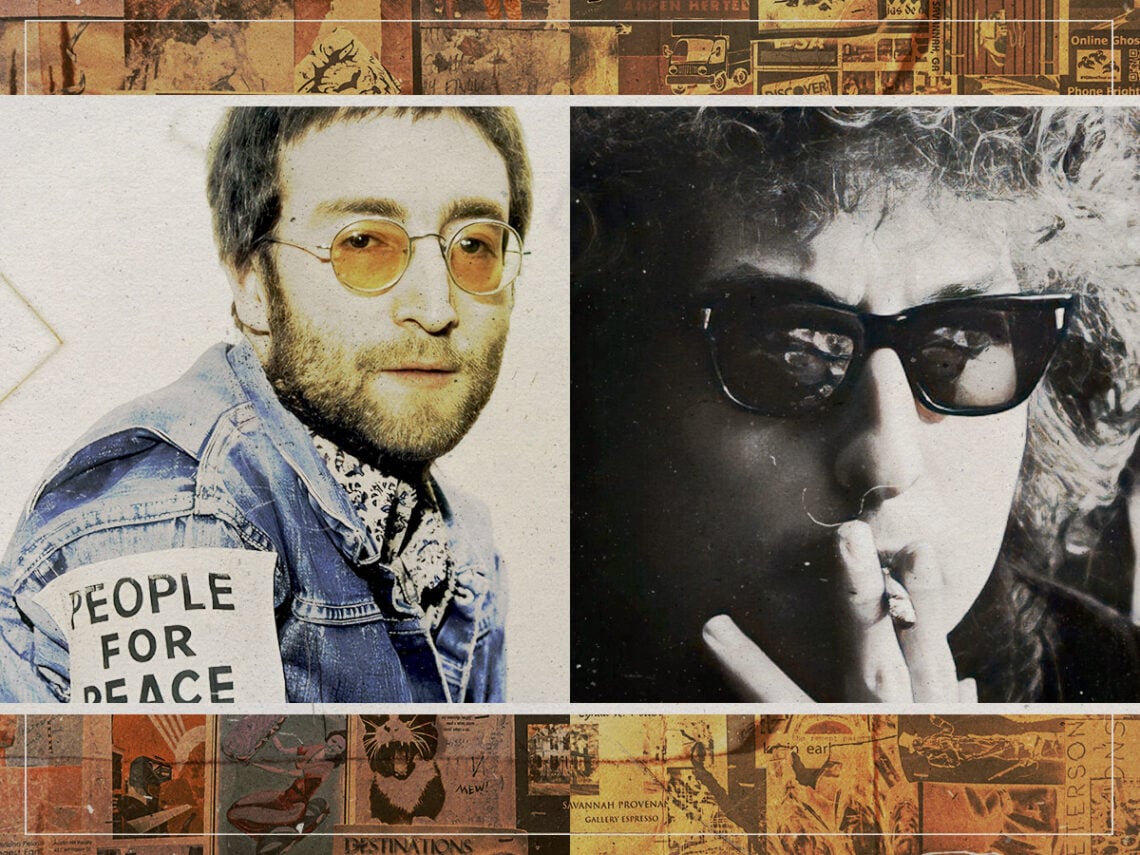
Bob Dylan and The Beatles – How John Lennon turned from hero-worship to a scathing attack: “Really pathetic”

Thinking of a world where Bob Dylan and The Beatles didn’t exist is a thought experiment akin to thinking of a new colour. Such was their all-encompassing impact on society, let alone culture; it pushes the mind towards inconceivable edges where imagination fails. In the 1960s, they picked the world up by the scruff of the neck and rattled it about like a coin in a washing machine. When the cycle was finished, nothing would ever be the same again. As the writer William S. Burroughs once declared, “Artists to my mind are the real architects of change, and not the political legislators who implement change after the fact”. In the case of luminaries like Dylan and John Lennon, that doesn’t seem as false as it might in these trying times.
Beyond their music, they are such notable entities in the cascading unfoldment of culture because of how supercharged and instant their impact seemed to be. Scholars of the arts might be able to look at nebulous movements like postmodernism and link them back to societal changes and so on, but any Tom, Dick or Harry from Timbuktu to Tahiti can look at The Beatles and Bob Dylan and say that when they came along something changed. Therefore, there has always been one question that has lingered over the seismic shift in sensibilities they lauded over the arts: how much of an impact did they really have on one another?
“He was our idol. It was a great honour to meet him; we had a crazy party that night we met,” a bemused Paul McCartney once said. “I thought I had gotten the meaning of life, that night.” He was, of course, referring to the night that The Beatles met Bob Dylan on August 28th, 1964, at New York’s Delmonico hotel. It was a meeting akin to something from Greek mythology, and the fateful offering of marijuana from Dylan to The Beatles is now ascribed in history as a moment that shaped a shift in their back catalogue.
Seemingly after a single toke of Dylan’s potent herb, the radio-friendly Fab Four were suddenly doused in a kaleidoscopic hue of psychedelia and spiritual edginess. While some artists might have tried to quell this narrative and suggest that they were heading in that direction anyway, The Beatles mythologised the meeting even further. It was always one of the band’s undeniable masterstrokes that at the dawn of pop culture, they understood the power of manipulating the press–building a lore for fans to devour beyond the music, one imbuing the other with greater transcendence.
While they had a team of people aiding this exercise, from the savvy Brian Epstein to Derek Taylor, who helped to launch them with a single live show review, John and Paul were masters in their own right. This was evidenced when McCartney proclaimed: “I could feel myself climbing a spiral walkway as I was talking to Dylan. I felt like I was figuring it all out, the meaning of life.” Suddenly, his fans were their fans and vice-versa, cross-pollinating to vital sides of the counterculture movement, rendering the pop more political and the politics poppier.
In truth, the musical influence of Dylan on The Beatles arrived long before any smoking sessions. Although Bob Dylan’s self-titled debut might have only featured two original songs, still trapped in folk traditions. However, his iconic follow-up in 1963, The Freewheelin’ Bob Dylan, liberated verses that captured the times and Dylan’s own emotional place within them that would revolutionise songwriting. In The Beatles Anthology, John Lennon explains: “In Paris in 1964 was the first time I ever heard Dylan at all. Paul got the record [The Freewheelin’ Bob Dylan] from a French DJ. For three weeks in Paris, we didn’t stop playing it. We all went potty about Dylan.” There is no doubt that after this period, the songs that the Fab Four were crafting became more complex, lyrically more probing, literature entered the picture, and even their haircuts were outwardly politically liberal. Hell, Lennon even started wearing a Breton cap, too.
This transition from wholesome pop ditties about holding hands wasn’t lost on Dylan either. When the iconoclastic folk star first heard ‘Norwegian Wood’, he recognised so much of himself in it that he even made a parody of the song called ‘4th Time Around’, which seemed to deliberately mock John Lennon. Listening to Rubber Soul, Dylan replied: “What is this? It’s me, ‘Bob’. [John’s] doing me! Even Sonny & Cher are doing me, but, fucking hell, I invented it.”
Another track that Lennon mentioned was spawned from his hero-worshipping of Dylan was ‘You’ve Got To Hide Your Love Away’ on Help!. “That’s me in my Dylan period again,” he happily declared. “I am like a chameleon, influenced by whatever is going on. If Elvis can do it, I can do it. If the Everly Brothers can do it, me and Paul can. Same with Dylan,” Lennon said about the track. Paul McCartney even took the term inspiration a step further in 1984 and claimed it was a direct imitation, stating: “That was John doing a Dylan… heavily influenced by Bob. If you listen, he’s singing it like Bob.”
However, this eulogising soon turned sour for Lennon. The ‘Smart One’ was never one to stay in the same lane for long. This gives his scathing turn a rather inevitable feel. John Lennon in 1966 might’ve been the folk star’s biggest fan, but as he grew older and Bob Dylan became a born-again Christian, the original vagabond fell out of favour with the rock ‘n’ roll messiah he had helped to spawn.

“So here we sit, watching the mighty Dylan and the mighty McCartney and the mighty Jagger slide down the mountain [with] mud and blood in their nails,” Lennon drawls into a dictaphone in 1979 before heading off to look for his slice of Scotland, where he has “always felt free”, within an hour of New York. However, his scathing tones are hardly the sort of chat you would associate with peace and love, residing somewhat closer to cynicism and scorn.
Sat at home – presumably from the bird twittering background noise, in some sort of outdoor space – Lennon records himself in a ramble during which he dissects the state of pop music and lambasts many of his contemporaries. “Well, I was listening to the radio,” he begins, “And Dylan’s new single or whatever the hell it is came on.” The track that he’s referring to is ‘Gotta Serve Somebody’, or as Lennon jokingly calls it ‘Everybody’s Gotta Get Served’, from Dylan’s 1979 record Slow Train Coming, the first in a series of born-again Christian records with heavy biblical overtones.
“He wants to be a waiter for Christ,” Lennon adds, laughing to himself. Thereafter, his critique becomes even more caustic. He adds,“The backing is mediocre […] the singing’s really pathetic and the words were just embarrassing.”
Later, he took this attack in a musical direction with his parody response to the demo ‘Serve Yourself’. Lennon sang: “You tell me you found Jesus/ Christ! Well, that’s great, and he’s the only one/ You say you just found Buddha?/, and he’s sittin’ on his arse in the sun?” The home-recorded satire, which you can listen to below, was first released in November 1998 as part of the John Lennon Anthology boxset.
Around the time that the home recording was made in 1980, Lennon remarked to David Sheff: “Anybody who wants to hear Dylan just because of who he is isn’t gonna understand what Dylan is saying now or then. They’re just following some kind of image. They’re the sheep anyway.”
He continued: “Still, the whole religion business does suffer from the ‘Onward Christian Soldiers’ bit. There’s too much talk about soldiers and marching and converting. I’m not pushing Buddhism, because I’m no more a Buddhist than I am a Christian, but there’s one thing I admire about the religion: there is no proselytizing.”
Lennon then clarified his own philosophy on the matter. “You have to think in terms of process,” he explained. “Relying on your own spirit is healthy. If Dylan is into Jesus because of needing to belong, whatever, perhaps the next step will be to see the good of the experience as well as the other side.”
The irony is that Lennon extolling his own beliefs so forcefully is in itself a form of agnostic proselytizing–as Macca would rather simply put it, another example of “too many people preaching”. However, this is, paradoxically, also an irony that wouldn’t have been lost on Lennon himself. While his brutal remarks regarding Dylan might prove startling to listen to when you consider the esteem he once held him in, duality is par for the course when it comes to music. Given its existence in music, it is, therefore, present in musicians, too. Lennon was aware of this and yielded duality as one of his strongest facets.
Arthur Schopenhauer, a German philosopher very much on Lennon’s radar, once stated: “The inexpressible depth of music so easy to understand and yet so inexplicable, is due to the fact that it reproduces all the emotions of our innermost being.” It would seem that Lennon has purged that innermost depth many times in songs that we all love. ‘Mother’ saw him embark upon primal screaming to exorcise the ghosts of his past. ‘Nowhere Man’ saw him extol his own anxieties. And ‘Jealous Guy’ saw him pronounce his own flaws and battle to fix them.
Likewise, it would seem that in this surfaced home recording from 1979, he was purging his innermost depth in a way that is a lot harder to listen to. This uglier side of the same coin that spawned a lot of his best music typifies his odd status: a messiah and a very naughty boy. Both of these are inseparable by virtue of his character and by design. After all, nobody records themselves on a dictaphone unless they intend for their words to be heard in posterity. In this regard, the bashing of Bob and a few more of his fellow contemporaries can be seen as a further piece of myth-making, another chapter to Lennon’s long lore. Which is something else he learned from the mystic Bob Dylan.

Never Miss A Tale
The Far Out Bob Dylan Newsletter
All the latest stories about Bob Dylan from the independent voice of culture.
Straight to your inbox.