


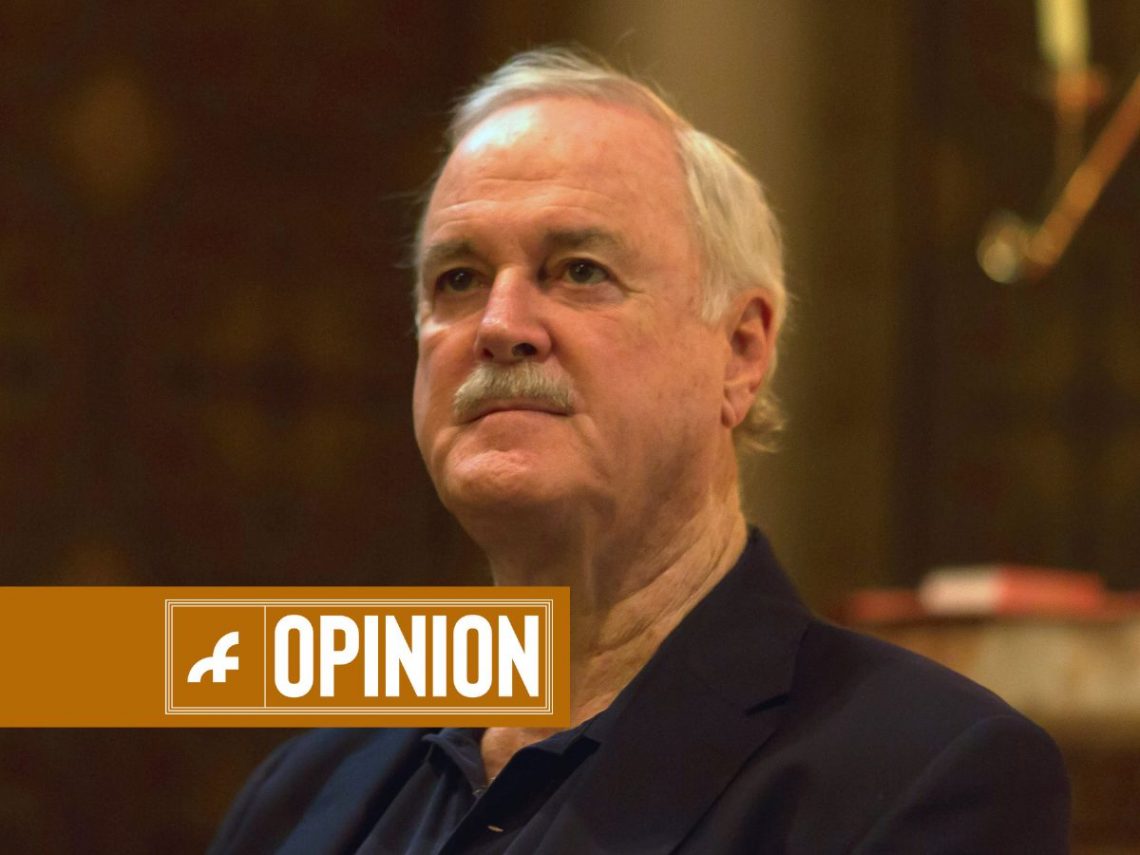
Why is John Cleese so obsessed with woke culture?

While in recent years, both Ricky Gervais and Dave Chappelle have defended the frontier of comedy from the onslaught of woke and cancel culture, one of the old guards of the art form has also made his stance, Monty Python’s John Cleese. The primary reason for Cleese’s attack on the consequences of wokeism is that he believes that it has a “disastrous effect” on creativity, which is the backbone of not just comedy but any artistic venture.
When Cleese was interviewed at FreedomFest in Las Vegas earlier this year, he said, “I think it’s particularly worrying at the moment because you can only create in an atmosphere of freedom, where you’re not checking everything you say critically before you move on. And a lot of comedians now are sitting there, and when they think of something, they say something like, ‘Can I get away with it? I don’t think so. So and so got into trouble, and he said that, Oh, she said that.’ Do you see what I mean? And that’s the death of creativity.”
For a long time now, millennia even, comedy has toyed with the very concept of wokeism, hitherto called ‘political correctness’. In a recent article, we examined the nature of comedy and argued that as far back as the ancient Greek theatre, comedy was primarily being used to examine the social values of society in an attempt to see what ought to be changed.
Cleese himself last year embarked on a journey of discovery about wokeism in a Channel 4 documentary entitled John Cleese: Cancel Me. Cleese said of the opportunity to make the documentary, “I’m delighted to have a chance to find out, on camera, about all the aspects of so-called political correctness. There’s so much I really don’t understand, like: how the impeccable idea of ‘Let’s all be kind to people’ has been developed in some cases ad absurdum.”
Evidently, cancel culture surrounding the realm of comedy is something that is close to his heart. Cleese had been the subject of cancellation when UKTV removed an episode of Fawlty Towers from streaming services. The episode in question had the cantankerous Major Gowen use a racist slur against the West Indies cricket team. However, Cleese felt that the scene of the episode was actually attempting to highlight the outdatedness, ridiculousness and futility of such views.
“If you put nonsense words into the mouth of someone you want to make fun of, you’re not broadcasting their views; you’re making fun of them,” Cleese said. “The major was an old fossil left over from decades before. We were not supporting his views; we were making fun of them. If they can’t see that – if people are too stupid to see that – what can one say?”
However, perhaps those old fossil views ought to be removed from entertainment platforms. It is beyond evidence that such words have caused deep offence to those that they have historically been aimed. Despite being under the guise of comedy, as Cleese says, only being there so the people who use them so wantonly can be derided, they have a historical context that cannot be ignored.
It’s admittedly a tricky situation that comedians such as Cleese find themselves in. Admittedly, creativity is somewhat stifled when the mind cannot freely explore itself without persistent interruption to check whether what is being written will offend someone. That’s not to say that comedy ought to be a case of ‘anything goes’, but rather that a certain level of initial freedom is necessary when creativity is called into question.
Cleese claims that political correctness “started out as a good idea, which is, ‘Let’s not be mean to people’, and I’m in favour of that.” He added, “The main thing is to try to be kind. But that then becomes a sort of indulgence of the most over-sensitive people in your culture, the people who are most easily upset. I don’t think we should organise a society around the sensibilities of the most easily upset people because then you have a very neurotic society.”
However, the real motive of political correctness is to begin to right some of the wrongs of our history, to move away from the oblivious language of our grandparents and Major Gowen, and into a brighter and kinder future.
Cleese evidently wants to join in the conversation. As a member of Monty Python, the performer predominantly laid the groundwork for the proceeding generations of comedy, but perhaps there is a layer of guilt over the touch-and-go themes found in his previous works. Then again, maybe he is genuinely worried about the future of comedy and the fact that its own ability to progress society is now in jeopardy. Or maybe he’s just desperate to be heard once more.
