


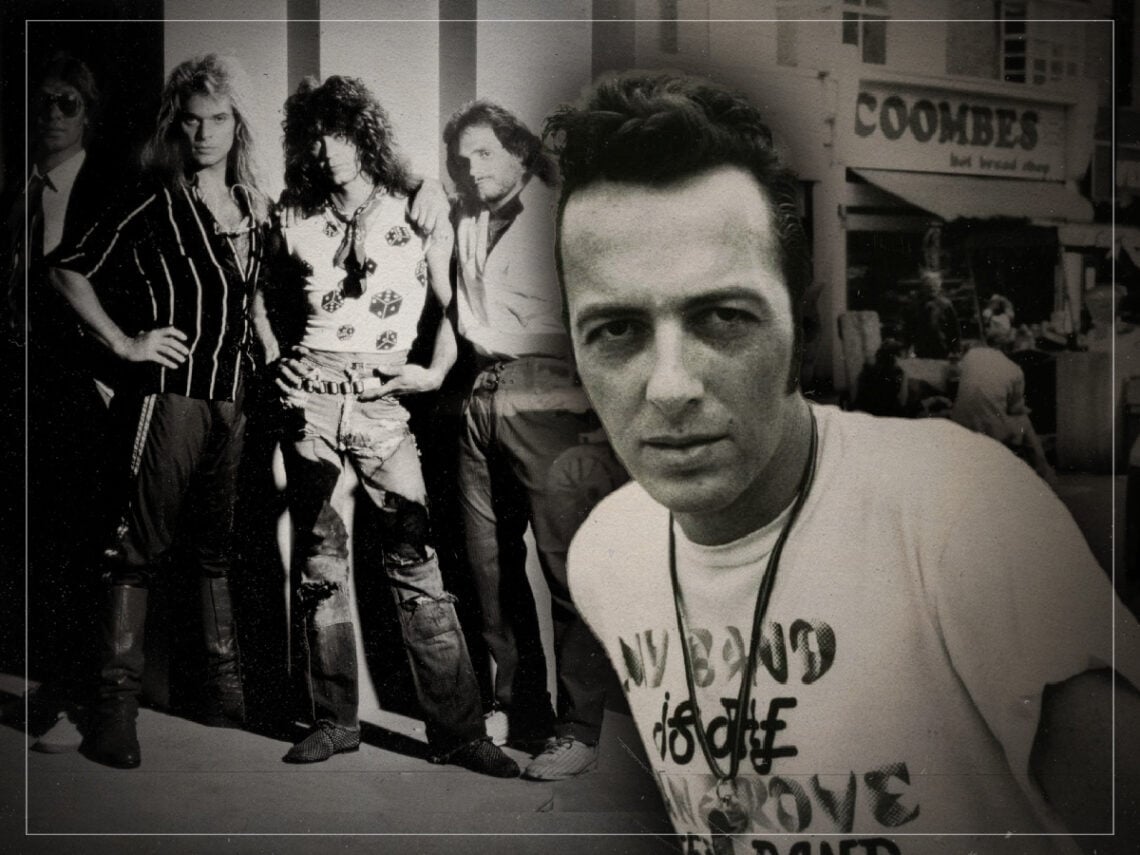
Joe Strummer’s scathing assessment of Van Halen: “That’s not rock ‘n’ roll”

By the mid-1980s, Joe Strummer might have felt like he was fighting a losing battle.
The political rebellion and idealism that had been at the core of The Clash’s music since their inception a decade earlier was hard enough to maintain in the face of unending Thatcherism; the changing state of popular music in the MTV age was a whole other obstacle. Strummer was determined to push forward, but he lost one of his most important allies along the way, opting to oust Mick Jones from the band in 1983 due to conflicting creative visions.
“I think we were getting boring on stage,” Strummer told the Atlanta Constitution in 1984, “It seemed like I was always by the microphone singing and playing rhythm guitar, and Mick was becoming a scientist with a lot of machines and a lot of times had his back to the audience while he fiddled with the machines.”
Strummer wanted to get back to the energy of the early Clash gigs, which he proudly remembered as “an eye-catching spectacle with people running around and jumping and getting excited”.
That type of punk rock spirit still existed, but it was now happening in small clubs in LA and Washington, DC, led by a new crop of hardcore bands with political notions even further to the left than Strummer’s. Those bands weren’t really competing with The Clash, though. As a major mainstream rock band in the ‘80s, Strummer’s central foes were basically the same ones he’d identified back in the early ‘70s: dull hard rock and metal acts.
“When we started, we’d set ourselves up against the heavy metal bands,” Strummer said, “And said ‘We are meaningful’. We took this snotty stand, and we had to back it up. Those heavy metal bands get out on the road a lot, and if we were serious and wanted to turn the music around, we’d have to match their work rate.”
Despite the success they’d experienced commercially with their previous album, 1982’s Combat Rock, Strummer seemed locked in on the idea that The Clash had lost their way. They weren’t playing enough gigs, the gigs themselves weren’t good enough, and the records were overproduced and overthought. “Guitars, bass, and drums,” he added, “That’s all I feel is necessary… We should use just that instead of all the electronics and overdubbing things”.
“It should be a lively, rebel kind of music,” Strummer continued, his mind drifting to the current crop of strutting, big-haired bands dominating MTV, adding, “I get distressed when it goes too pop and people call it rock ‘n’ roll. Without The Clash around, when people talk about wild rock ‘n’ roll, they’re talking about Van Halen, and that’s not rock ‘n’ roll as I knew it as a child, or what I want to play.”
For added historical context, Van Halen’s synth-driven single ‘Jump’ was the biggest rock song on Earth at this moment in time, and the song and its matching video were, quite possibly, the bane of Joe Strummer’s existence as he plotted The Clash’s course in tumultuous times.
“That kind of music has no morals,” Strummer said of Diamond Dave and the boys, “Some musicians don’t think about what they’re doing, and they don’t think people listen to their words and take them seriously. Well, they do. People take what you do seriously.”
In other words, David Lee Roth, you’d better be ready to defend why you’re hot for that teacher.
