


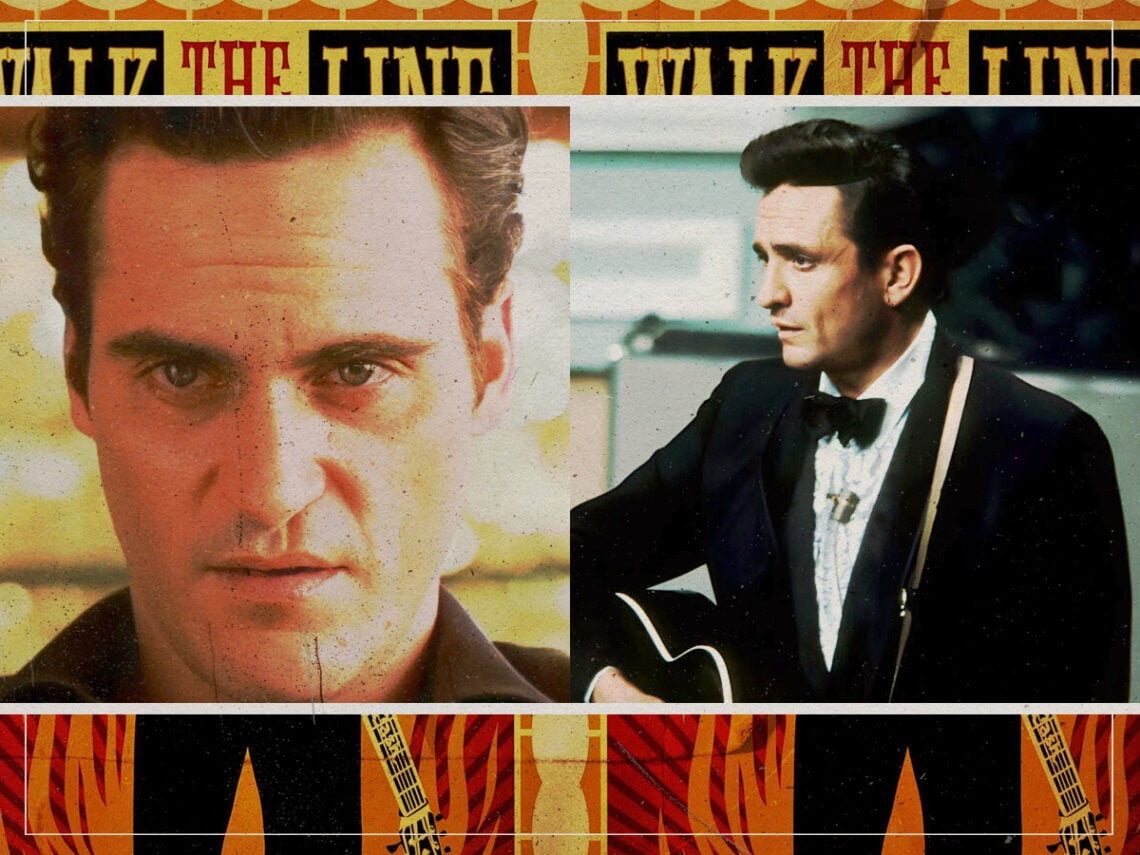
Joaquin Phoenix names his favourite Johnny Cash song

“A lot of stuff I do for a part,” Joaquin Phoenix once said, “People don’t even notice, but I notice, and it makes the character whole for me.” From Her and The Sisters Brothers to Ridley Scott’s Gladiator, this obsession with nuance and perfectionist look at performance has made him a household name. His often deeply flawed characters always have a semblance of humanity and a wealth of depth.
These performances have allowed Phoenix to prove himself as an actor, but one of his most memorable roles is arguably his portrayal of the legendary musician Johnny Cash in the 2005 film Walk The Line. Starring opposite Reese Witherspoon, Phoenix works the material to deftly tackle Cash’s life as a musician and his tragic addiction to drugs. Once more, he brings something unknowable under the surface to a star that the world thought they knew so well.
Johnny Cash had a long and fascinating career, but Walk The Line focuses primarily on his romance with June Carter. The film is ultimately a love story more so than a biopic. Phoenix underscores this in an interview for Indie London, stating: “John was trying to marry June Carter for like 15 years.” Even simply referring to him as ‘John’, which no other human has yet attempted, hints at the performative nature of Phoenix—one that made him the perfect fit to play The Man in Black.
It’s no surprise, then, that Phoenix himself is a fan of the country star. His knowledge of Cash was mostly based on the musician’s live album at Folsom Prison, though, as he stated, “To me Johnny Cash, what I first knew of Johnny Cash, it’s the Johnny Cash from the late ’60s.” Phoenix did go back and investigate Cash’s early recordings; however, they were presumably in the lead-up to Walk The Line.

Cash was a prolific musician who enjoyed extended periods of success throughout most of his career. However, he certainly experienced his share of ups and downs, particularly in the 1970s and 1980s, as he struggled with drug addiction. Despite these challenges, Cash released numerous records, firmly establishing his distinctive outlaw sound and leaving an indelible mark on the music world.
Cash’s many walking riffs and soulful phrases make up iconic songs such as ‘Folsom Prison Blues‘, ‘All Over Again’, ‘So Doggone Lonesome’, and, of course, ‘I Walk The Line’. None of which, however, Phoenix marks among his favourites.
Instead, Phoenix cites ‘Home Of The Blues’, a track released in 1958 that has Cash lamenting about losing sweethearts and wallowing at “the home of the blues”. The song puts the singer’s vulnerability on full display, something that Phoenix’s film aimed to emulate, and like Phoenix’s Walk The Line, ‘Home Of The Blues’ also centres around Cash’s struggles with loneliness and the pursuit of love.
‘Home Of The Blues’ isn’t quite Phoenix’s favourite, though, later naming ‘I Still Miss Someone’ as his most treasured Johnny Cash tune. Phoenix explains that the song’s presumed connection to June is what draws him to the song, saying, “I think that’s written about June, and in some ways, it really kind of encapsulates the isolation that John felt for much of his life.”
Released in 1958, the song details Cash’s inability to let go of a lost love as he comments on passers-by and his attempts to move on before ultimately crashing back into the realisation that “I still miss someone”. Like ‘Home Of The Blues’, it’s a song that taps into Cash’s vulnerability and, as Phoenix points out, the loneliness that Cash suffered from.
“I could just see John surrounded by the celebrity and the excitement of everything,” the actor says, explaining that in spite of the life of celebrity that Cash was enjoying, “He just goes into this private corner because he’s thinking about June and he just wants to be with her.”
Phoenix’s connection with Johnny and June extends beyond the music, though, with Phoenix detailing his meeting with the two as “totally unpretentious, down to earth”. Having met the couple himself, it’s no surprise that ‘I Still Miss Someone’ is Phoenix’s favourite: “That’s a really powerful, beautiful song”.
