


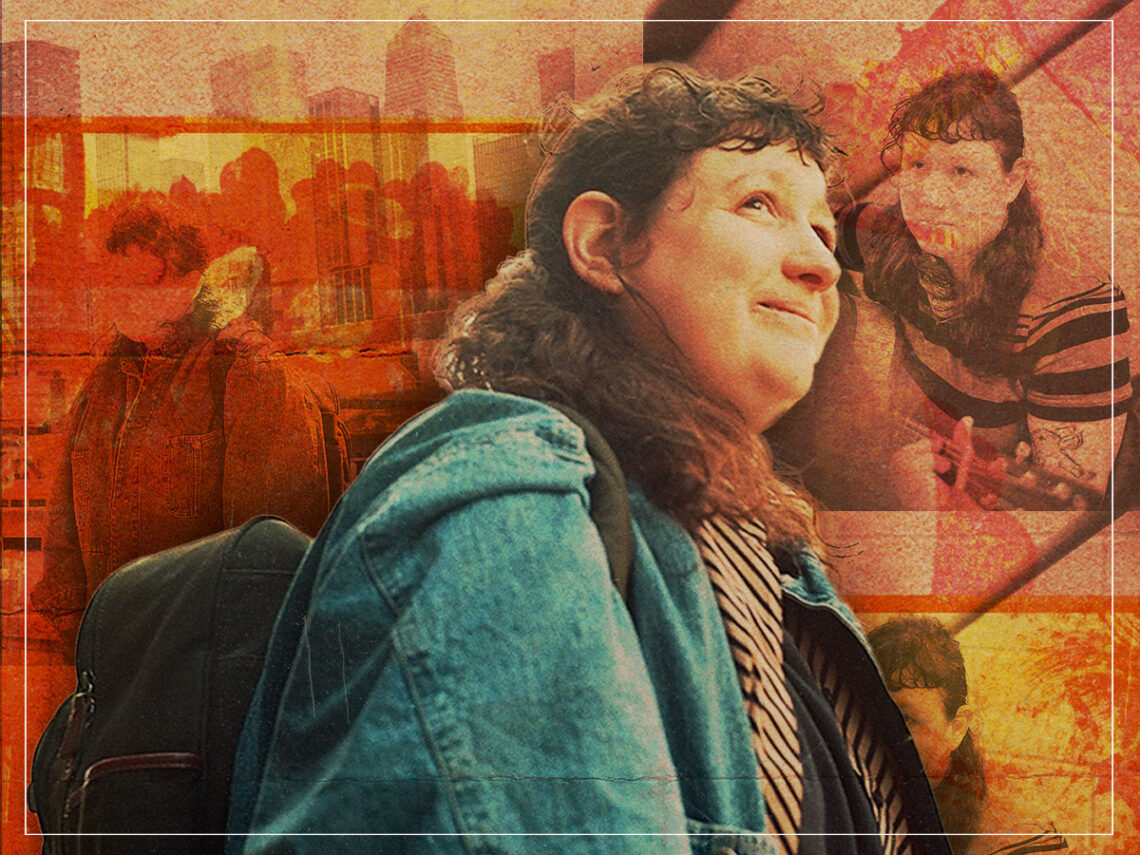
Joanna Sternberg’s dream is coming true: “That is why I write songs”

The view from New York’s Manhattan Plaza is incredibly humbling. Or empowering—depending on your mood. Not everyone understands the energy of the place, but there’s something about the slight glimpses of the Hudson River and the towering buildings that can make you feel both unbelievably small and as if anything is possible—a constant contradiction felt in the hearts of many of the complex’s creatives, including Joanna Sternberg.
Growing up, Sternberg didn’t know any different. With an artist father and a mother who appeared in theatre productions, creativity was everywhere. Sternberg’s childhood home, an apartment on the 40th floor of Manhattan Plaza, was a natural hub for those working in the creative industries, with a view that unsuspectingly became the backdrop for many of their own endeavours.
Throughout the 1970s, Manhattan Plaza would be called home by many high-profile inhabitants, including Charles Mingus, Tennessee Williams, Angela Lansbury, Dexter Gordon, Larry David, James Earl Jones, Alicia Keys, and many more—Sternberg is certainly not the first talent to grace the sanctuary in the skies. Still, Sternberg’s upbringing likely differs from those names to a fittingly quirky degree.
“I am very fortunate to have been born into a musical family,” Joanna explains. This is no word of a lie. Sternberg’s family are what they describe as “Yiddish Theatre Gods”, comprising grandmother Fraydele Oysher, great uncle Moishe Oysher, opera singer grandpa Harold Sternberg, comedian aunt Marilyn Michaels, and perhaps most importantly, their father. “My dad had always been the person I looked up to in terms of music,” Sternberg continues.
“He is an amazing singer, songwriter, and multi-instrumentalist. He would always play the guitar and piano, and when I was a toddler, I would crawl into his open guitar case.” Naturally, Sternberg’s first influence—and the one that’s remained a pulsing constant throughout their life—is their father. From there, however, the whirlwind of discovery was insurmountable. “There are home videos of four-year-old-me dancing around the apartment as Little Richard, Chuck Berry, and The Beatles records are blasting on the stereo,” Sternberg recalls.
“I wanted to be like my dad and play music,” the singer continues. “The Beatles have always been my obsession, and I always dreamt of being able to write and sing my own songs, but the main moment that started my relationship with music was a lucky random event. I was one or two years old, and our small family came together at my auntie’s house for Passover. Suddenly, everyone heard a little voice humming. I was humming a very complex melody, which they were all amazed by, including my grandfather, who was a singer in the Metropolitan Opera for 40 years, and my grandmother, who is my favourite singer who ever lived.”
The melody, which was the theme of Mickey’s Christmas Carol, has many “jumps and unexpected turns”, Sternberg explains. Their family was so impressed that they turned to friends for advice on what to do. Clearly, the world needed to hear Sternberg’s voice, and so that’s what they set out to achieve: “They decided to send me to piano lessons at the Suzuki School For Strings,” Sternberg shares. “That was the beginning of me and music”. It seems everyone has a creative destiny in the Sternberg clan and music was steadily marking itself as Joanna’s, but arriving at the point where it becomes a profession was far from easy.

Of course, learning that you have talent is one thing, but building your own community is another. “I frequently lose belief in myself,” Sternberg explains, which is particularly hard to hear knowing the quality of talent at hand. Artists are often their own worst critics, and Sternberg probably knows that better than most. However, the singer explains that one thing that helps is not thinking too much, as does ignoring that little voice in your head that tries to tell you that you’re not good enough.
“I intentionally block out the option to ponder what my style is,” Sternberg explains. “That is probably because I would feel the imposter syndrome of not doing whatever genre it is correctly. Also, I just love all music and really do not like to separate it into categories. When I play instruments to accompany or jam with other musicians, I do everything I can to stay within the bounds of whatever style we are playing in, but I definitely do not follow the rules and do unconventional things. I just be myself and play like myself, and it comes out that way.”
Thankfully, being creative means constantly having multiple avenues of outlet and streams of inspiration. For Sternberg, many sources of influence exist, including “people and sounds and smells and textures and TV shows and movies and books and plays,” but when the time is right, letting it flow often feels like the most natural thing in the world. Sometimes, it even happens in a dream.
‘She Dreams’, as the name suggests, was a song born out of one of these moments. “I woke up and ran to the bathroom to sing the melody into my phone’s voice memos,” Sternberg tells me. “Sometimes, I get melodies when I wake up from dreams, but most of my songs come from melodies that pop into my head at random times of the day or night.” Of course, Sternberg sometimes writes a song as a way of releasing pent-up energy, but the best approach is when it all comes pouring out without any coaxing.
“When I hear music that inspires me, I grab my guitar and immediately start coming up with a melody with simultaneous words,” Sternberg adds. “The issue is only when I get too burned out and depressed to even attempt to be inspired. Being inspired gives you energy, but it also takes a certain amount of energy to be in the mindset of being ready to receive.”
Writing from personal experiences is what makes Sternberg feel truly inspired, and being trustworthy and personable is a superpower, no matter how much it may feel like the opposite. In the music industry, artists can feel easily swept away, and Sternberg is always open to making friends, even if the feeling isn’t mutual. “I am wanting to be friends with every person I meet,” the singer admits. “I’m not joking. People only really wanted to start being my friend once I got decent at playing music.”
Growing up around a family of creatives might seem like an incredibly populous and crowded atmosphere, one that constantly incites inspiration and makes you feel like you belong. In Sternberg’s case, however, a lot of loneliness began to creep in at the same time, and friends were difficult to come by, potentially due to the inherently isolating nature of the hub they called home. This made something that seemed like a family destiny, a tricky, lonesome pursuit.
When they began to make music and started to enjoy small successes, this all changed. This is not lost on Sternberg, who finds that, while some things never pan out the way you wanted or expected, you can always find a way to appreciate the experiences, even if it’s merely the source of inspiration they provide. “Without [those people], I wouldn’t have had any of the experiences that inspired me to write songs,” they explain.
As the human condition decrees, however, this transition didn’t stop the musician from wondering how different things could have been. “I wonder,” Sternberg entertains the thought, if only briefly, “If I still would have written songs if I hadn’t had the change in suddenly available friendships…”

The external network isn’t the only thing that poses challenges—and rewards. Sternberg is also an exceptionally talented artist away from music, often living in a creative haze between sketches and songs. “The way I see it,” Sternberg explains, “Is drawing is like being on land, and music is like being underwater.” A stark comparison with even starker connotations.
“It takes a lot more energy to be underwater, and there are certainly scary creatures in there,” they continue. “There are scary creatures on land, too, but at least you can breathe and walk around. Music is a release of energy for me, and drawing gives me energy because I can be calm and in my thoughts in solitude.”
This yin and yang is where their songs are borne. “Those are songs I have saved up over the years for making my dream record,” the singer exclaims, noting the exhausting process of creation. “In an amazing studio, with an amazing record label and an amazing producer and engineer, with me playing all the instruments.” Throughout I’ve Got Me, Sternberg delivered an impressive feat, contributing the cello, violin, piano, drums, double bass, electric bass, guitar, and, of course, the cherry on top of the cake: vocals. “We finally were able to create the perfect setting for this dream of mine to come true,” Sternberg states.
“Those are songs I have saved up over the years for making my dream record,” the singer exclaims, noting the exhausting process of creation. “In an amazing studio, with an amazing record label and an amazing producer and engineer, with me playing all the instruments.” Throughout I’ve Got Me, Sternberg delivered an impressive feat, contributing the cello, violin, piano, drums, double bass, electric bass, guitar, and, of course, the cherry on top of the cake: vocals. “We finally were able to create the perfect setting for this dream of mine to come true,” Sternberg states.
While the actual process itself was like nothing they had ever done, it isn’t just about the ways it all came together: whatever they do, whoever they meet, Sternberg always strives to “help people feel better”. In fact, above all, Sternberg explains that “the biggest compliment and honour I can get is when someone tells me that my songs have helped them in some way. That is why I write songs.”
The Manhattan skyline might have occupied Sternberg’s peripherals more times than even they can count, but the impact of their music glides much further than the familiar space around them. Even as Sternberg began to find their own voice in the early days, attempting to mimic artists like Nina Simone to try to conceal the false impression of having no voice at all, the only thing that felt worth it was the dream of it all.
Being kind isn’t a difficult quality, but helping others to the extent that they have, and to do so while still figuring it all out, is an extraordinary achievement. Sternberg’s own personal influences could go on for “pages and pages”, but so too could the number of people the artist has helped with their own intimate musings about the strangeness of life and its relationships. Sternberg often mentions the concept of luckiness, unaware of the sheer artistry at the crux of it all. One day, hopefully, the artist will shun the imposter syndrome for well-deserved pride.
But for now, it’s one step at a time. “My brain can only do one thing at a time,” Sternberg admits. At the moment, their mind is gearing up for touring on the West Coast before gracing festival stages, but soon enough, the cycle of songwriting will begin again. “I am looking forward to a period where I can solely focus on songwriting,” Sternberg says. “I have a lot of songs I need to finish!”
