


Joan Didion’s favourite band: “Missionaries of apocalyptic sex”

In the 2017 documentary Joan Didion: The Center Will Not Hold, the author and her nephew-director Griffin Dunne are seen discussing The White Album, her 1979 essay collection comprising 15 vignettes written across the 1960s, detailing Didion’s trials and tribulations as she navigated crossing paths with artists, politicians, radicals and more during the counterculture era of California.
In one section, she finds herself in a sound studio watching The Doors record Waiting for the Sun in 1968, where she cheekily responds to Dunne’s query about what drew her to the band, with “Bad boys”. With Jim Morrison at the helm, The Doors carved a dangerous strain of rock ‘n’ roll that rocked the dominant hippie ideology to its core. They were not phased by peace and love; they wanted chaos, chasing a transcendence of reality and exploring a strange, subconscious trip. Both provocative and philosophical, the rock ‘n’ roll poetry of Morrison and co came to soundtrack California.
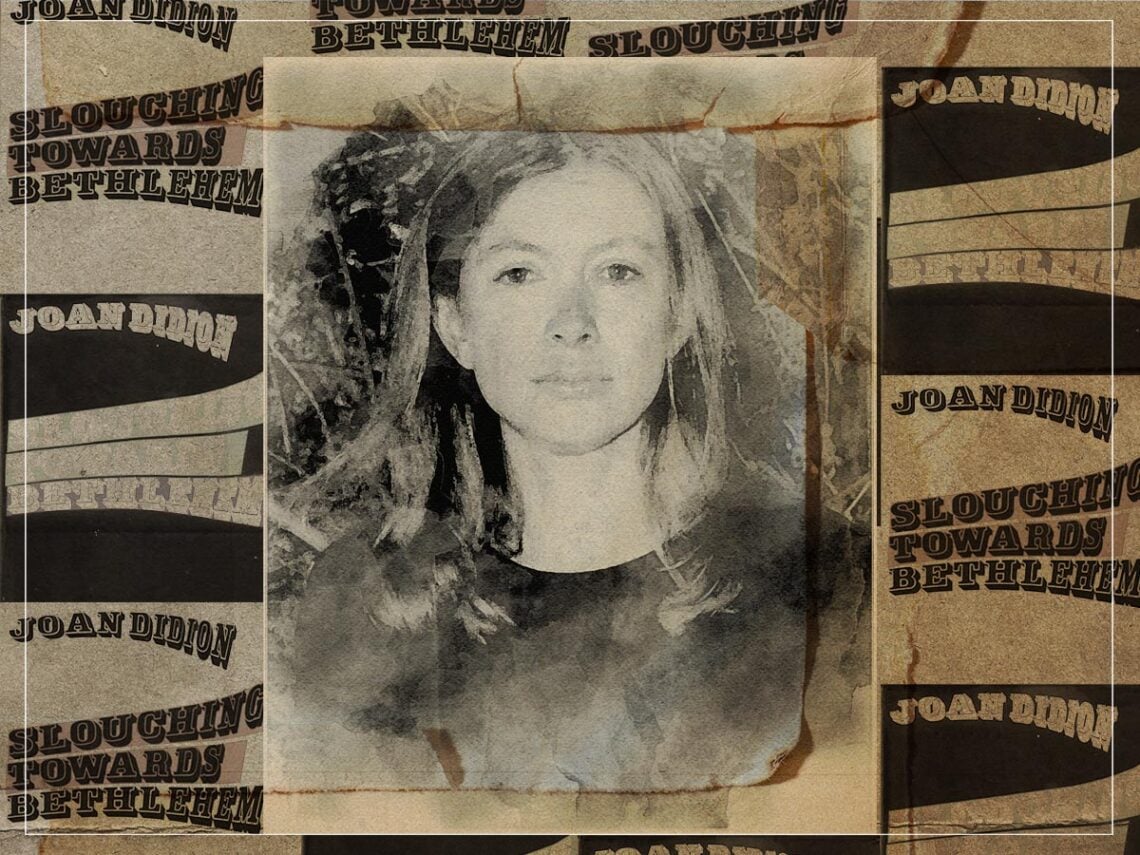
“Rock and roll musicians are the ideal subject for me,” Didion tells Dunne, “They would just lead their lives in front of you”. However, The Doors were not the first musicians she found herself intrigued by, as she makes clear in The White Album, noting, “my attention was only minimally engaged by the preoccupations of rock-and-roll [sic] bands”. She’d profiled Joan Baez for the New York Times in 1966 and wandered into a Grateful Dead rehearsal while travelling through San Francisco’s Haight Ashbury (both pieces would later appear in her previous essay collection, Slouching Towards Bethlehem), but in Didion’s eyes, The Doors were different, representing a shift in the cultural consciousness that was undeniable.
The Doors’ section of The White Album begins: “It was six, seven o’clock of an early spring evening in 1968 and I was sitting on the cold vinyl floor of a sound studio on Sunset Boulevard, watching a band called The Doors record a rhythm track.” Immediately, we are put in the room with a petite Didion engulfed by speakers, instruments and soundboards, eyeing the clock and waiting for something of interest to happen. Yet, we get a rare glimpse not of the journalist, but the fan within the writer.
“The Doors were different, The Doors interested me,” she wrote, “The Doors seemed unconvinced that love was brotherhood and the Kama Sutra. The Doors’ music insisted that love was sex and sex was death and therein salvation. The Doors were the Norman Mailers of the Top 40, missionaries of apocalyptic sex.”
Didion also understood that there was more to them than a pretty-faced singer and melodic songs; she sensed something pivotal hidden in their music, something that piqued her curiosity. She once said, “I have always found that if I examine something, it’s less scary”, hence in The White Album, Didion examines The Doors in a way that they hadn’t been before. She meditates on Morrison, who is conveniently late to the recording session, describing the singer as “a 24-year-old graduate of UCLA who wore black vinyl pants and no underwear and tended to suggest some range of the possible just beyond a suicide pact”. Ever-attentive to details, Didion poignantly recognises the sadness that lurked behind Morrison’s attitude, almost foreshadowing his demise just as he began, well aware of his reputation tarnishing his mystique from alluring to hedonistic.
Didion also acutely picks up on the tensions between Morrison and his bandmates, describing the session as an “uneasy symbiosis”, noting keyboardist Ray Manzarek’s evident frustrations, hunched over a Gibson keyboard. “You think Morrison’s going to come back?” Didion recounts him asking to no one in particular, “So we can do some vocals?” When the elusive frontman finally appeared, she picked up on how his arrival went unacknowledged, even after an hour, when no one seemed inclined to talk to him.
Stuck in the middle of their tension, Morrison broke their silence by suggesting a future rehearsal plan to Manzarek in a near-whisper. With half an ear to the surface-level conversation, Didion counted the knobs on the electric console, closing her essay with a keen eye on the frontman, who was seated on a leather couch. “He lit a match,” she wrote, “He studied the flame awhile and then very slowly, very deliberately, lowered it to the fly of his black vinyl pants”.
Her description of the scene, coupled with the overarching vibe of the space, which felt like a permanent stay, personifies her experience of one stuck in limbo, caught in one of The Doors’ rock ‘n’ roll trips. The difference now, however, was that Didion saw straight through their veil, asserting, “It would be some weeks before The Doors finished recording this album. I did not see it through.”
This section of The White Album remains one of the most evocative pieces of rock journalism ever written. Without recording a word of dialogue she shared with the band members, Didion personifies each member acutely; each is characterised as passive, not rude or dismissive of her, but stuck in their own realm. In a few paragraphs, she managed to chronicle one of rock’s most polarising bands in a way that no journalist ever could, with the essay standing a stellar display of her cool-toned craft and a record of her love for the band with always a crtitcal eye.
