


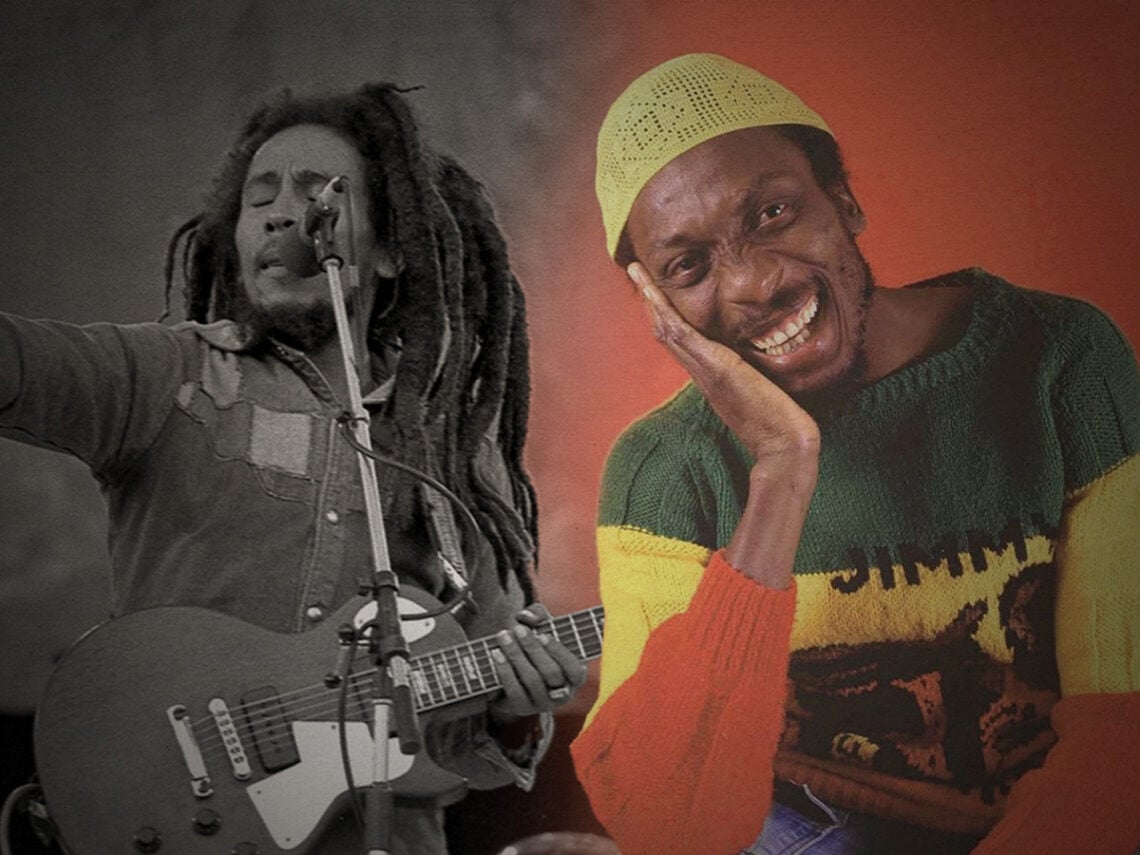
How Jimmy Cliff helped Bob Marley secure his first record contract: “He passed through my hands”

It is nigh on impossible to think of the reggae realm without immediately being drawn to the sight and sound of Bob Marley, the undisputed king of the genre and Jamaica’s greatest musical export. Without the similarly pioneering sounds of Jimmy Cliff, though, the world might never have known Marley’s name.
Ska and reggae music were the sounds of independence in early 1960s Jamaica, blending the distant sounds of American R&B with their own distinct national identity. In the days before that movement blossomed across the globe, infecting the sound systems of everywhere from Brixton to Baltimore, the music scene of the Caribbean island was fairly small and fairly tightly-knit, leading virtually every future reggae hero to rub shoulders at one time or another.
It was during his teenage years that Jimmy Cliff cut his first recordings on the island, forming the humble origins of what would eventually become an incredible discography of groundbreaking reggae mastery. Back in those early days, though, the very best artists weren’t just performers; they were also talent scouts, producers, and A&R people all rolled up into one. So, when Cliff signed on with Leslie Kong’s Beverley’s Records in 1961, he was also tasked with seeking out new talent for the label.
Cliff, to his credit, had an unbelievable hit rate when it came to sniffing out that musical talent. Not only did he audition Desmond Dekker, who would later go on to become the first reggae artist to reach the top of the UK singles charts with his 1969 masterpiece ‘Israelites’, but he also discovered Bob Marley.
As the late songwriter once recalled to Uncut, “He [Marley] was sent to me by Desmond Dekker, who I had auditioned earlier. He got his song recorded, so he went and told Bob, as they both used to work at the same place, as welders.” According to Cliff, Marley’s music power was immediately evident.
“Bob Marley walked in like somebody who was in a hurry to get somewhere,” he continued. “I sensed he was a very rhythmic person, and very aware of the power of words – that told me he would be a star.” Cliff added, “It’s a good feeling to know that he passed through my hands.”
That rushed audition culminated in Marley’s first-ever single, ‘Judge Not’, released under the less catchy name, Robert Marley and Beverley’s All-Stars. Although it could hardly be considered among his greatest recordings, that unlikely record was the starting pistol for one of the most beloved, important discographies in musical history.
Impressively, the career crossover between Marley and Jimmy Cliff doesn’t stop there, either. Years later, when Cliff was coming to the end of his time at Island Records, after almost single-handedly establishing that label as the de facto place to go for reggae excellence, a replacement was needed for Island’s roster. Needless to say, it didn’t take long for Chris Blackwell to identify Bob Marley as that replacement, thus giving a global voice to the legendary songwriter.
Today, both songwriters sit as the only two Jamaican artists in the Rock and Roll Hall of Fame, having between them successfully carved out a space for rocksteady rhythms on the worldwide stage. Seemingly, though, that might have never happened had Marley not taken some time off from his welding job to meet with Jimmy Cliff all those years ago.
