


‘Mountainhead’ movie review: Jesse Armstrong’s ‘Succession’ follow-up is a razor-sharp take on tech culture that already feels dull

When Jesse Armstrong closed out season four of the wildly acclaimed HBO show Succession, everyone wanted to know what he’d be doing next. After cutting his teeth on Armando Iannucci projects like The Thick of It and In the Loop, he struck gold with his Murdoch-coded Shakespearean drama about the Roy family and the ownership of their media dynasty. Armstrong’s next move, it turned out, was an HBO movie called Mountainhead, which was released earlier this week. This time, the writer set his sights on the world of tech bros, and the results are spectacularly messy.
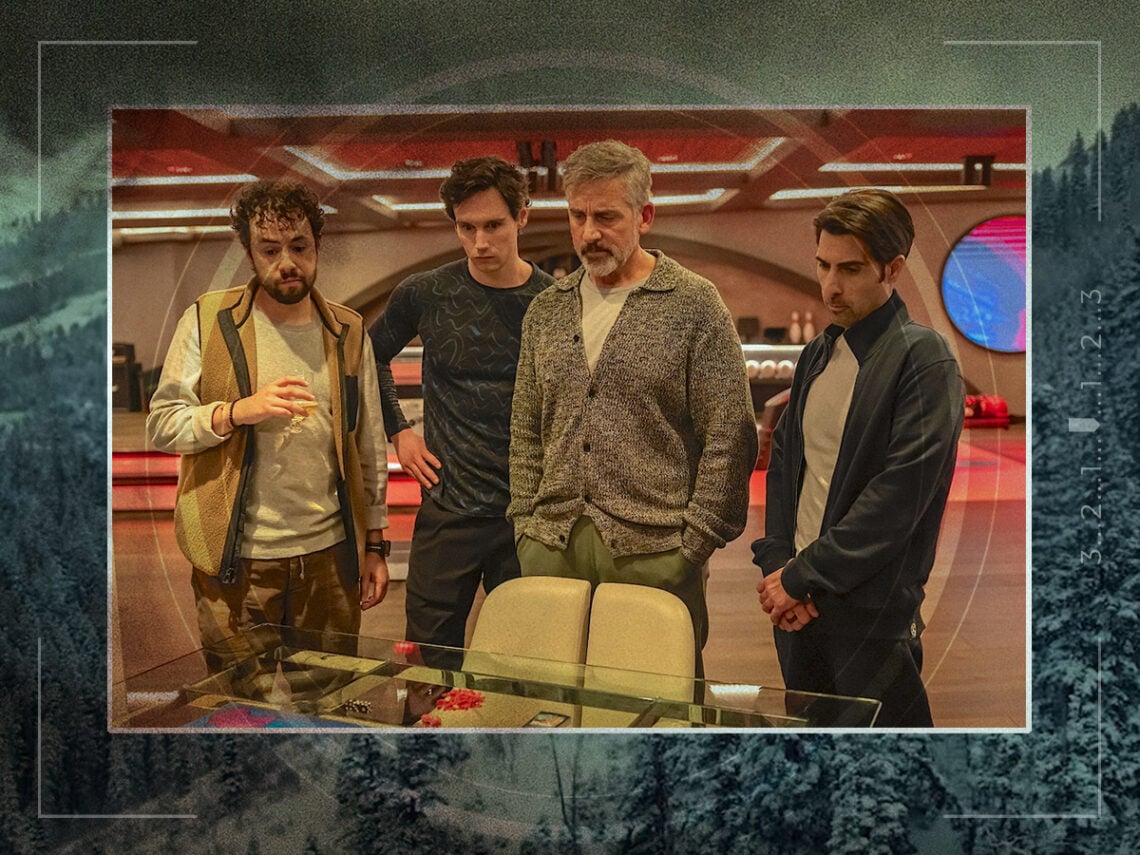
Taking a cue from the single-location set-ups of movies like 12 Angry Men and Rear Window, Mountainhead takes place almost exclusively at a sprawling mountain estate in Utah where four tech moguls spend a weekend while the outside world teeters on the brink of all-out chaos. Steve Carell plays Randall, the oldest member of the group, a telecoms billionaire who has just disregarded yet another diagnosis of incurable cancer. Cory Michael Smith plays Venis, the owner of a social media platform called Traam, and casually the richest member of the friend group by a couple of hundred billion. When the film starts, he hits ‘go’ on a set of new features on the app that proliferate deepfakes and disinformation and cause global turmoil. Ramy Youssef plays Jeff, the founder of an AI company prospectively offering guardrails for Traam, if the two can strike a deal. And Jason Schwartzman plays Souper, the owner of Mountainhead and the pauper of the group, with a scant $550million.
The thesis of the film—and it certainly feels as though it was built around a thesis more than anything—is that none of these men are serious people. They live in an echo chamber, big themselves up with insider lingo like ‘first principles’, ‘P-doom’, and ‘decel’, and casually discuss taking down the US president (‘couping it out’). As they scroll through Traam and watch cities burn, all Venis wants to talk about is how crisp the images are, while Randall simply says, “Think of all the people who aren’t killing each other”.
Ultimately, the group’s tentative scheme for global domination is sidelined by Jeff, who voices the faintest suggestion of dissent and draws on the violent enmity of the others. As is usually the case with Armstrong, it’s the dialogue that steals the limelight rather than the plot. All of the men are mashups of Roman, Connor, and Kendall Roy from Succession, with plenty of Musk-y references thrown in for authenticity. It’s a razor-sharp script (literally, at one point), but it is also painfully on the nose.
We’ve been living in a technocracy for a while now. Social media platforms have facilitated global uprisings, spread hate speech, attacked free speech, and stoked polarisation. Elon Musk brandishing a chainsaw during a conservative political conference is a parody of himself, a deeply unserious person who wields more power than anyone else in the world. Mark Zuckerberg, Sam Altman, Peter Thiel, Jeff Bezos, and their ilk have been sowing hate and inequality while amassing power and complaining about woke culture. They are their own parodies. The characters in Armstrong’s film could never outdo their real-world malevolence and absurdity, which we have already gotten so used to, we don’t even bat an eyelid these days. An issue, perhaps not just with the film, but how the world turns today.
Mountainhead, which is named, of course, after Ayn Rand’s libertarian battlecry, The Fountainhead, bears greater similarities to The Thick of It than Succession, presenting a group of people who wield an enormous amount of power but are buffoons parading themselves as masterminds. There is no secret to their wealth. They are merely the lucky winners of the game of inequality and inheritance. This perspective checks out. You need only scroll through Musk’s tweets to realise just how unserious and demented he is. He exists in the real world, unfortunately, and provides all the word salad and bombast that a comedy writer could ever need.
Beyond some vintage one-liners and stellar performances, Mountainhead is a pretty limp affair by comparison, especially when all pretence at real-world implications is supplanted by interpersonal melodrama. In a few decades, it might serve as a hyper-specific time capsule of the year 2024, but in 2025, it’s more of a sophisticated Saturday Night Live sketch than anything else—keenly observant, but not particularly revelatory.
