


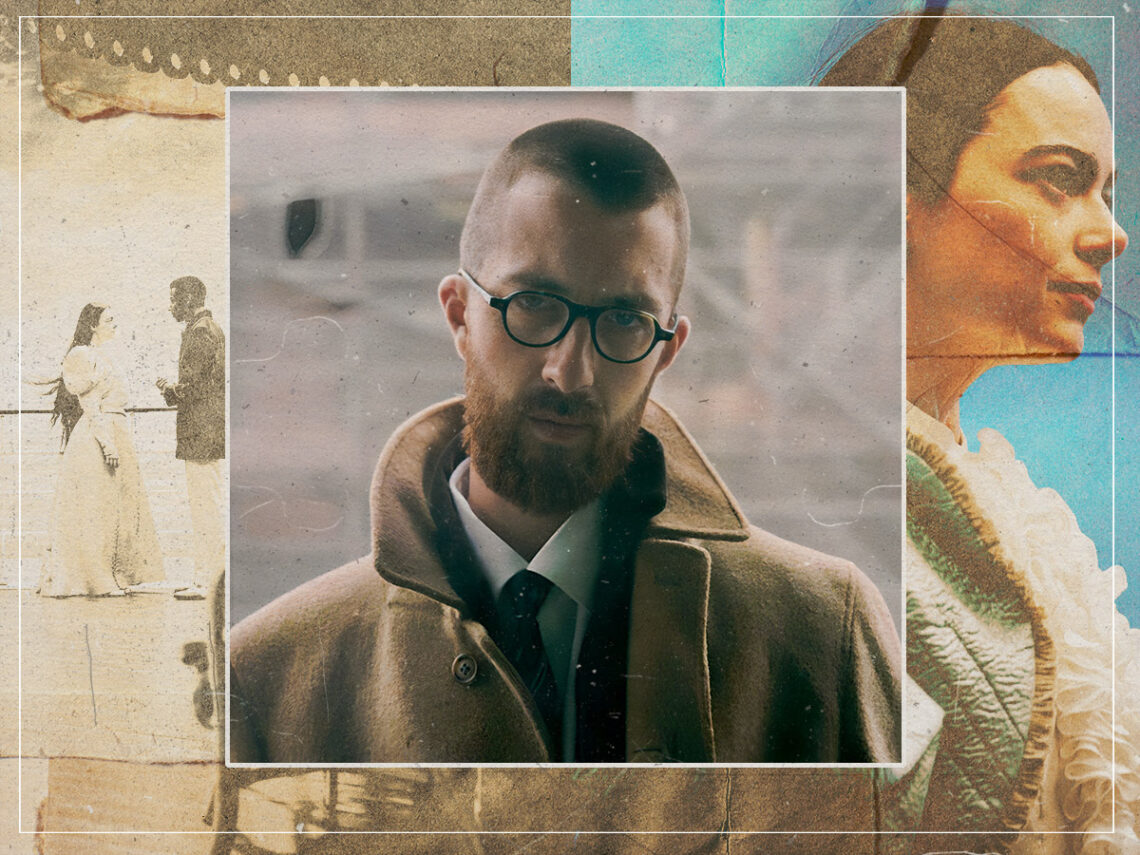
How Jerskin Fendrix gave the ‘Poor Things’ score a contemporary pulse

“Two suitcases full of black hair,” Jerskin Fendrix, otherwise known as Joscelin Dent-Pooley, sings on an early solo song, “… black hair, honey, on the condoms in your purse”. His baritone voice pervades through a reverberating bass and an unsettling sample before plunging into unusual synths and strings. ‘Black Hair’ proves his rightful place in the contemporary alternative scene, but it also contains lyrics that could just as easily be applied to the subject of his latest creative endeavour: Bella Baxter in Yorgos Lanthimos’ Poor Things.
The latest offering from Lanthimos stars Emma Stone as Bella, a Frankenstein-esque figure with the world at her feet. Long black hair trailing behind her, she embarks upon a voyage of retrofuturist Europe, darting between countries with as much abandon as she switches up sex positions. Though the film often fails to deliver on its feminist promises, seeming to conflate sexual exploitation with liberation, it’s a masterclass in production, unparalleled in its visual and sonic prowess.
At the centre of the latter, you can find Dent-Pooley. A classically trained former Cambridge student and a staple in the beloved Brixton Windmill scene, the multi-talented instrumentalist has previously split his time between hyperpop production, Black Midi collaborations and the opera. Now, in the mirror image of Bella, he has taken his first steps into a new world: film composition.
For an artist with only an album of “dumb pop songs” to his name, as Dent-Pooley self-described his 2020 debut Winterreise to the LA Times, Poor Things seems like a behemoth of a first cinematic project. With Lanthimos and Stone’s names attached, alongside supporting performances from Mark Ruffalo and Willem Dafoe, expectations were lofty.
Despite honing one of the most off-putting filmmaking styles in contemporary cinema, Lanthimos has amassed a devoted cult following around the premises of tragedy and taboo. From the dystopian commentary on modern dating depicted in The Lobster to the slightly more playful and accessible The Favourite, his commitment to the weirdest areas of storytelling has won him a devoted audience.
Although Lanthimos has eight directorial credits to his name and a crowd of cinephiles waiting on his next offering, the Greek director has never previously worked with a composer. Accompanying music for his movies has often been dominated by classical compositions, with the occasional exception — shout-out to the impossibly awkward cover of Ellie Goulding’s ‘Burn’ featured in The Killing of a Sacred Deer.
Like Bella, and like Dent-Pooley, original scoring is a world Lanthimos was yet to discover until Poor Things. Perhaps this, alongside his penchant for the peculiar in modern art and his auteur-like artistic control, played into Lanthimos’ decision to hire a completely underground musician with no previous scoring experience.
“He’s obviously a very singular artist and he goes about things in an unorthodox manner,” Dent-Pooley suggested, “And for him to have this really big project with Searchlight and then decide to choose someone who’s basically just released an album of dumb pop songs to do it – there’s something kind of mischevious in that.” It’s a sense of mischief that’s reflected both in the story of Bella and in the music that accompanies her dalliances and travels.
Tasked with creating a score before shooting had even begun and given no other musical reference points, Dent-Pooley relied on scripts and concepts to bring Bella’s story to life. Bringing the awkward angularity of his solo work into the studio, he fused the classical and the contemporary by warping and layering instruments such as flutes, oboes, and organs.
At once endearing and eerie, it’s a mischievous take on the classical score, one a more experienced composer might never have been able to realise. Infused with the naivety and youthful spirit of Bella and of upcomer Dent-Pooley, it’s the sonic equivalent of seeing and adventuring such a fantastical world for the first time.
It’s also infused with the art of experimentation, which lies at the heart of the story of Poor Things and at the heart of Dent-Pooley’s artistry. Just as Dr Godwin Baxter, also known as God, experiments with life in the operating theatre, Dent-Pooley experimented with it in the studio, hoping to emulate it within his compositions and truly give the soundtrack a contemporary pulse.
“I was really interested in wind instruments and breath as a musical idea,” he told Classical Post, “Breath and life are inextricably tied up, so giving the impression of something which isn’t sentient or alive replicating anything that is alive sets off a really primal, fear-based instinct, something which is preternaturally horrifying.”
The result is a score which is at once horrifying and impossibly human, beautiful and terrifying, like the world around Bella. Poor Things is constantly looking forwards and backwards – in its retrofuturist surroundings, in its blurring of life and death, in its flitting between childhood and adulthood. In its source material, Alasdair Grey’s novel of the same name, even darts between truth and fiction. So why not also apply this same marriage of the old and new, the dying and the reborn, to its musical accompaniment?
Between classical instrumentation and weird, Windmill-born influences, Dent-Pooley achieved exactly that, creating a score that would embody the atmosphere of Poor Things from its very first trailer. Lanthimos’ choice to hire a completely inexperienced composer was a brave one, but ultimately a great one. Perhaps he knew that there was nothing that sounds quite like Winterreise and, as a consequence, there would be nothing that sounded quite like the Poor Things score.
With his penchant for the peculiar and for sonic storytelling, Dent-Pooley seems set to become a highly in-demand original composer within film, but it wouldn’t be surprising if he dipped his toes into another entirely new world instead.
