


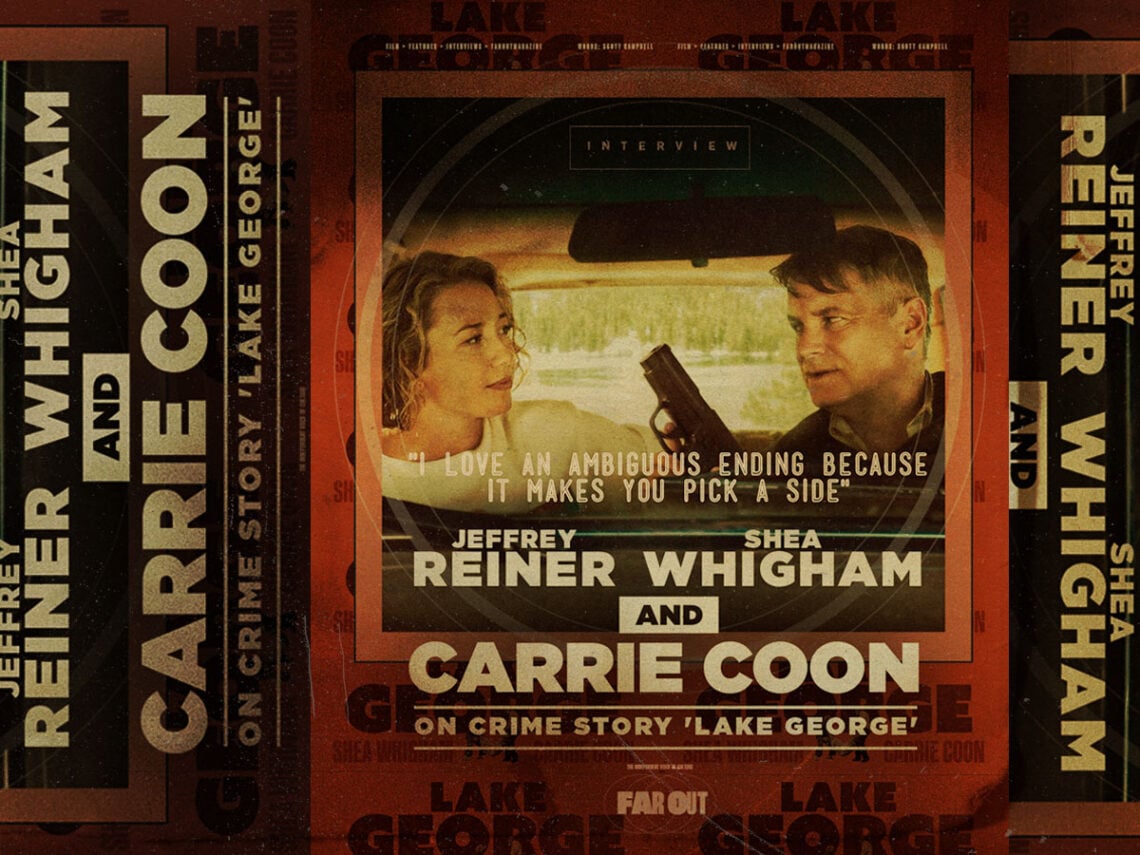
“I love an ambiguous ending because it makes you pick a side”: Jeffrey Reiner, Shea Whigham, and Carrie Coon on crime story ‘Lake George’

There are a lot of moving pieces required to fall into place when making any movie, but sometimes it can feel like fate. That’s certainly the case for writer and director Jeffrey Reiner’s noir-inspired crime story Lake George, which reached the screen in its finished form through a series of fortunate events and coincidences.
The story follows Shea Whigham’s Don, an insurance adjustor fresh out of prison after a ten-year stretch. Desperate for cash, he turns to Glenn Fleshler’s gangster and former associate, Arman, for help. He’s happy to assist, but there’s a catch: Don has to kill Arman’s girlfriend, Carrie Coon’s Phyllis.
When the time comes, though, he can’t pull the trigger. Instead, Don and Phyllis concoct a scheme that sees the mismatched duo play Arman at his own game by stealing money he’s stashed at various safehouses, embarking on a road-tripping adventure that touches base with the crime genre, black comedy and hard-boiled thriller, with a touch of romance thrown in for good measure.
While the role wasn’t written specifically for him, Reiner penned the script with Whigham in mind. The actor has been friends with Coon for years, and they co-starred in the third season of Fargo, a series that Reiner also worked on during its second season as a director, helming two episodes of the second season. With that in mind, did they feel a sense of serendipity in Lake George coming together like it did?
“Yeah, I guess serendipity is the word. Kismet,” the filmmaker agreed. “Just relief, to be honest with you, that I got such great actors and got financing. I was very lucky. Very, very lucky. Shea brought Carrie into the fold, but I had interest in Carrie way back, and one day, I’ll find the letter that I did not send to her. I’m just very fortunate to have these two actors for a small movie. You can’t get better actors, in my opinion.”

As mentioned, Lake George weaves between multiple genres, often in the space of a single scene, leaving Reiner, Whigham, and Coon aware that there was a constant tonal tightrope to walk to ensure that even though the film constantly kept one foot planted inside so many different worlds, none of them were overpowered by the others.
“Some people read the script and didn’t understand the tone,” the director confessed. “Shea instantly understood it, and Carrie, despite even maybe some of her reps not understanding completely, got it.” Fortunately, Coon understood the assignment the first time she read the screenplay.
“There’s a version of this script as you recognise that if you could play it straight down the middle, it would have some fidelity to genre,” she offered. “But we were more interested in the version that was a little stranger, a little weirder, a little outside the box. And what I appreciated was that we would often do a scene straight down the middle, the version you would expect to see if you read it and did in scene study class, and then Jeffrey would say, ‘I don’t know. I just imagine you sitting on her lap.'”
“And then we would do the scene that way, and that’s a good example, I think, of how it worked,” the actor continued. “We were always experimenting within a range, knowing that in the edit, Jeffrey would fine-tune that tone that we were looking for, which kept it away from just landing in one genre, I would say, and very much adjacent to the comps that Jeffrey had in mind when he wrote it.”
To that end, Reiner cited Don Siegel’s 1964 noir The Killers with Lee Marvin, Angie Dickinson, and Clu Gulager as a touchstone. “Clu Gulager, like in the middle of scenes, is doing push-ups, and it’s really hilarious. And that movie, it’s that tonal thing that brings something obtuse into it, and it just unnerves people, and it’s entertaining.”
“We leaned heavily on Jeffrey like Carrie was saying, but if you watch the film, we played every scene truthfully,” Whigham interjected. “That’s the whole key. If we ever get caught winking at the camera, no matter how insane the piece goes, it doesn’t work. We knew it was funny.”
The actor gets several memorable comic beats, including hiding in an attic mid-heist and struggling to use a modern phone after a decade behind bars. As comedic as those moments are, Whigham was always cognisant of making sure he never played them for the cheap seats.
“If we’re sitting in the attic and watching what goes on and you see Carrie just go, ‘Hmm’, that tells the story,” he elaborated. “Now, if we start going back and forth like this, it doesn’t work. Where I have a problem is when people start winking and spinning things, and then it doesn’t work. So I think that’s one of the reasons why it works at the end of the day.”
Along similar lines, Lake George is a heightened film in certain respects, but it’s not a far-fetched one. That said, there are certain scenes, most notably spur-of-the-moment finger amputation during Don and Carrie’s first robbery and a blood-covered mock burial to convince Arman that she’d dead, are undeniably funny, which was born from close collaboration between Reiner and his two leads.
“The burial! The most fun I’ve ever had,” Coon fondly recalled. “I was so excited about the burial.” For Reiner, he placed the credit in the hands of the performers: “These guys completely ran with that. I would say that I set the camera up, and Carrie really instigated everything. And Shea was amazing.”

“Carrie surprised Shea at times,” the director suggested. “It was her energy. And in the scene in the garage where they cut the guy’s finger off, that took a lot of work. It was really fine-tuning because it was… I think we shot that after the burial scene, did we not?” Nobody could give a definitive answer, but that was beside the point.
“I don’t remember, but it was hard,” Coon took over. “It was hard to find the tone of that scene, and we did it a lot,” a sentiment Reiner concurred with: “Yeah, it was really hard. And then the physical comedy, because we’re dealing with a very large human being, and we were really concerned about his safety, and it was really hot in the garage. Nobody knows how funny these two actors are, although now people are starting to realise that they’re really funny.”
“I’m always excited about roles that invite physicalisation, that invite action because, as a woman, I’m not invited into that world very frequently,” Coon reflected. “And I’m a very physical person. I like using my whole body in my work, and it’s so rare that I’m asked to do that. The, you know, the wife, the supporting wife roles, don’t ask for much except walking around in your heels and scowling at some guy you were supposed to have left that you end up staying with for no reason.”
“It was fun to get to engage in those bits. I mean, they really are bits, and we knew the time we had, and we would just play and then let Jeffrey fix it,” she mischievously added. For Whigham, the role of Phyllis is “as close to Carrie Coon as you’ll find,” and not because she’s playing a “psycho killer,” as The Leftovers and The White Lotus star self-effacingly put it.
“Her comedy, she knows how to get it out of me,” Whigham mused on his longtime friend. “I find her infinitely amusing. I wanted to use that throughout this. She just pops, man. I can’t tell you the number of actors that I respect who are like, ‘I want to work with her’. She’s incredible in it.”
“But when you have a Shea Whigham, you always have the truth,” as Coon continued the love-in. “There’s not a false bone in Shea Whigham’s body. It doesn’t matter what kind of character he’s playing; it’s always truthful. And it’s just an easy energy to play with because it’s always a scene that’s happening between two people. Shea is one of the most selfless actors I know. It’s always about the scene.”
“It’s interesting because I don’t really read what people say much about the movie, but when I remember one person said ‘the ending wasn’t for me’, I kind of like those notes,” Reiner recalled of some feedback to Lake George.
“Because for us to have those funny scenes like the burial, and then to have this, which I think is a very heartbreaking scene at the end, and commit to it. That’s challenging to believe in that as filmmakers and actors. ‘OK, we were just three days ago laughing at Carrie getting buried alive, and now we’re basically crying, but that’s why we make them: so we can commit to something that maybe makes people uncomfortable. So that, I think, was a real challenge.”
Throughout the film, sparks constantly fly between Don and Phyllis to give the narrative a romantic edge, even though it doesn’t unfold or materialise in the way audiences may expect. It was never going to be realised as anything else, which was Reiner’s intention from the start.
“That’s the way I always envisioned it,” he stated. “I never wanted there to be any real sexual component to it. As we progressed, I just sensed that there was this burgeoning love between the two characters and people who don’t have love in their lives who need it desperately. These two have it in spades as far as their relationship, so it was really fun to see that connection.”

“That was one thing that really appealed to me about the script,” Coon elaborated. “It resisted that obvious path, but it still existed in the storytelling but wasn’t an explicit part of the storytelling, and it felt very adult to me. It felt very grown up. And I love that Phyllis was a 43-year-old woman, not a 28-year-old woman. This is a woman with a lot of life experience, and these people have a lot of complexity, so anything that’s developing between them is not simple. It’s just not a simple story.”
“I think chemistry is a mystery,” Whigham weighed in. “Too often, you’re thrown into these situations, and people try to force chemistry. I’m a big believer in going against any of that; it has to happen organically, or you feel it viscerally. You feel it when you see it on the screen. And with her and I, it’s effortless, and it comes from a place of generosity. Like I always tell her, I want her to be better than in a scene than I am.”
“When you’re in acting school early on, it’s like, ‘I need to win this scene. I’ve got to win this scene’. And I go away from that. You have trust within that, but you never know how it’s going to work. You just have it. We don’t question it. It’s just there.”
“We’ve been thick as thieves since Fargo,” Coon continued. “And I agree with Shea; the greatest compliment you can ever get as an actor, I think, is, ‘Man, that actor did their best work with you’. Everybody who acts with you says, ‘Wow, that’s the best work they’ve ever done’. That’s the kind of compliment I want.”
“I’ve done pilots where you have to do everything, and you have to rush, and it’s like, ‘Oh god, we’re shooting in three weeks,” the experienced television director said. “And then you get on the set the first day, and you realise, ‘These actors have no chemistry at all’. And you have another month of shooting, and you know you’re doomed. It’s like, ‘This will never get picked up.'”
“Even if they hate each other, that’s not bad either because at least there’s chemistry there, right? When there’s no tension and no love, it’s like, ‘Oh boy’. To illustrate Reiner’s point, Whigham evoked one of Hollywood’s most beloved romantic movies. “It could be Richard Gere and Debra Winger; that’s the famous one in An Officer and a Gentleman. They always say they hated each other, but when they called action, between action and cut, you just never know.”
Going back to the physicality of Lake George, Whigham has been earning a reputation as the king of the cinematic foot chase. He tried to run down Joaquin Phoenix’s Arthur Fleck in Joker and attempted to out-manoeuvre Tom Cruise in Mission: Impossible – Dead Reckoning, but did he feel like he’d met his match trying to keep pace in his latest film alongside former university football and track star, not to mention Copley Athletic Hall of Fame inductee, Carrie Coon?
“I’ve got to be careful about this,” Whigham began, aware of who he could upset. “Let me say this about Mr Cruise because I love Mr Cruise, and you’re going to see another great foot chase coming up in a couple of months. But I will say, in that car park, she was so fast, right?”
“She literally lived for that day because she’s a former soccer player. She told me every chance she had, she said, ‘You know how fast I really am, right?’ I know how fast. I know how great you were at soccer. We get it. And we shot that thing fucking, I don’t know, 50 times, just so she could outrun me.”
“Not as fast as I used to be, which is a little sad,” Coon added. Still, Whigham laid down the gauntlet. “I would love to see her and Tom in a foot race. He’s competitive; they’re both very competitive.” Maintaining the Mission: Impossible theme, Coon felt compelled to praise another member of the franchise outside of Cruise and Whigham outside of her enthusiasm for challenging Cruise in his chosen arena.

“Can I just say Rebecca Ferguson is amazing in those films, by the way?” She can, and she’s not the only one who thinks so. “I agree,” came the response from Cruise’s Dead Reckoning and The Final Reckoning co-star, with Coon getting the last word. “What a truthful, grounding, physical presence she is. I just really admire her. I just wanted to shout that out.”
Getting back on track, Lake George ends on an ambiguous note, which will be danced around for the purpose of spoilers. However, as much as Reiner tried to sit on the fence, he did at least intimate that how the final scene of the movie is interpreted depends entirely on how the viewer chooses to interpret it.
“I’d call it facts, and it’s also fiction because I made it up,” came the suitably unhelpful answer. “I really don’t know the answer to that. I know what I want. We always get asked that. I don’t know, why don’t you ask the guys who were actually there?” Fair enough, which is exactly what happened.
“I say that good art, rightly, tells more about the viewer than it does the movie, right?” Coon questioned. “Depending on how the viewer perceives that ending, it says something about your perspective on love, on the film, and on the kind of ending you like. I love an ambiguous ending because it makes you pick a side.”
“I’ve never had as many questions about that as I have on this film,” Whigham ruminated. “I don’t want to say 50/50; I get pretty split on how people feel, maybe how they’re feeling in their own lives and what they want to feel. I mean, just to be fair, the three of us, Carrie wasn’t that involved; it was a difficult day. I had to know, specificity-wise. I have to know in this scene, and that’s the most important thing when you’re doing something like that; you can’t be ambiguous as to what’s happening, you know?”
Reiner, Coon, and Whigham all have different opinions on the final scene of Lake George, leaving the movie’s resolution entirely in the eye of the beholder.
