


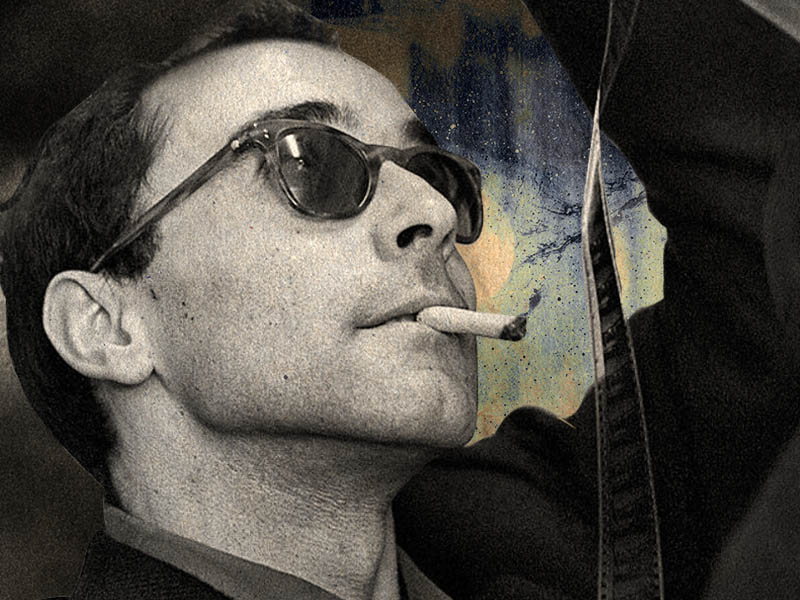
Jean-Luc Godard: The French New Wave’s last soldier is dead

For a long time, I really thought Jean-Luc Godard would live forever. Over the years, Godard witnessed the demise of every single one of his French New Wave comrades, but he soldiered on. Although he announced his retirement last year, he refused to stop working completely and revealed that he was working on two new projects. It really seemed like he would outlive everyone out of pure spite.
That’s exactly why a part of me couldn’t believe it when I found out that Godard finally succumbed to the inevitability of human mortality. The uncompromising pioneer passed away at the ripe old age of 91. Despite the fact that he lived for almost a century and created an extensive filmography, his death is a significant tragedy for the world of cinema because Godard had so much more to say.
Born in Paris in 1930, Godard belonged to an economically privileged family and spent a lot of his formative years in Switzerland. He wasn’t attracted to the cinema at first, but everything changed when he read an essay by André Malraux. Although he enrolled in an anthropology programme at the Sorbonne, he surrendered to the gravitational pull of Paris’ ciné-clubs and forgot about attending classes.
Picture this: it’s Paris in the 1950s. Cinema is still a nascent art form that is beginning to grab hold of the public consciousness. The air is constantly charged with revolutionary ideas, with neurotic youngsters chattering about the epistemological and ontological implications of the images that haunt them. Cinema’s potential is still limitless, and the people who spend entire days in the darkness of the theatre know it. Out of this incendiary cultural microcosm, Jean-Luc Godard emerged.
Along with other influential figures like Jacques Rivette, François Truffaut and Claude Chabrol, Godard found film criticism to be an adequate outlet for his overwhelming cinephilia. Establishing themselves as the young warriors of Cahiers du cinéma, they played a crucial role in the development of the auteur theory. While their writings were refreshing and powerful, the world wasn’t prepared for their cinema.
Even within the context of the New Wave, Godard stands out as the harbinger of a new cinema. While Truffaut set the ball rolling with The 400 Blows and Jean-Pierre Melville conducted proto-New Wave experiments in his gangster flicks, Godard changed the rules of the game with Breathless. A thoroughly unique free-wheeling philosophical romp through the streets of Paris, the film established a new visual language for cinema.
To this day, Godard remains a divisive figure within the film community because everyone knows that his films are “important”, but only a few people feel that way. According to Quentin Tarantino, Godard’s cinema is a gateway drug for aspiring filmmakers because he offers the kind of freedom that is not found anywhere else. However, Tarantino also believes that everyone grows out of it eventually.
Maybe that’s why Godard has always been the patron saint of cinephilia instead of filmmaking. For those who have dedicated their lives to understanding external realities and the fabric of space-time through cinema, Godard represents the ultimate fantasy. While most of us are overwhelmed by the power of images, he endlessly manipulated them until a new system was created within which the irrationality of the universe inspired humour rather than dread.
Godard’s cinephilia defined his cinema, and he kept challenging the ethics of cinephilia itself. When we think of Godard, our minds usually wander towards buzzwords like jump cuts and continuity editing or the fame of his early gems such as Vivre sa vie and Pierrot le Fou. However, Godard’s most fascinating period started in 1967 with the release of La Chinoise and Weekend.
Even as all his comrades faded away, Godard kept the spirit of the French New Wave alive. It’s almost shocking to realise that his recent works, such as Goodbye to Language and The Image Book, were created by an 80-year-old auteur. They are bolder and infinitely more experimental than the creations of many young directors working today who are regularly touted as “radical”. It’s tragic because Godard lived long enough to see radicalism being transformed into a commercial product.
Along with Godard, today is the day that the French New Wave officially comes to an end. “Film is over,” Godard declared a decade ago. Since then, it has only gotten worse – the theatre experience is threatened by extinction, creative conceptualisation is being determined by algorithmic viability and the accelerating replacement of art with content. Although film art might be dead, cinephilia isn’t.
As long as aspiring directors are shaken up and truly radicalised by Godard’s unforgettable experiments, cinephilia will endure. And out of this battered and bruised cinephilia, a new cinema will explode.
