


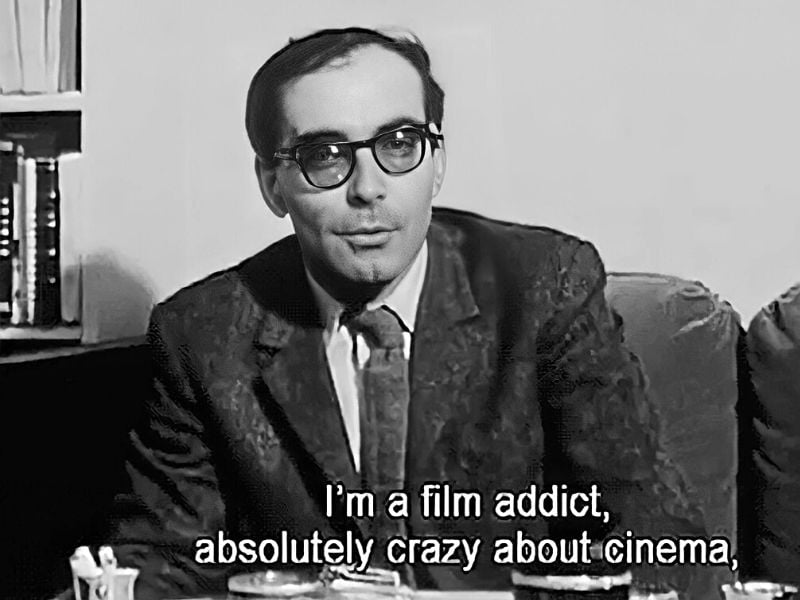
Jean-Luc Godard once named the 10 best American films of all time

Jean-Luc Godard, widely regarded as one of the greatest film directors of all time, has passed away at the age of 91. Having started life as a critic as a prerequisite to the forming of his eventual New Wave ideas, Godard’s legacy is forever etched into the annals of cinematic history.
The famed director, born in Paris in 1930, was raised in Nyon on the banks of Lake Geneva. Later in life and full of lofty ambition, he moved back to Paris in 1959 and quickly fell in with the city’s intellectuals. Around this time, he met the likes of critic André Bazin and fellow directors François Truffaut and Claude Chabrol.
With a new burning sense of creativity, Godard began writing for various film magazines that popped up sporadically around the city, including the highly influential publication Cahiers du Cinema. Forever living up to his reputation as an iconoclast, Jean-Luc defended the techniques and aesthetics of Hollywood’s golden-age directors. However, he would later turn his back on the Hollywood studio system in his own work, instead opting to take his camera to the streets of Paris and work on a shoestring budget.
While Godard didn’t agree with Hollywood’s methods, he still appreciated certain pictures. As part of his contribution to film writing, a young Godard provided a list of what he considered to be the ten best American films of all time as part of an article which was published in 1964, a fascinating insight into the mindset of a filmmaker forming his early impression of the art form.
Godard, who was heavily critical of mainstream French cinema in the past, once said that its sense of tradition only “emphasised craft over innovation, privileged established directors over new directors, and preferred the great works of the past to experimentation.”
While Godard’s films have influenced some of the greats, such as Martin Scorsese, Quentin Tarantino, Jim Jarmusch, Wim Wenders and more, the French-Swiss film director has never been afraid to show his admiration for some of cinema’s finest work.
Having established himself as a pioneer of the 1960s French New Wave film movement, Godard’s unrelenting approach to being a film critic prior to moving on set has been lauded in equal measure to some of his most creative works. While most of his filmography remained exclusive to Europe, his extensive back catalogue of work was given a US release in due time and the filmmaker received worldwide acclaim.
“The cinema is not a craft. It is an art,” Godard once said. “It does not mean teamwork. One is always alone on the set as before the blank page. And to be alone… means to ask questions. And to make films means to answer them.”
While French cinema took most of Godard’s attention, he did reference a list of his favourite American films when contributing to the critics section of Cahiers du cinema, a publication for New-Wave critics who turned their words into films in later years.
Despite famously stating: “I pity the French cinema because it has no money. I pity the American cinema because it has no ideas”, Godard has always been willing to celebrate some of the finest cinematic creations. The list includes some expected names, such as Alfred Hitchcock and Orson Welles, in reference to some of the movie industry’s most pioneering figures.
See the full list below.
Jean-Luc Godard’s favourite films:
- Scarface – (Howard Hawks, 1932)
- The Great Dictator – (Charlie Chaplin, 1940)
- Vertigo – (Alfred Hitchcock, 1958)
- The Searchers – (John Ford, 1956)
- Singin’ in the Rain – (Kelly-Donen, 1952)
- The Lady from Shanghai – (Orson Welles, 1947)
- Bigger Than Life – (Nicholas Ray, 1956)
- Angel Face – (Otto Preminger, 1953)
- To Be or Not To Be – (Ernst Lubitsch, 1942)
- Dishonored – (Josef von Sternberg, 1931)
Of course, the feeling between this list of acclaimed directors and Godard was very much mutual. To best exhibit that, we turn to the great Orson Welles, who once said of the French director: “His gifts as a director are enormous. I just can’t take him very seriously as a thinker – and that’s where we seem to differ, because he does. His message is what he cares about these days, and, like most movie messages, it could be written on the head of a pin.”
