


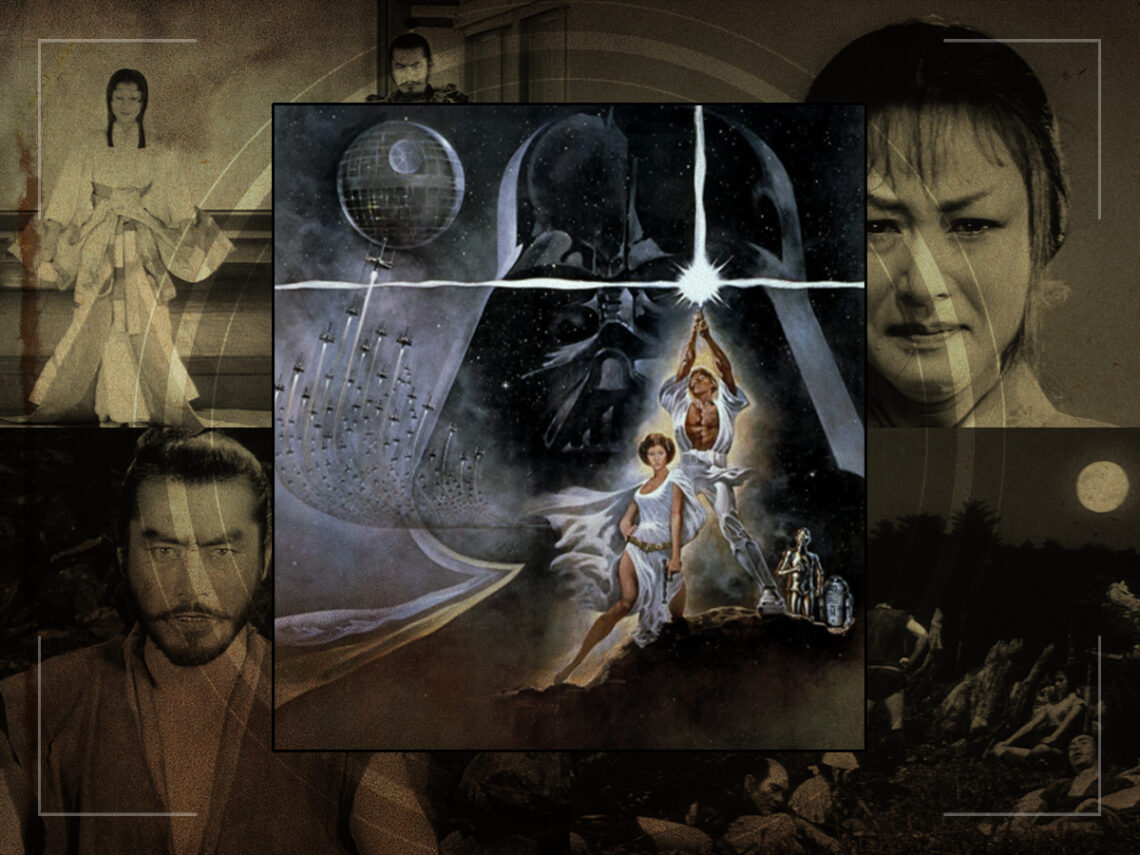
“More of a coincidence than anything else”: The Japanese samurai film that inspired George Lucas and ‘Star Wars’

When Star Wars was released in 1977, it blew the doors off the box office. From a modest budget of $11million, this fantasy opera set in space raked in $775m and created one of the most lucrative dynasties in Hollywood history. For most viewers at the time, it was thrillingly original. Cutting-edge special effects, weird hair, and lots of wisecracking droids made it look like nothing in cinema ever had. But was it really that original?
Many cinephiles have been quick to point out that the movie is basically just a Westernised samurai movie in space. The lightsabers, cloaks, strict moral code, and philosophical approach to being a warrior are all in direct keeping with Japanese samurai movies, but the connection is much more specific than that. Lucas was drawing on one film in particular, and if you’ve seen it, it’s hard to view Star Wars as anything other than a quirky remake.
Akira Kurosawa’s The Hidden Fortress was released in 1958 and follows two bickering peasants (Minoru Chiaki and Kamatari Fujiwara) who agree to help escort a famous general and a young woman (Toshiro Mifune and Misa Uehara, respectively) through enemy territory to safety. The woman is later revealed to be a princess. Lucas updated the characters by making the peasants droids, but he pretty much stuck with everything else.
The Star Wars creator has simultaneously acknowledged and downplayed the influence of The Hidden Fortress, saying that the thing that struck him the most about the film was the fact that the story was told by two of the least powerful characters. “I decided that would be a nice way to tell the Star Wars story, which was to take the two lowliest characters, as Kurosawa did, and tell the story from their point of view, which in the Star Wars case is the two droids,” he explained.
But while Lucas was willing to acknowledge that influence, he insisted that the central plot of a princess trying to get past enemy lines was “more of a coincidence than anything else.” He even suggested that the princess in Star Wars was more of a fighter than the one in Hidden Fortress. Princess Leia might wield a bit more sarcasm than Princess Yuki, but both are more than capable of fighting for themselves.
There are plenty of other parallels that suggest Lucas was just a tad more influenced by Hidden Fortress than he’s willing to let on. He used horizontal wipes as transitions the way the Japanese master did, and mimicked his use of long lenses and wide vistas. The general in Kurosawa’s film also duelled and defeated his arch-rival, but left him scarred rather than taking the opportunity to kill him. This storyline is nearly an exact replica of Obi-Wan’s duel with Darth Vader. Lucas even considered casting Mifune as Obi-Wan before deciding on Alec Guinness.
Were there other influences?
Although Star Wars most closely resembles The Hidden Fortress, Lucas was drawing on many other cinematic influences. Seven Samurai was his favourite Kurosawa film, and aside from channelling its breathtaking action sequences and samurai code, he took away something very specific. According to screenwriter Lawrence Kasdan, Yoda was modelled on Shimada, the ageing samurai who doles out wisdom to his younger peers.
As for non-Kurosawa-related influences, the list is long. C-3PO closely resembles the humanoid robot in the 1927 Fritz Lang masterpiece Metropolis. John Ford’s The Searchers offered both visual and thematic inspiration. The 1956 western is set in a vast, barren desert like Tatooine, where its main character, played by John Wayne, returns home to find that his property and family have been burned to the ground.
Luke Skywalker makes a similar discovery, and, in both films, this moment sets the journeys of the respective protagonists in motion. Interestingly, Ford was a key influence on Kurosawa, too. As far as the specific visual world goes, no film had a more profound influence on Star Wars than Stanley Kubrick’s 2001: A Space Odyssey. Even Lucas had to admit that it was “far superior.”
