


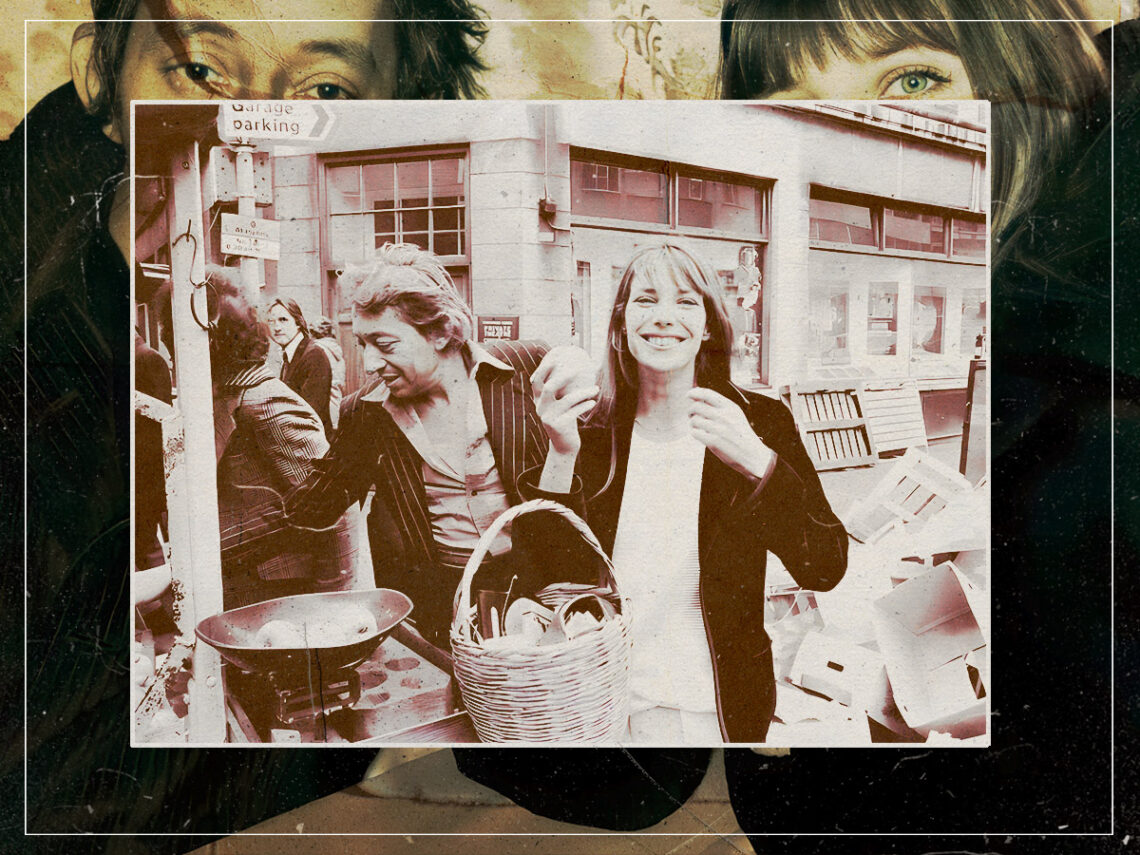
‘Jane Birkin/Serge Gainsbourg’: Jane Birkin’s finest work

The 1960s gave rise to some classic French icons, such as Brigitte Bardot, Françoise Hardy and Catherine Deneuve. Then there was Jane Birkin, who was somewhat of an anomaly. Born in England, Birkin emerged as an icon of swinging London, starring in movies that reflected the era, like Blow-Up.
However, her acting career soon took her to France, where she successfully landed a role opposite her soon-to-be partner Serge Gainsbourg in Slogan. There was a sizeable age difference between the two, with Birkin being just 22 and Gainsbourg 40 when they met. Despite this, they fell passionately in love, and Birkin gave birth to their daughter, Charlotte, in 1971.
Gainsbourg had recently been in a relationship with Bardot before he met Birkin – a voluptuous blonde bombshell and French sex symbol who couldn’t be more different to his new lover. Birkin was insecure about her flat-chestedness and lanky posture, and she wanted to do whatever she could to secure Gainsbourg’s devotion. Thus, she agreed to sing ‘Je t’aime… moi non plus’, which Gainsbourg had written with Bardot in mind. This jealousy spurred Birkin on, and despite having relatively little experience as a singer, the result is one of the most provocative songs ever made.
Incredibly French and outrageous in its utilisation of breathy vocals from Birkin, which simulated an orgasm, the song became highly controversial. However, the pair rose to international fame because of it, known for singing the ‘dirty’ French song that many radio stations had no choice but to ban. The iconic track, with its seductive organs and beautiful dichotomy between Birkin’s light, feminine vocals and Gainsbourg’s deep, masculine delivery, appears as the opening track on their collaborative album, Jane Birkin/Serge Gainsbourg.
The album was Birkin’s first, although she went on to release several solo records in the coming years. While these are all good in their own right, there’s something so captivating about Jane Birkin/Serge Gainsbourg, which possesses a distinctively playful element, although this never overshadows a baseline level of sensuality and romance, which reflects the pair’s budding relationship.
The pair compliment each other fantastically – sometimes duetting, sometimes letting the other dominate a track. Several of Birkin’s best songs can be found here, such as the cheekily-named ‘69 année érotique’ and ‘Jane B’. On the former, euphoric strings sweep in time with an upbeat rhythm and alluring guitars. Birkin’s delivery of the title lyrics feels inherently daring and lively, and it’s as though you can hear her smiling as she sings the lines.
On ‘Jane B’, she describes herself over a gorgeously sensual instrumental palette, lifted from Chopin’s Prelude, Op. 28, No. 4 in E Minor. Alongside ‘Je t’aime… moi non plus’, it is easily one of the album’s most addictive tracks. However, she allows her youthfulness to peak through on songs like ‘Orang-Outan’, with lyrics that translate in English to “I love my orangutan doll” and “I never sleep without it.” Somehow, this works, and it’s delightful to hear Birkin indulge in such a joyously light-hearted song.
However, her vocal talents truly shine on ‘Le Canari Est Sur Le Balcon’, a gentle number that sees Birkin sing about a woman who considers the fate of her pet canary while pondering ending her life. This dark and slightly bizarre choice of subject matter adds another dimension to the album that demonstrates Birkin’s range.
Jane Birkin/Serge Gainsbourg helped launch Birkin to further recognition, becoming a French star despite her English roots. Her slightly unusual French accent – it is obvious that it is not her native language – gives the album extra charm, and you can’t help but love Birkin’s ability to throw herself into new territory, becoming an unexpected musical icon in the process.
