


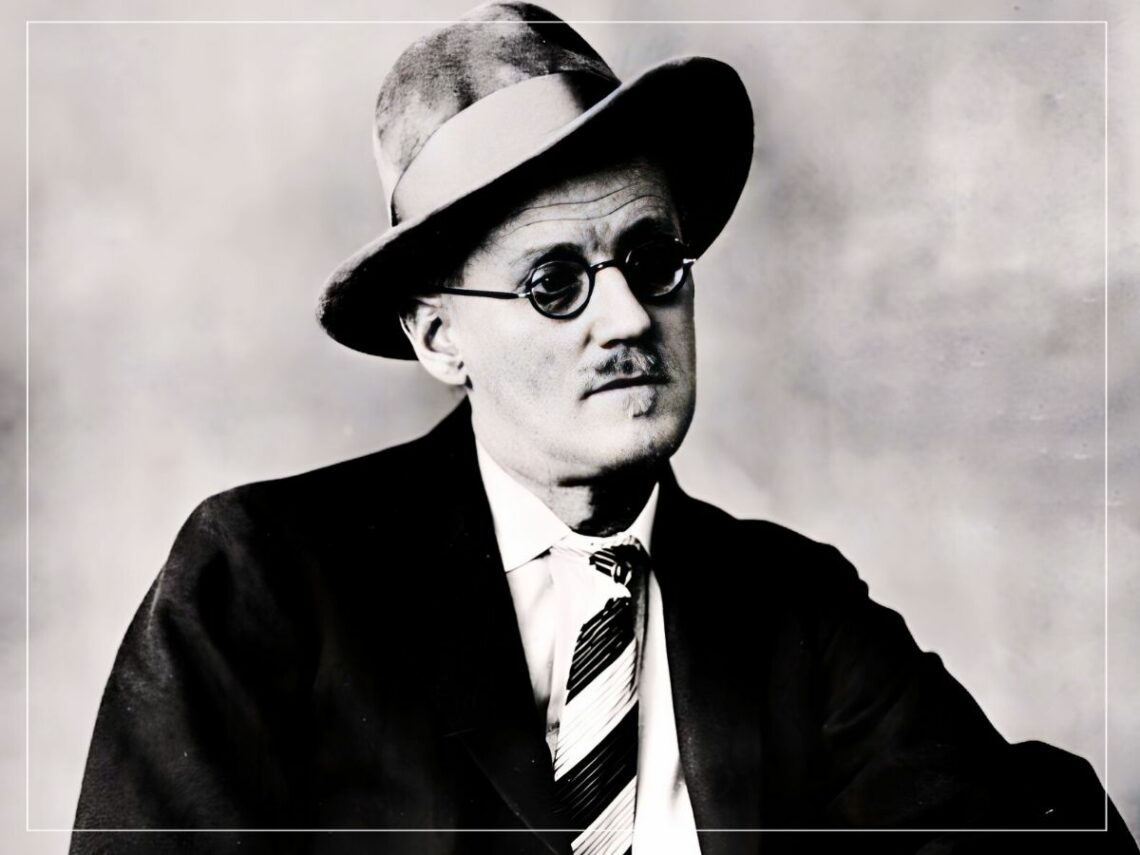
Listen to James Joyce’s only recorded musical composition

James Joyce was many things: a literary genius, a traveller, and a dirty bastard. The man lived a life of epic proportions, which took him to places far removed from the humdrum ordinary of the era he was operating in. Of course, his most famous and accomplished cultural effort is 1922’s Ulysses, a landmark in English literature that utilised the episodes of Homer’s Odyssey in different styles, including a stream of consciousness; it was unrivalled in scope and execution at the time. Yet, this was just the tip of the iceberg; his 58 years on the planet were brimming with activity.
One of the most revered chapters in Joyce’s life was his time in Paris in the 1920s, a hotbed of cutting-edge thinking and artistic innovations. He became great friends with a host of other pivotal figures during this time, with the most notable being globe-trotting American journalist and fellow Renaissance man Ernest Hemingway. As esteemed polyglots and heavy drinkers alike, the pair were great friends and got up to many drunken misadventures across the winding cobbles of the French capital. While Joyce was the physical opposite of his hulking, often aggressive American friend, the middle-class Irishman could also get rowdy when he’d had a few too many.
Whenever Joyce would pick a fight, feeling overconfident in his abilities to defend himself, the lecherous rotter who supplied Ulysses and Dubliners would hide behind the For Whom the Bell Tolls author. He would say, quaking in his boots: “Deal with him, Hemingway. Deal with him.”
Regardless of their antics, the pair shared a bond that went far beyond the hellraising. In one interview, Joyce stated, “He’s a good writer, Hemingway. He writes as he is… there is much more behind Hemingway’s form than people know.” He was in no doubt that Hemingway was not the brutish mass of flesh he was made out to be.
Like every great author, Joyce had many shades. In one account, where Hemingway discussed his friend’s ability, he noted what he believed was Joyce’s “weakness”. To him, it was the bespectacled Irishman’s inability to realise that the only good writing was that which was made up, the imagined. This is why he thought Joyce’s reimagining of Telemachus in Ulysses, Stephen Dedalus, was by far the lousiest character in the sprawling novel, as he represented Joyce himself. Hemingway said: “Joyce was so damn romantic and intellectual.”
Although it’s strange that Hemingway should make such comments about what makes a work great when you consider his fictionalised accounts of the real, he was right that Joyce was a hopeless romantic. Even his filthy, sordid letters to his wife Nora, which contain some of the most comically disgusting prose you’re ever likely to read, are underpinned by his immense love for the woman.
This hopeless romantic nature would feed into his work, particularly in the character Molly Bloom in Ulysses and in his other efforts, such as the collection of snapshots of his native city, Dubliners. It also fed into another medium.
One area he excelled at but didn’t pursue nearly as extensively as his writing was music. In the early 1900s, he discovered that he was a talented tenor and, at first, debated becoming a performer. He was even a contestant in the Irish music competition Feis Ceoil. Although he would eventually choose writing as his main endeavour, Joyce always loved music, and when in Zürich during the First World War, he learned music theory and notation.
These formative lessons led him to write his only known composition, ‘Bid Adieu To Girlish Days’. It’s a beautiful, terribly romantic number, and the words and music he wrote were brought to life in 1981 by tenor Kevin McDermott and pianist Ralph Richey. Given his position as a tenor, you can imagine him singing it. It’s a shame he didn’t write more.
