


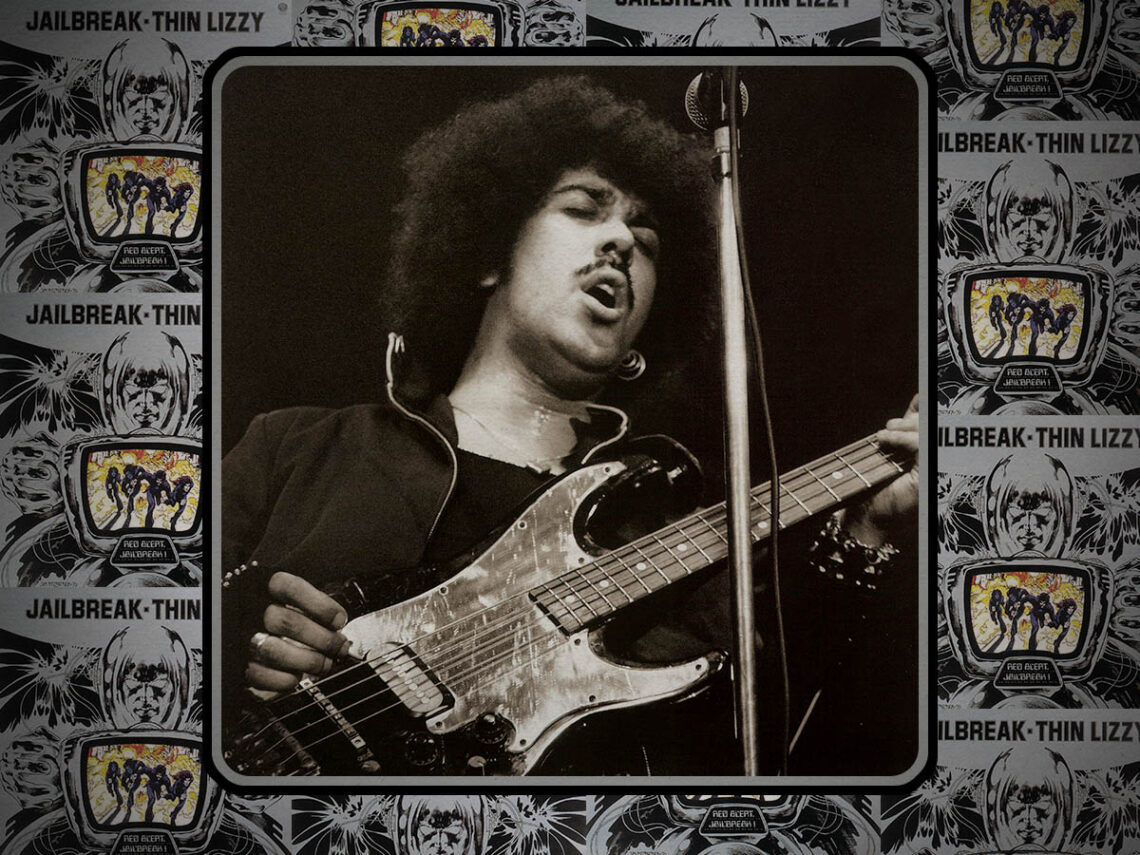
‘Jailbreak’: The album of my childhood

Back in 2008, was I perhaps the only six-year-old on Earth who would request Thin Lizzy on the aux cord?
It’s quite possible. But there I was, for all my naive years, happily thrashing away to the familiar vocals of Phil Lynott and the blitz of hard rock guitars that backed him, without really ever having any concept of fame, let alone who these people were and the music I loved so much being released the better part of three decades before I was born.
This could partly be attributed to the fact that my dad, born in the early 1960s, held off having children of his own until the early 2000s, thus creating a 40-year chasm between society, politics, people, and, most importantly in this context, music. That could have formed a gulf, but instead it fostered a true cross-generational connection.
My parents are probably reading this, so I should just take a moment of pause to say: stop taking offence, I’m not claiming we should call the care home just yet. But the point remains that while most kids in my class were hearing only the latest songs on the radio as their formative sonic education, I was hearing the top 40, but with Thin Lizzy, AC/DC, The Beatles, and Black Sabbath thrown in beside it.
Even to this day, there is a certain incomprehensible part of my dad’s brain that has never left the ‘70s. Most days, completely out of context, he’ll start singing the invariably wrong lyrics to some niche song or advert from the era, and expect all those around him to be immediately on his wavelength.
But through all the bizarre confusion this often poses, the wires never seemed to get crossed when it came to Thin Lizzy. Without the age and awareness to appreciate it at the time, the band, and in particular their album Jailbreak, has never left my psyche as one of the important musical fabrics that formed the basis of my childhood memories.

Reading about the making of the album now, it stands out to me that Thin Lizzy’s guitarists, Scott Gorham and Brian Robertson, were critical of its sound and production in the sense of its tightness and rigidity. They pined for a freedom and element of looseness that the record’s producer, John Alcock, simply did not afford to them, almost as if it were a privilege.
That certainly goes a long way in explaining why tracks like the titular ‘Jailbreak’ and ‘The Boys Are Back in Town’ are seemingly so highly-strung and frenetic, not to mention this was coming from a band on their last chance of breaking the industry. Its speed was laced with a sense of edginess and fractious energy that made you feel as if something exciting and unbridled was bubbling just below the surface.
Before anyone reads too far into that, in the context of the rest of this piece, of course, I was not sniffing lines or getting a taste of the hardened criminal life at the age of just six years old. Yet even without fully understanding the content, the point was that the power possessed in such tracks pulsed their way into my impressionable brain more than any standard pop beat of the late 2000s could have done at the time.
Putting this in the same picture as my own family connections paints a very clear portrait. They were Irish rockers leaning on the experience and influences that no British or American band could possibly conceive of, in itself providing them a slice of ingenuity in the energy they could bring and the passion they could bridle.
Yet in my own little world, with my paternal great-grandfather having hailed from County Meath and making the leap to Scotland, music like Thin Lizzy’s – albeit multiple generations down the line – spoke volumes about my dad’s subconscious decision to keep his ancestral heritage alive on his own musical terms.
Passing that down to his kids through the language of rock music may not, admittedly, be what his ancestors would have expected when they envisioned their future lineage. But then again, as I say, this was a child of the ‘60s – what else do they expect? It was going to be guitar riffs or nothing.
My dad’s own memories of Jailbreak might have been playing the LP in the crammed bedroom he shared with his brothers at home, or later going to see Thin Lizzy in the flesh at many a now-dearly departed venue such as the Glasgow Apollo with his pals, probably having little memory of the event from becoming pissed in the process.
For my own part, my memories are obviously far less inebriated. They revolved more around long road trips in the car, sunny days spent out in the garden with an old stereo system, and air guitars at family parties once the men had a few beers down their necks. That’s the power of a good album that transcends generations, but even more than that, it’s the power of Irish rock and roll and the legacy of Phil Lynott.
