


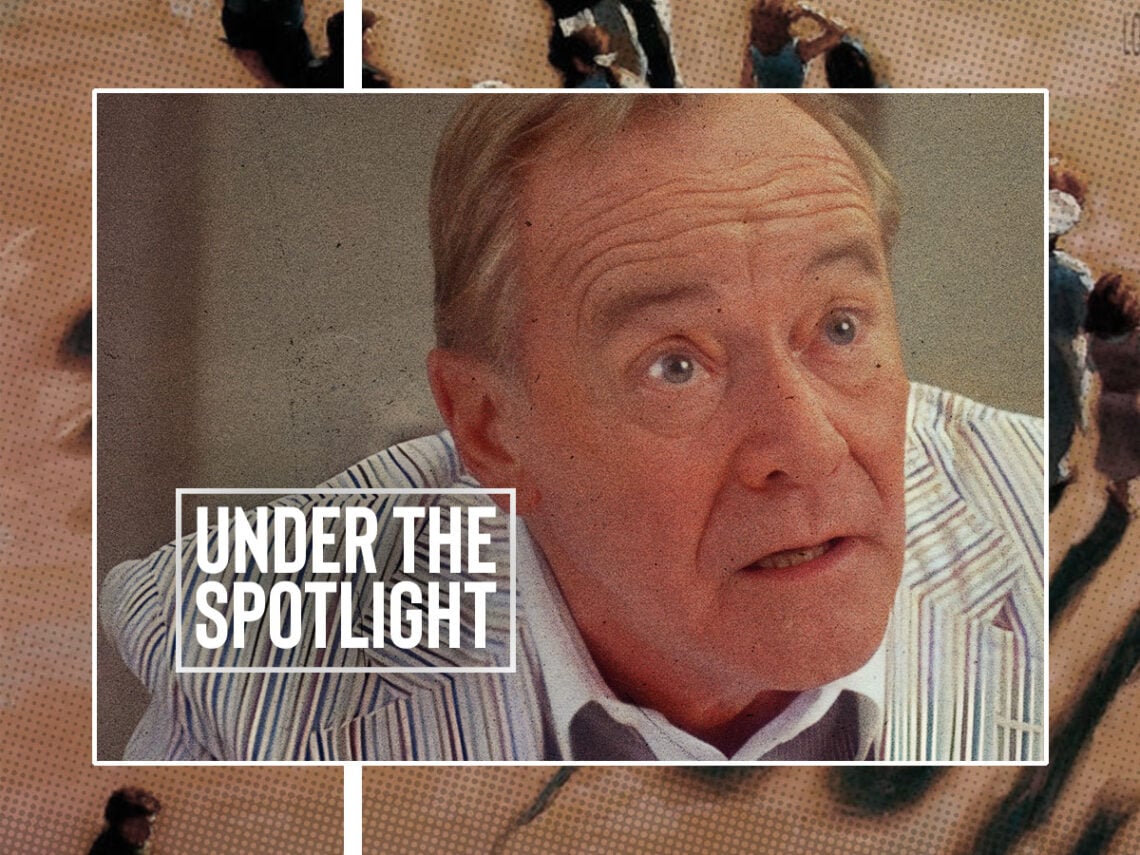
Under the Spotlight: Jack Lemmon’s powerful performance in ‘Short Cuts’

Short Cuts by Robert Altman reminds me how special it can be when a prominent director utilises a comedy actor in a more high-brow film. When it’s at its absolute best, the filmmakers will play softly on the comedian’s instinct for bringing humour to a role, using it to elevate an otherwise more serious character to a heightened level of complexity.
There are few truly great examples of this, which is what makes it so exceptional when done well. Stanley Kubrick’s casting of Peter Sellers in Lolita and Dr. Strangelove is one of the most well-known and respected cases; Kubrick, who was in awe of Sellers, gave him multiple roles in each film.
Then there was the iconic cameo of Mike Meyers as the dryly sardonic British General in Quentin Tarantino’s Inglorious Basterds. Donning a thick moustache, an RP English accent and an arch demeanour, it was a delight to see the famous comic reveal some seriously fun acting chops.
The best example, however, would quite probably have to be Jack Lemmon’s performance as the estranged father in Altman’s ensemble film. In the 1950s and 1960s, Lemmon had cemented himself as a truly great comic actor, starring in films such as The Odd Couple, The Apartment and Mister Roberts, for which he won an Oscar for ‘Best Supporting Actor’.
Short Cuts, whilst by no means Lemmon’s first foray into more serious territory, showcased a staggeringly powerful performance which remains to this day of the greatest roles of his career. The fact that he has less than ten minutes of screen time and shares the film with more than 20 other cast members is a testament to how profoundly moving his portrayal of Paul Finnigan truly is.
Given the ensemble nature of the film, which offers fleeting separate and connected vignettes of different characters in Los Angeles, there are only a few scenes in which Lemmon is in, but one particular scene stands out above the rest. In it, Finnigan reemerges into his adult son’s life following the hospitalisation of the grandson. After being absent and estranged for most of his life, the son is understandably perturbed by the sudden appearance of his elderly father.
The two men linger in the hospital cafeteria, waiting for an update on the status of the grandson, who lies in a coma several corridors away. As they idly fix themselves coffee, fruit and cereal, Finnigan begins to slowly ramble his way into a story about when Howard, his son and the grandson’s father, was himself in an accident not unlike what has just occurred. As the camera inches closer to his face, we start to understand that, in a roundabout way, Finnigan is explaining why he and Howard’s mother separated and why he’s been absent all these years.
From the moment he opens with, “I did something that day that I’d never done in my life,” we realise that his story is headed to a particularly dark place. Yet, as he gently fumbles over his words, stuttering and stalling, Lemmon lulls us into a false sense of security that gradually gets eroded as his monologue gets well underway. He explains how on the day of Howard’s own accident, he called in sick to work, visiting his sister-in-law instead with the aim of fixing a fridge. As Lemmon expertly lurches from dismissal to denial to confession, without ever actually stating out loud the facts, it becomes clear that Howard’s mother walked in on him and her sister having an affair, hence their subsequent separation.
It’s a phenomenal monologue, the perfect instance of superb writing being executed by a terrific actor, and the beauty of it comes from the way Lemmon softly allows the rhythm and cadence of comedy to slip into the performance. “I didn’t wanna hurt her feelings, y’know?” he says nonchalantly, to the increasing horror of his son. “After all, it was your mother’s sister.”
By the time he’s finished his story, the grandfather has attempted to reframe the narrative as one of Howard’s mother cruelly casting him aside at a time when both parents were needed. But the damage is done; we see in his son’s eyes that any last shred of respect for his father has vanished. “I hoped someday the truth would come out and your mother would understand,” he whimpers, but despite his tearful eyes, Lemmon’s character has eviscerated all their credibility. We’re no longer sure if he’s genuinely upset or simply spinning more lies.
The power of this performance, and this particular scene, would go on to specifically inspire another: Philip Baker Hall’s confession in Magnolia. Having self-identified as “little Bobby Altman”, a reference to the obvious influence that Altman had on director Paul Thomas Anderson, his third feature also featured a sweeping ensemble cast of troubled characters and their interconnected lives in Los Angeles.
