


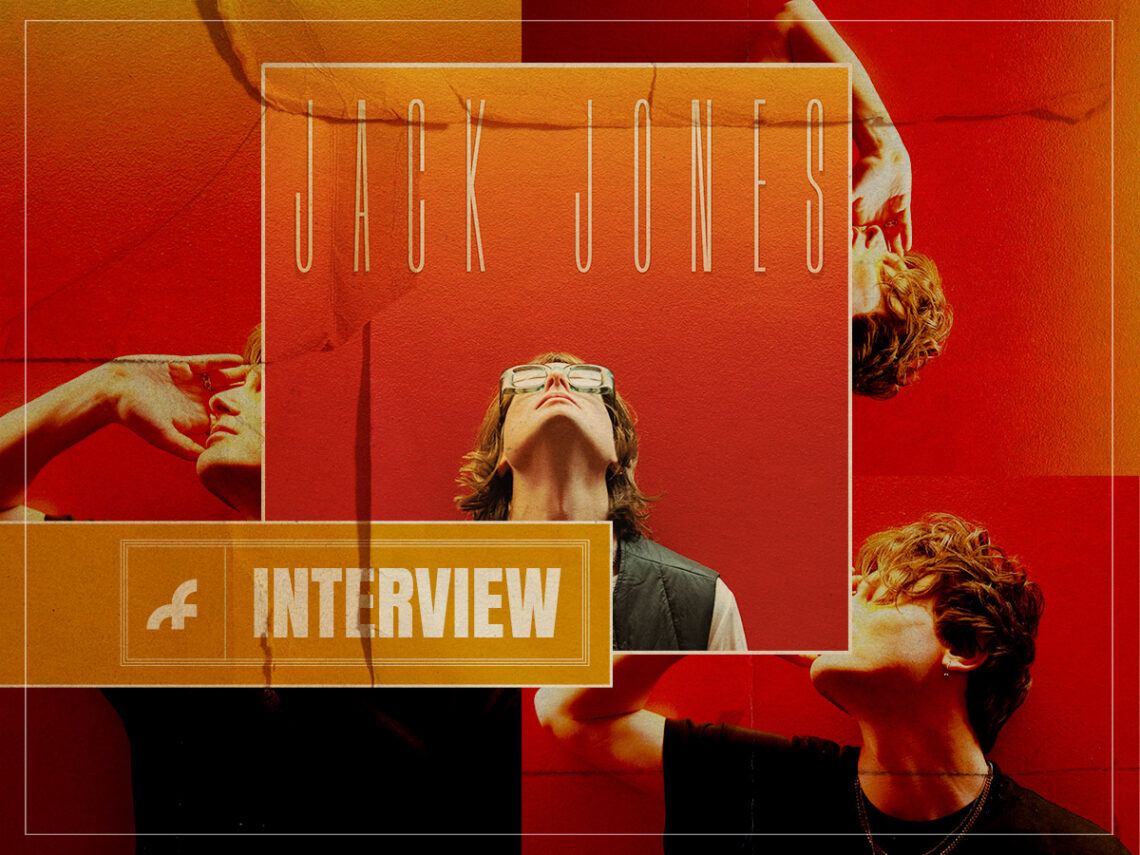
Jack Jones candidly discusses the panic attacks and humanity behind his new album: “You find you’re not so alone”

In a world of technology, online personas and a renewed interest in affected artistic irony, it can feel like honest songwriting is on its way out. I don’t mean honest in a James Blunt-esque, deeply saccharine way, but rather, in a manner where music is employed as a conduit for frankly addressing very real matters. Songwriting where an artist extracts themes from deep within, bending them to broader resonance. This is a form Trampolene frontman Jack Jones excels at on his self-titled solo debut, which arrived on September 20th via Pete Doherty‘s Strap Originals.
While Jones has always been a traditional songwriter in that he usually starts the process with an acoustic and vocals, his solo debut strikes a starkly different path. This unforeseen new environment has provided him with a route to refreshing his craft, opening up a secret door into the mind’s eye of all listeners, provided they have a heart. Jones linked up with fast-rising production whizz Adam French in Manchester, crafting an album that’s a sincere blend of his potent poetry with captivating electronica, placing the vocals front and centre while ballasting them with expressive music that mirrors the earnest soul of the messaging.
Honestly exploring the songwriter’s recent struggles with getting sober, debilitating mental health travails and sharp vignettes of British life, the record is about as full-frontal as anything you’ll hear in 2024. Unsurprisingly, the man behind it was also more forthcoming than most musicians. When I spoke to him over Zoom, he openly delved into the experiences behind Jack Jones, and how he came to craft such an affecting body of work.
Jones explained that the basis of the album was that he had been keeping diaries over the post-Covid period and that there “was so much in them” that he wasn’t sure if he could put them all into songs. “The words needed to stand on their own,” he explains, as “I felt they would somehow help people or would be useful to me to be able to say them out loud.”
Converging with French in Manchester proved to be a stroke of genius, even if it didn’t feel like it at the time, with Jones in a completely alien environment where guitars were banned from the studio and he was challenged to write over beats. At first, he thought, “Crikey,” and was so far out of his comfort zone that it seemed certain disaster was looming. Like everything in his life, Jones persevered, and this new approach and sound eventually became his latest obsession.

Is Jones feeling confident about the record? “Yeah absolutely,” he says. “I feel like it’s captured a time in my life. I’m really grateful for it, looking back now.”
One of the highlights of the record is the single ‘Breathe’, which typifies both the heady euphoria of the album’s sonics and Jones’s candid lyricism. Openly discussing his experiences with panic attacks, with lines such as the forthright opener, “You never forget your first panic attack”, the song is symbolic of Jones using personal experiences for the greater good, boldly characterising and untangling something that affects so many, but is still so inexplicable to the masses, with the feeling of one utterly suffocating for those affected.
Jones concedes that he always thought he’d be alright in life, trudged on with his psychological matters, and had never really paid much mind to what a panic attack actually is until he first suffered one. He explains: “I still think that until you’ve had some sort of mental health breakdown, you can’t really describe it, or no one can understand it, as it’s quite unfathomable.”
As with many people, including myself, experiencing the “absolute horror” of a panic first-hand changed Jones’ perspective. It felt so unreal, and he could not believe it was happening. The long-held belief that he was “stronger or whatever” and impervious to such things was rapidly proven to be a fallacy.
Jones disclosed that before the pandemic, he had started to get sober, and although he can’t be sure where the panic attacks came from, it was almost certainly a blend of what was going on at the time. “I think it probably is a mixture of being sober and feeling so vulnerable,” he says, while also revealing that he also caught Covid and “was really quite ill”, which also played a part.
“I would just struggle with…” he starts the most wholehearted part of the conversation. “I was trying to buy a hoover for my missus in Westfield. And I thought about my mother, and I literally broke down in the middle of Westfield and was crying, and then I couldn’t stop crying for about six weeks. I had all these looping thoughts of these tragic things and awful images in my mind, and it was just like there was nowhere I could go. I thought I was schizophrenic. I had these things called disassociation, where you don’t really even feel like you’re in your body. And it wasn’t like a taking load of mushrooms.”
Remarkably, I had the same experience after being stricken with a virus around the same time, when panic attacks – something I honestly thought were made up – reared their harrowing head. I shared Jones’ perspective on them, and he could not believe that we’d experienced practically identical situations. This is the beauty of personal records—they are often the most universal of all.

Offering a hefty dose of hope to mirror that of the album, he adds: “It’s so strange, you share a little bit about something that’s happened, and you find you’re not so alone. But at the time, when it’s happening, you think, ‘Fuck. This is the end of my life. It’s only happening to me.’ It doesn’t seem like there’s a way out, does it?”
The panic attacks changed Jones’ life so much that he still meditates to feel grounded in reality every day. He thinks it took him 18 months to regain any semblance of normality, but even then, he had to change everything about the way he lived because he was so worried about slipping back into the throes of that terrifying mental state.
“My mind would come up with new problems, new reasons that would cause me pain or make me suffer,” Jones says, striking a more mellow note than his typically chipper self. “Getting humbled by the mind is what I would describe it as. Every day, it was like, ‘Oh, what’s it gonna think of now? What can I do now?'”
Jones started seeing therapists and was eventually diagnosed with OCD, which he never realised he’d had. However, his tendency to be obsessive about certain aspects of life, such as his music, now started to make more sense. The diagnosis provided yet another thing to try and learn to live with.
Returning to ‘Breathe’ and why it is so resonant, Jones says he’s happy that he managed to convey the emotions attached to such a complex experience as that’s precisely what he set out to do. While it might feel like the end of the world at the time, he maintains that there is always hope.
One thing that really helped him was the Headspace app. Jones questioned whether it was a “corny” admission to make, but he took a course on anxiety meditations for six weeks. As the app’s co-founder, Andy Puddicombe, is a former Buddhist monk, it stoked his interest in the religion. So, following this fixation, as he does, he went to live with a group of Buddhist monks in Newcastle for a month. With no phones, no technology, and strange totems from the past, such as everyone eating together, Jones slowly came back to himself.
Jones was scared he wouldn’t ever leave this state of utter consonance, but when he eventually did return, he felt more at ease with his new self. He recalls softly: “I came out, and I felt a lot more able to deal with stuff again; it felt very different, like a different calmness inside me. So, it was an odd thing, but I’m getting better at not getting attached to thoughts, which is basically what I do all the time.”
Jones concludes that he’s lucky that he has music to express himself, with all of his albums from across his career forming diaries of his life. He doesn’t know why he does it, but songwriting prompts the most passion inside of him, and for that reason it’s one thing he will never give up. “The best lyrics are always true,” he reasons. That feels palpable on his solo debut.
