


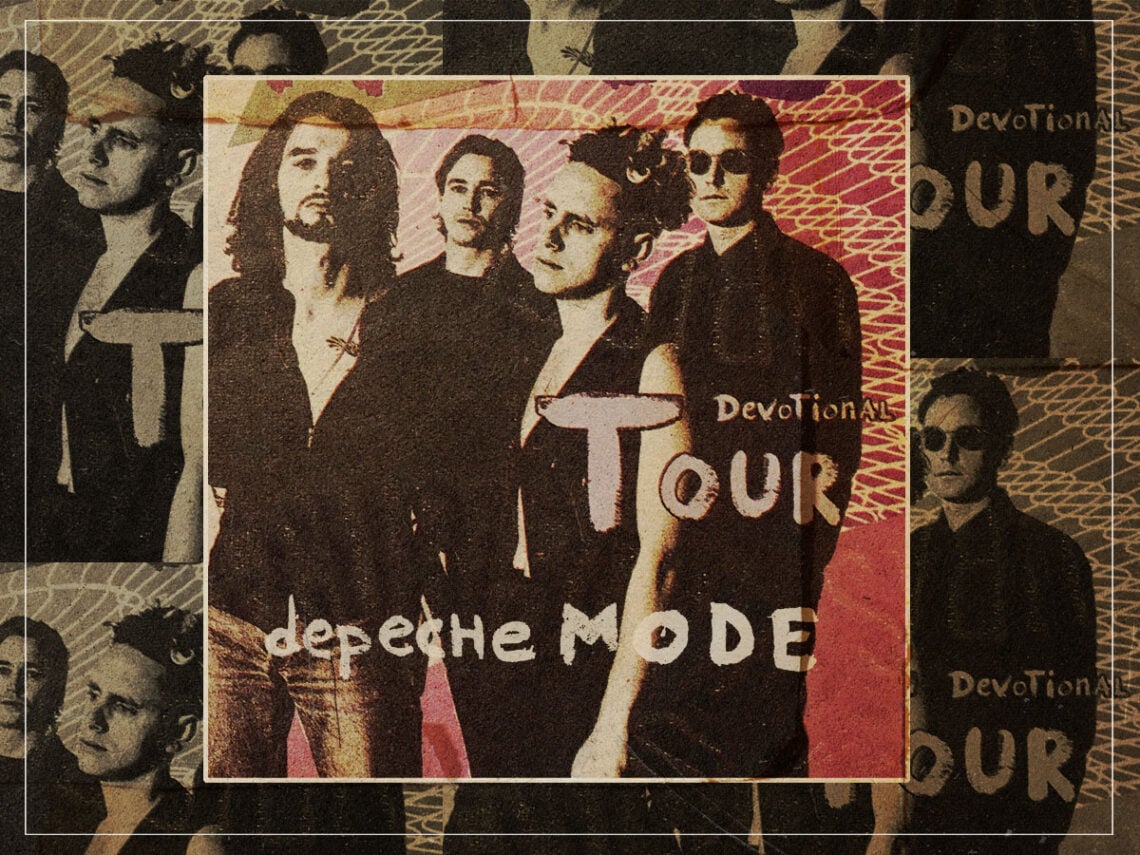
“It was a breakdown” The infamous tour that almost completely destroyed Depeche Mode

Depeche Mode wanting to change their reputation makes complete sense. In the 1980s, their synth-pop youthful façade made many think they were just a fresh-faced band for the younger audiences. Shedding such a skin was one sure way to being taken more seriously. Unfortunately, at the dawn of the 1990s, things were certainly looking more serious—but in a way that almost destroyed everything.
In 1993, in the firm grip of drug and alcohol addiction, Depeche Mode began their Devotional Tour off the back of Songs of Faith and Devotion. It was one of the most extensive tours any band has ever done, lasting 14 months, beginning in early 1993 and bleeding over into 1994 as they continued with the Exotic Tour, promoting the same album.
The tour seemed cursed from the outset: with a crew of 120, including a psychiatrist to support Dave Gahan during the height of addiction, the show kicked off with a performance in Lille, France. At this point, heroin had become impossible for the lead singer to escape. The drug had infiltrated his life more than he could have ever realised, and the psychiatrist failed to get through to him, mostly due to the fact that he became willingly ostracised in private rooms when he wasn’t on stage.
Each venue was marked by a scene that’s difficult to imagine—all members had their own hotel floors in an attempt to apply some level of control to the various parties that ensue. Martin Gore later called it “a practical necessity” and one which came out to be more than necessary considering the fact that one of the show afterparties in Berlin resulted in a police raid and a ban from the hotel.
Gahan was arrested in September 1993 after punching a concierge at a hotel and spent the night in jail. Around a month later, he suffered a heart attack on stage and was taken out on a stretcher while the rest of the band proceeded to play ‘Death’s Door’. Afterwards, against the doctor’s advice, the singer returned to the band to finish the tour.
Gore’s drug and alcohol addiction also spiralled beyond control, resulting in him having seizures and panic attacks while on tour, and also getting arrested in Colorado for causing a raucous with a boombox. Andrew Fletcher also encountered an intense bout of clinical depression that reportedly resulted in a full-blown breakdown by the summer of 1994. “With the targets, the deadlines, the partying, the excess, I just lost it,” he later explained.
Adding: “I had an obsessive-compulsive disorder, which made me displace this stress into worries about bodily symptoms. This sounds terrible, but I thought I had a brain tumour. I couldn’t sleep. I couldn’t think, this headache wouldn’t go away. I had tests. It wasn’t a brain tumour, it was a breakdown.”
As a result, Fletcher quit the tour in March. In fact, events that occurred during this tour were rumoured to have sparked Alan Wilder to quit the band entirely in 1995, citing “a consistent imbalance in the distribution of the workload” and contributions to the band that never achieved “respect and acknowledgement”. It’s also rumoured that Fletcher grew an intense aversion to Wilder, the latter of which alluded to such frictions when he allegedly said: “There are things that better never come to day-light.”
At the time, Gahan was asked how things were between the band, and he simply replied: “Really good.” But things were far from it—especially considering the fact that, a couple of months later, Gahan bit a journalist on the neck, apparently due to his fascination with vampires. Throughout the whole tour, Gore revealed that he only went to bed early once. “You don’t get offstage usually ’til 10.30, 11, so to get to bed by 12, you’ve really achieved something there,” he said.
In July 1994, Gahan wanted to mark the end of the tour by doing a celebratory stage dive but ended up going to the hospital with cracked ribs—something he only realised had happened 24 hours later. On top of this, the band had been touring with Primal Scream, who later revealed that all of the drugs and alcohol they had done scared them into sobriety, and they recorded their next album completely devoid of any substance.
There’s no doubt that all of this must be harrowing to revisit for fans who watched it all unfold and the band members themselves, but it’s also interesting to observe the excellence that played out in spite of such endeavours. At the time, Depeche Mode still had a sound more accomplished and refined than most—listen back to any of the live versions that took place during that time, and Gahan’s voice, despite being a little croaky and worn around the edges, is still filled with immense prowess.
“What people have heard about that tour is all pretty much true,” Wilder once reflected. But sometimes, the sun shone and dried up any remnants of dampening residue. “Not only was it the most successful tour with some of the best shows we’d ever played, but personally, I can’t see what all the fuss is about – I had a great time,” he added. Gahan shared the same sentiment despite completely uprooting his entire lifestyle after a near-death experience some two years later.
Exotic, in particular, was when it all seemed to come together. “What we discovered was that we enjoyed playing together this time more than any other time before,” the frontman said. “I think Devotional really had different facets – the debauchery, the fun, the suffering, the tensions and the great and professional show.”
