


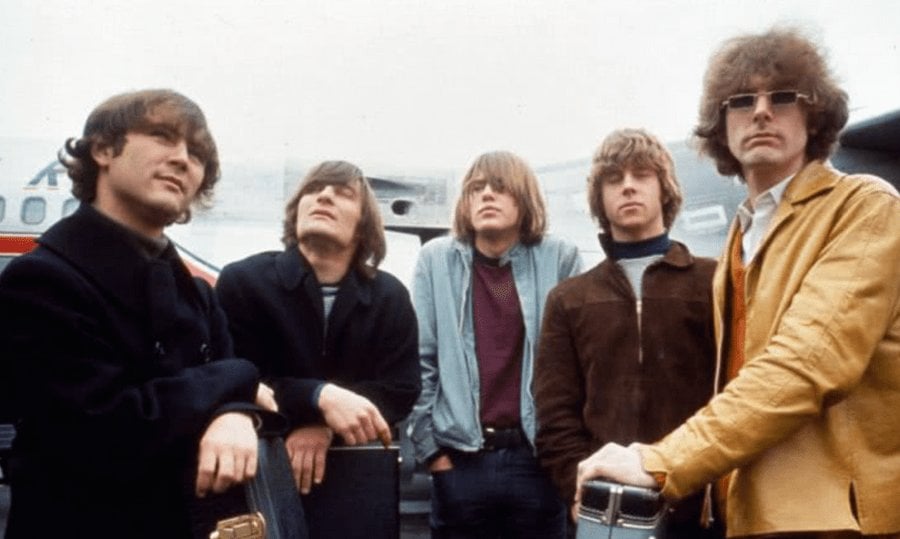
Hear the velvety isolated vocals for ‘Mr Tambourine Man’ by The Byrds

While there are countless areas of David Crosby’s life that we, and likely he, would rather forget, one thing is for certain: he had a seriously beautiful vocal. So, rather than languish in the sorrow of his recent passing, we thought it best to revisit some of his finest work. We’ve trawled the archives to bring you this: an isolated recording of Roger McGuinn, Gene Clarke, David Crosby, and Chris Hillman’s tight-knit vocals.
‘Mr Tambourine Man’ is the ultimate folk-rock classic. Composed by Bob Dylan and featured on his 1965 album Bringing It All Back Home, the track was re-released as a single that same year by West Coast janglers The Byrds, who transformed the track into a glimmering slice of proto-psychedelia. It was only in the hands of Crosby and the rest of the group that the song actually gained some traction on the airwaves. While Dylan’s words were world-beating, he lacked the panache in front of the mic that the band had at their disposal.
Dylan began writing ‘Mr Tambourine Man’ in the February of 1964 during a marijuana-fuelled road trip to San Fransisco, finishing it off once he was back home in New York. Dylan has since revealed that the titular tambourine man was inspired by a folk guitarist called Bruce Longhorne. “Bruce was playing with me on a bunch of early records,” he writes in Chronicles. “On one session, [producer] Tom Wilson had asked him to play tambourine. And he had this gigantic tambourine. It was, like, really big. It was as big as a wagon wheel. He was playing and this vision of him playing just stuck in my mind.”
Dylan debuted the track during his show at London’s Royal Festival Hall in 1964, a gig which boasted an audience featuring none other than The Rolling Stones. On his return to America, he recorded a demo of the song during sessions for Another Side of Bob Dylan. The Byrds’ manager, Jim Dickson, got hold of an acetate of the early demo featuring Jack ‘Ramblin’ Elliot and passed it on to The Byrds.
Initially, Roger McGuinn and co. were hesitant to do the song as Dickson was suggesting and simply re-record the track, feeling that it didn’t have enough hit potential. Considering the material had come from a somewhat unknown entity in Dylan, born out of the smokey coffee houses of the folk movement mecca of Greenwich Village, the chances of pop stardom were slim. But, The Byrds saw a glimmer of potential when they began singing the tune.
After coming around to the idea, McGuinn started modifying Dylan’s composition, altering the time signature from 2/4 to 4/4/. Dickson, meanwhile, had the bright idea of adding an electric guitar line over McGuinn’s initial 12-string guitar arrangement. Dylan was invited to watch The Byrds at work and was impressed that McGuinn had successfully transformed a straight-up country tune into a danceable pop hit.
Crosby recalled the moment: “He came to hear us in the studio when we were building The Byrds. After the word got out that we gonna do ‘Mr. Tambourine Man’ and we were probably gonna be good, he came there, and he heard us playing his song electric, and you could see the gears grinding in his head. It was plain as day. It was like watching a slow-motion lightning bolt.”
The song was later dubbed the “first folk rock smash hit” and arguably gave rise to the genre in the mainstream, paving the way for Dylan’s own domination.
Of course, the icing on the cake is the group’s vocal harmonies, which give the melody the velvety texture that make it so mesmerising. Make sure you check out the isolated recording of those vocals if you haven’t already, you won’t regret it.

Never Miss A Tale
The Far Out Bob Dylan Newsletter
All the latest stories about Bob Dylan from the independent voice of culture.
Straight to your inbox.