


Isao Tomita: the man who invented the modern sound of Japan

Contemporary music has a small set of innovators to thank for its current status. One man consistently overlooked by mainstream Western accounts is Isao Tomita, who pioneered electronic music, analogue synthesisers, and sound design. Alongside others who showed music the way forward, such as Wendy Carlos, Rachel Elkind and Yellow Magic Orchestra – whom Tomita directly inspired – he soundtracked a world where life and technology were fast becoming inextricable.
Born in Tokyo in April 1932, Tomita spent his earliest childhood with his father in China. After returning to his homeland when a little older, he was privately schooled in orchestration and composition while studying art history at Tokyo’s Keio University. This would provide him with the foundation to build his glittering legacy. In a taste of what was to come, after graduating in 1955, Tomita became a full-time composer for TV, film and theatre. He composed the music for the Japanese Olympic gymnastics team at the 1956 Summer Olympics in Melbourne.
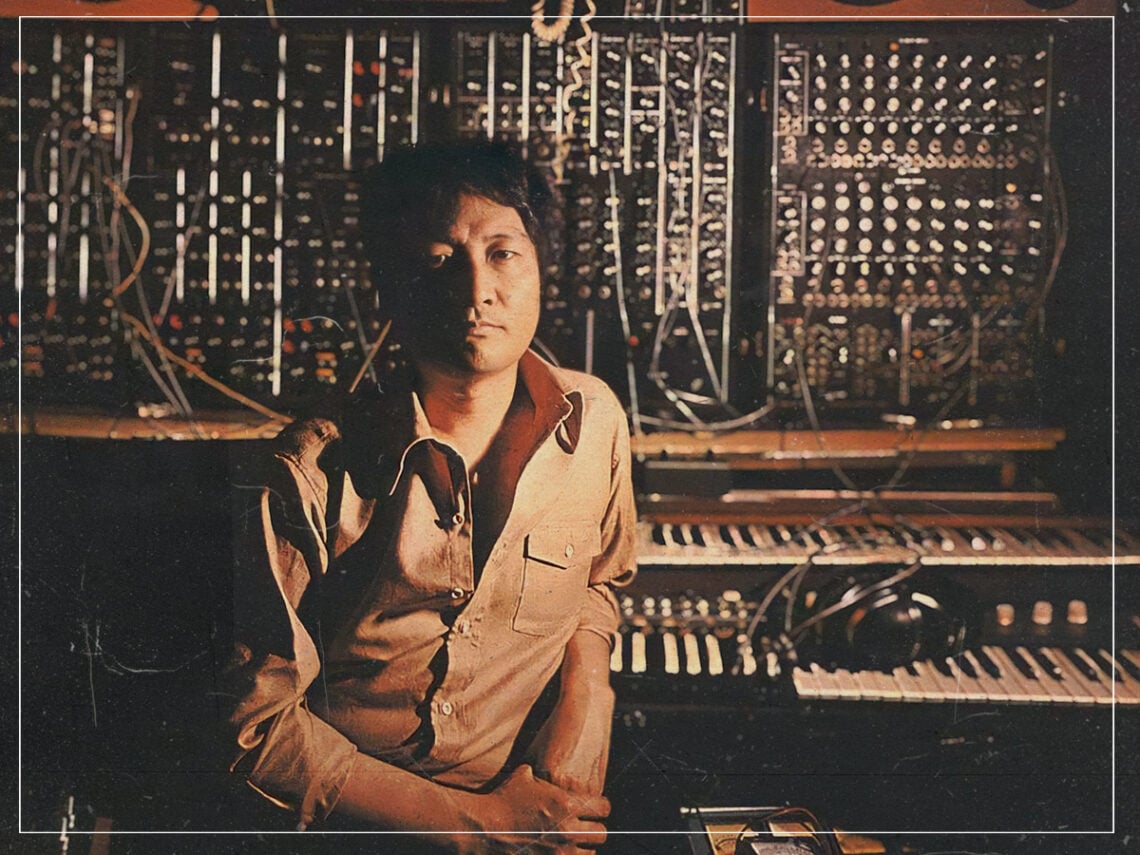
Spurred on by the advancements made by Wendy Carlos and Robert Moog, Tomita turned his concentration to the burgeoning world of electronic music. Throwing himself head first into this complex new area, he began building his home studio and, at a significant personal cost, imported a Moog III synthesiser into Japan, making him one of the first to do so. His debut electronic album was 1972’s Electric Samurai: Switched on Rock, which recreated contemporary rock and pop in electronic form and used speech synthesis instead of human vocals.
During this period, Tomita earned an understudy, Hideki Matsutake, who assisted him in bringing his celestial early works to life before he became the unofficial fourth member of the Yellow Magic Orchestra. The group was another widely consequential name in this field, which featured none other than Ryuichi Sakamoto, another definitive pioneer of ambient and broader electronic music.
In 1974, Tomita released his second album, Snowflakes are Dancing, which arranged French composer Claude Debussy’s impressionist works for the synthesiser. An incredibly significant release, it popularised the sound of many now-ubiquitous aspects of synth programming.
Boasting ambience, the most realistic string simulations the world had heard at that point, bell-like sounds and an array of processed effects such as flanging, phase shifting, reverberation and ring modulation. These are now all commonplace in synthesiser-related genres and broader popular music. It would also effectively weaponise analogue music sequencers.
One of the most consequential achievements of the record was its polyphonic sound. This arrived before the now-ubiquitous form of synthesiser using this type of sound, which was released in 1975 in the form of Moog’s Polymoog and then in 1976 with Korg’s PE-1000. To create polyphony – the simultaneous combination of two or more tones or melodic lines – Tomita used multitrack recording, as Carlos had done previously. He recorded each voice of a composition individually on separate tape tracks before mixing the final product into stereo or quad. In the analogue spirit of the day, completing the record took a whopping 14 months.
Following the 1974 masterpiece, Tomita would continue down his classical route by reworking albums by the likes of Stravinsky, Mussogorsky and Holst. In a reflection of the time and how unready most people, particularly the musical establishment, were for the advancement his efforts represented, 1976’s rendition of Holst’s The Planets caused an outrage, with Imogen Holst, the English composer’s daughter refusing him permission to interpret his work in such a supposedly flagrant way.
In a reflection of the pioneering spirit of Isao Tomita, in the 1980s, he performed his widely influential “SoundCloud” concerts, where he used the extensive speaker system surrounding the audience to envelop them in an ethereal “cloud of sound”. This appropriately set the scene for future innovations by sound design masters such as Jon Hopkins. One of his most famous shows – Mind of the Universe – occurred at 1984’s Ars Electronica festival in Linz, Austria, where he mixed tracks live – something modern audiences are now used to – in a glass pyramid suspended over 80,000 people.
This aptly brings us to those he has influenced. Flying Lotus is one of his work’s most lauded contemporary adherents, who has also played behind structures mixing his tracks to his astounded audiences. Other prominent names include Stevie Wonder, Black Milk, and another electronic music pioneer, J Dilla, who changed the face of beat-making and production. Elsewhere, Kitarō, Busta Rhymes, Early Sweatshirt, and Michael Jackson are recorded as fans. The late pop star even reportedly discussed collaborating with the Japanese innovator, but it never came to fruition.
Isao Tomita died of heart failure on May 5th, 2016, after struggling with heart disease for years. He will always be remembered as the man who sonically mirrored his home country’s break from its devastation in the Second World War and its rapidly accelerating technological advancements in the era of rebuilding. This was the sound of a re-energised Japan and one that was re-writing its story as a key player in an interconnected, postmodern world.
