


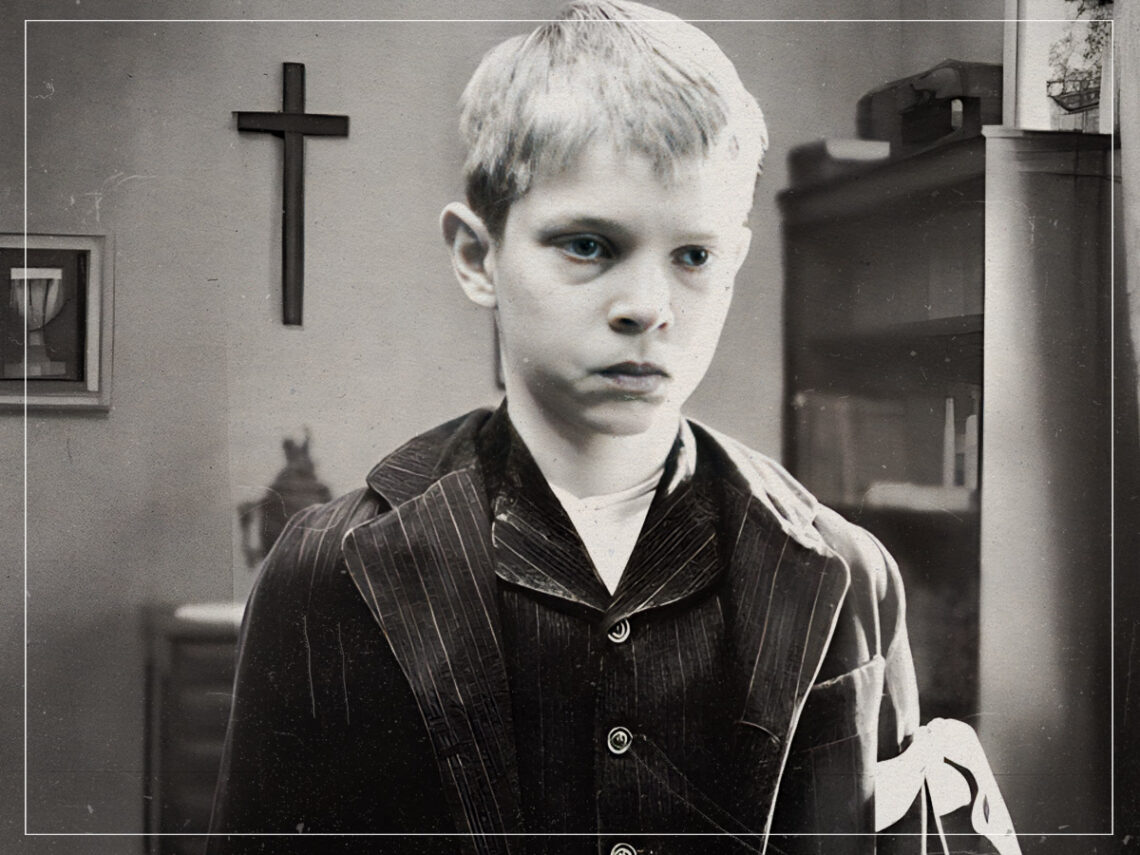
Is ‘The White Ribbon’ the most disturbing children’s story of all time?

Michael Haneke has become one of international cinema’s most provocative and daring auteurs by applying his familiar thematic touch to a number of stories that couldn’t be more different from each other on a superficial level, with The White Ribbon marking his suitably twisted take on the children’s story.
For over 30 years, the Austrian filmmaker has used outwardly cold, unsentimental, and often graphic imagery to convey his thoughts and feelings on social, economic, and societal issues that remain as prevalent today as they’ve ever been, whether it’s class, gender, race, violence, politics, or bureaucracy.
Those are universal themes applicable to almost every form of cinema, with his black-and-white 2009 mystery drama trading in multiple Haneke signatures. Unfolding in a remote German village in 1913, The White Ribbon zeroes in on a dysfunctional society where everyone seems to be shrouded in a thick blanket of malice and misery.
Random acts of violence and destruction plague the fictitious Eichwald, whether it’s a doctor being thrown from his horse after it barrels into a tripwire, the young son of a local landowner being kidnapped and beaten, a child with Down’s syndrome being brutally assaulted, or local crops being destroyed out of nothing but sheer spitefulness.
It follows the template of a children’s story in that its younger characters are placed at the forefront of the story, but this being Haneke, there isn’t a shred of whimsy or light-heartedness to be found. Instead, everyone bows at the whim of a baron, a pastor, and a doctor, who rule Eichwald with an iron fist that instils fear into the heart of its populace.
The younger generation are told that the onset of puberty is something that should make them feel guilty because they’ve been told the feelings they can’t explain are punishment for their impure actions. They wear the titular ribbons to remind them of their innocence that’s about to be ripped away from them, with the aforementioned incidents of extreme violence arousing much suspicion and finger-pointing.
All of which ends up being placed on the back burner when the first World War breaks out, but Haneke did at least make a point of comparing The White Ribbon to another well-known – and equally troubling beneath the surface – children’s story when describing his approach to shining a harsh light on how a suppressive society can ruin a generation when there’s nobody around to tell them otherwise.
“I want to show how all sorts of suppression can make you open to an idea when someone comes along and says: ‘I can save you’. It’s like the story of the Pied Piper,” he said. “It’s the war that takes place between people that makes them receptive to such ideologies. The civil war between groups of people.”
It’s a mystery that doesn’t provide any clear answers, but the parables and allegories are clear. It might be set two decades previously, but The White Ribbon echoes the nascent rise of fascism and Nazism in Germany, where the people holding the power wield it for all the wrong reasons to rebuke, marginalise, brutalise, and generally disregard anyone who doesn’t fall in line with their belief system.
