


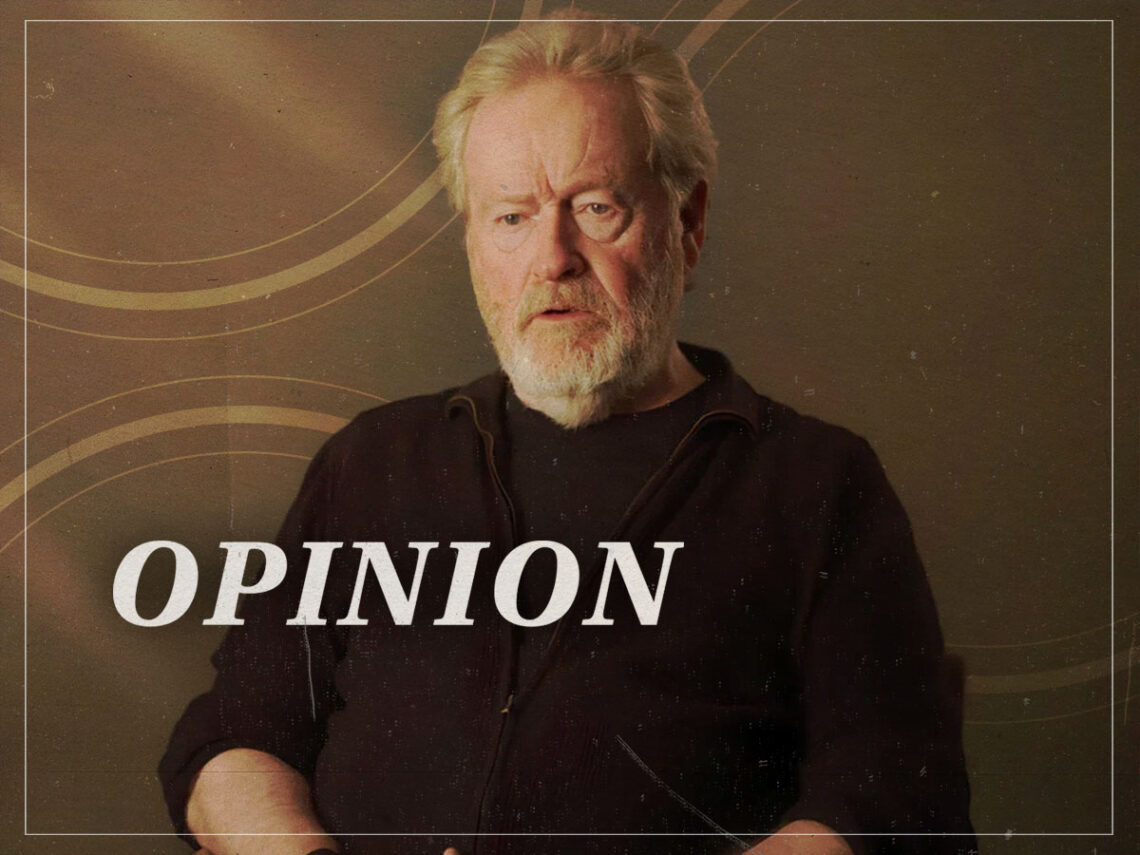
Is Ridley Scott cancelling himself?

When Alien was released in 1979, it was a smash, raking in $187million from a relatively modest $11m budget and marking its then-unknown director as one of his generation’s most exciting new filmmakers. Ridley Scott had only made one feature film before the chest-bursting space thriller, but after years working in the ad world, his flair for visual storytelling was fully formed, and he was ready to take on Hollywood.
More than four decades later, Scott remains one of the most consistently bankable directors in the business, having brought blockbusters like 2000’s Gladiator, 2007’s American Gangster, and 2015’s The Martian to the screen. He even had time to make undisputed classics like 1982’s Blade Runner and 1991’s Thelma and Louise. In the past few years, he’s sped his output, sometimes making more than one film a year. Now in his late 80s, Scott is still churning out box office hits. Just last year, his sequel to Gladiator pulled in $458m, and he has no fewer than six projects in the pipeline.
Lately, however, Scott’s successes have been overshadowed by, well, Scott himself. Cantankerous press-baiting is nothing new for the director, of course. He’s been known to tell historians to “shut the fuck up” and said variations on that sentence to many interviewers. He doesn’t suffer fools gladly, but in recent months, he has started to look a bit like the fool himself.
For one thing, he just can’t let go of that one bad review that New Yorker critic Pauline Kael gave him in 1982 for Blade Runner. He brings it up in almost every interview and even keeps a framed copy in his office. As recently as one week ago, in an interview with GQ, he was still railing against the critic, who, for the record, died in 2001.
“It’s insolent,” he fumed. “At my level, it’s insolent.” That sense of entitlement has been a recurring theme in the director’s recent interviews. Earlier this month, he announced that his long-gestating biopic of the Bee Gees was off due to financial disputes with Paramount.
“They didn’t like my deal,” he said. “So I said, I’ll move on. I’m expensive, but I’m fucking good.” He moved on. They didn’t follow.
If Scott was getting better at filmmaking, these sorts of comments would deserve a collective “You go, girl!” from the film industry. As things stand, however, he has yet to match the cinematic heights of earlier movies like Alien and even the first Gladiator. The sequel to the 2000 sword-and-sandals epic was a deliciously silly romp, but it lacked the emotional import and narrative focus of the original movie. Meanwhile, films like House of Gucci and Napoleon are bloated and self-important.
Then there were the comments from his longtime cinematographer. Speaking on the DocFix Documentary Storytelling podcast last November, John Mathieson, who has served as Scott’s director of photography on nearly every film since Gladiator, called out his frequent collaborator for “lazy” filmmaking.
He was speaking specifically about Scott’s use of multiple cameras to capture as many angles of a scene as possible. This technique speeds up the filming process, but according to Mathieson, it does not make for a better film.
“He wants to just get it all done,” the cinematographer said, explaining that using multiple cameras makes it impossible to create depth and atmosphere with lighting. He explained that these days, Scott starts shooting pretty much as soon as the actors get on set, skipping the usual rehearsals and blocking of scenes to move things quickly along. “It’s a bit rush, rush, rush,” Mathieson said. “And that’s changed. That’s the way he wants to do it, and I don’t like it.”
Scott clearly still has an enormous amount of goodwill with Hollywood and moviegoers, but as he continues to speed up his output and loosen his grip on quality, his constant sniping about critics and complaints about being undervalued becomes less entertaining than tiresome. It doesn’t change his films, but it does change how he is perceived.
Being cancelled means that people collectively decide that they don’t want to hear from you anymore. While that is usually the result of some kind of self-imposed scandal of repugnant proportions, Scott might be slowly inching his way towards self-imposed tedium, which, from a publicity standpoint, is arguably worse.
