


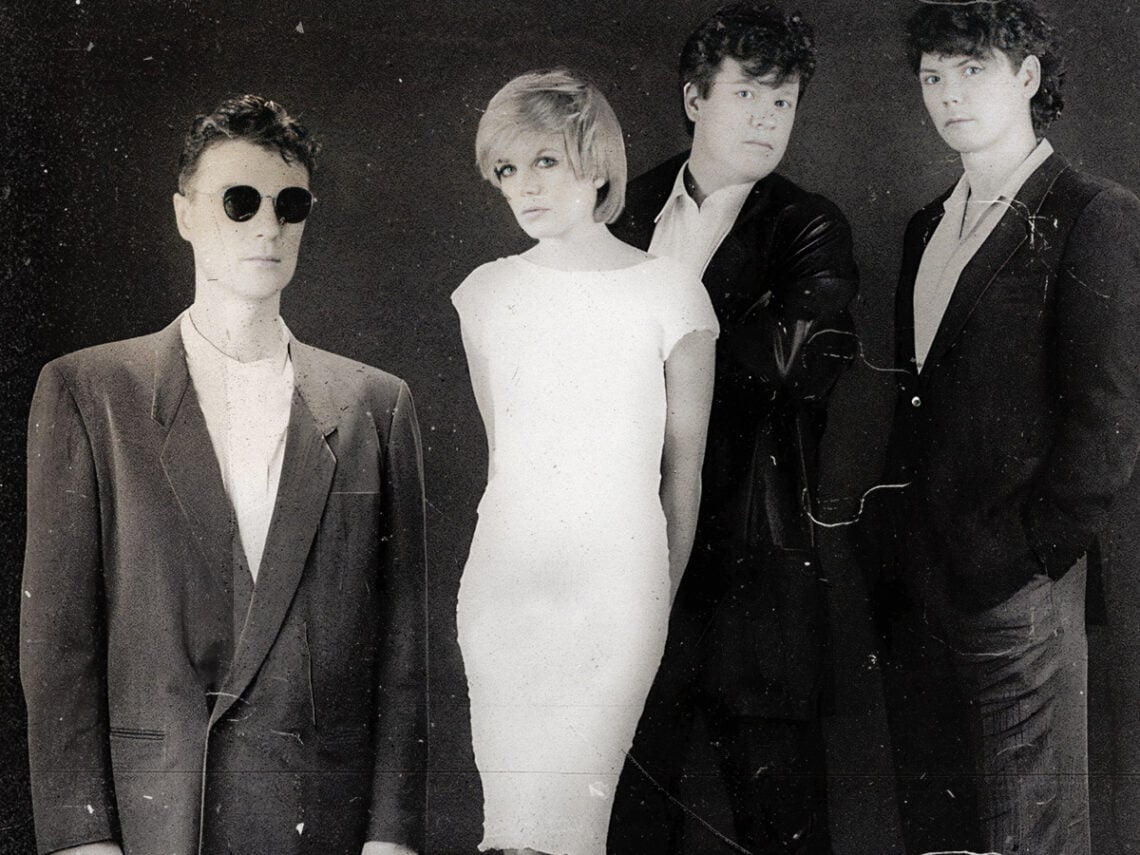
Is ‘Heaven’ the Talking Heads’ study of Buddhism?

When Fear of Music came out in 1979, much of the CBGB punk bubble had already burst, and the Talking Heads were probably pleased to further liberate themselves from the limitations of that loose association.
Even so, there were some lingering punk sensibilities that were still going to be read into their work—the sense of cynicism, rejection of traditional institutions, unrepentant piss-taking. Perceived as intellectual art school kids with Dadaist inclinations, one couldn’t really take anything the band did on face value alone. David Byrne, as a lyricist, in particular, was too complicated a cat to just write a straightforward song about, say, the afterlife.
And so, when the track ‘Heaven’ quickly emerged as one of the standout singles on Fear of Music, a lot of fans immediately presumed, despite the song’s genuine beauty and punchline-free ambiguity, that it was a satirical takedown of Christian notions of ‘that place you go’ when you die.
In the song, Byrne describes Heaven as a popular bar that everyone wants to “get to”, where “they play my favourite song, play it once again, play it all night long”. That sounds fun enough, I guess, until you get to the chorus, where the scene is reframed behind the notion that the endless repetition of something, even if it’s nice, eventually strips all meaning away from it.
“Heaven is a place. A place where nothing. Nothing ever happens”.
Talking Heads, ‘Heaven’
There’s a great Twilight Zone episode from the 1960s that covers this same turf: a gambler and hustler dies and finds himself in a new dimension where he wins every bet he places and every game of pool he plays. It seems like the greatest thing ever, until he realises that the removal of chance and risk devalues any sense of victory and undercuts any happiness. And then he figures out that he might not actually be in heaven, but doomed forever to meaninglessness in “the other place”.
It’s certainly easy to read the Talking Heads’ ‘Heaven’ as a similar critique of the Church’s clouds-and-harps concept of heaven, where you’re reunited with loved ones and can just chill out forever in a novelty Airbnb. Byrne’s haunted, heartfelt delivery of the chorus certainly doesn’t feel joyous, but is it meant to be completely sarcastic?
Over time, a lot of listeners have come around to a different reading of ‘Heaven’, especially as the singer’s own spiritually curious nature has been explored further throughout his career, rarely hinting at someone with a cynical instinct on topics this heavy.
Byrne’s ex-Talking Heads bandmate Christ Frantz seemed to confirm the non-satirical nature of ‘Heaven’ in a 2020 interview with Songfacts, noting, “I connected to the song ‘Heaven’ but I didn’t relate to the idea that heaven is a place where nothing ever happens. I understand it’s kind of a Zen thing, but I didn’t really connect with it. I did like the chord changes, it reminded me of a Neil Young song.”
The “Zen thing”, or the notion that Byrne was going for more of a Buddhist perspective with his bar called Heaven, does feel like a slightly more probable origin story for the song. Rather than “nothing ever happening” being an eternal sentence of misery, the concept aligns more with the state of nirvana, where your mind essentially empties, you are freed of all your concerns and desires, and, basically, nothing ever happens…but in a good way!
Byrne has regularly discussed Buddhist principles and concepts in interviews, and whether or not he would classify himself as a Buddhist himself, he has seemingly incorporated many of the religion’s tenets as tools to navigate his life. As recently as 2023, in a profile with the New York Times, Byrne talked a lot about his sense of self and the problems with modern individualism.
“Is there any continuous self?” Byrne asked, “You could say you’ve retained memories from various parts of your life, but memories are very malleable. We reshape them every time we remember them. They’re not fixed. Every self you go through, you dredge something up and make it apply to whoever you are at that moment. It’s a hard thing for us to intuitively accept the idea of ‘self is an illusion’. It’s very Buddhist, but it’s also increasingly more scientific. It’s not just a spiritual concept. It’s also a kind of neural concept.”
Losing that illusion of the self, then, could represent a step toward something more transcendental, peaceful, maybe even heavenly, where nothing is also something.
