


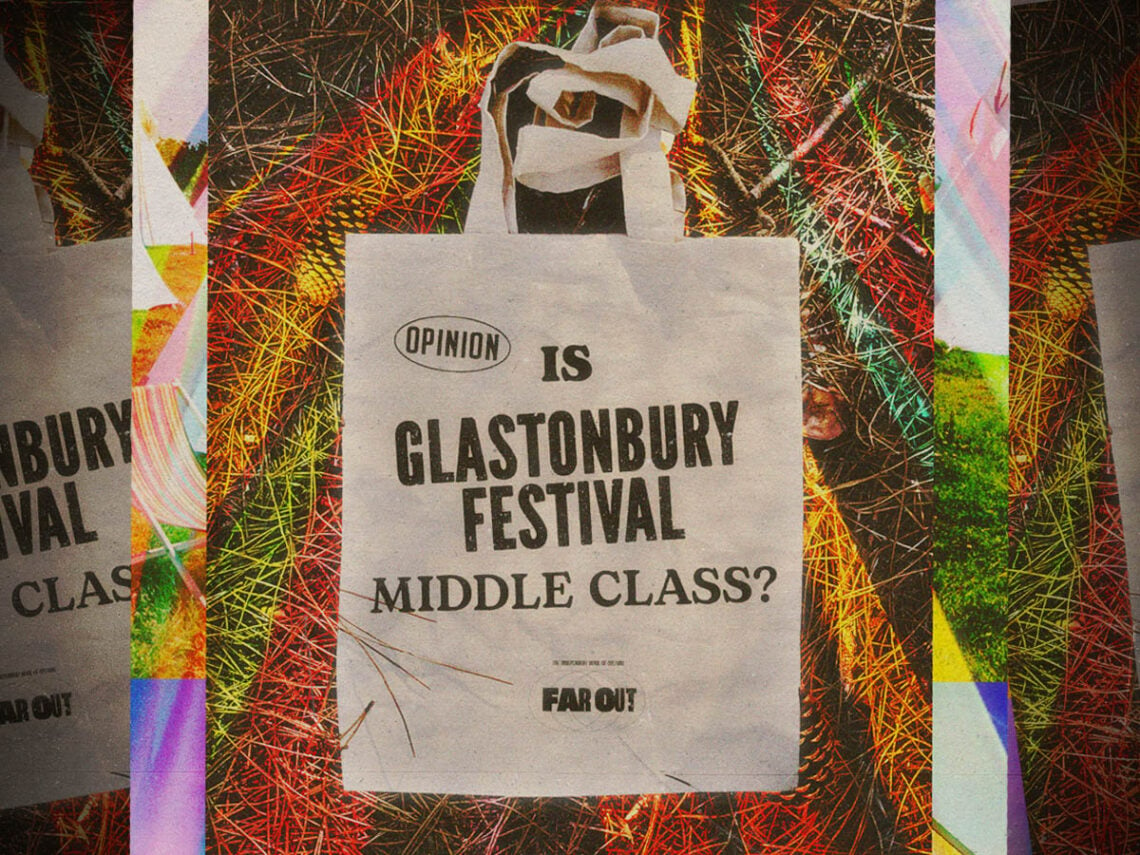
Is Glastonbury Festival middle-class?

The near-annual arrival of the Glastonbury Festival of Contemporary Performing Arts on the national musical and cultural calendar is a landmark event wrapped in numerous rituals and traditions.
The anxiety-inducing ordeal of around two million eager hopefuls glued to their laptops trying to nab those golden tickets, the online clash of jubilant celebrations and bitter prayers for rain splashed across social media, and the months-long sleuthing of artists’ touring schedules to spot a gap across the last weekend of June. Just as seemingly customary as forgetting how to pack your Quechua pop-up and someone, somewhere having destroyed a portaloo by Wednesday 10am, is the chorus of liberal and conservative pundits alike breathlessly lambasting any festival goer as the paragons of middle-class luxury.
“Going to Glasto this year with your little tent?” dodgy columnist Rod Liddle weirdly probes in The Spectator, as if camping is some sign of left decadence. “You vote Green or Labour or Lib Dem; you support ‘Palestine’, even if you are not wholly sure what is meant by ‘from the river to the sea’; you are proud to recycle…OK, you’re a little alarmed at the rise in Jimi and Olivia’s school fees this year as a consequence of those new taxes, and you are holding off from installing a heat pump for now,” he bores on, every fibre of his being wallowing in his calculated condescension.
Liddle can’t stop; the countercultural titan labelled Glastonbury a “bland, broad corporate smugfest” in 2011 and bemoaned its lack of “radical and cutting edge” billing. Robert Hadley headed to the festival’s Covid-delayed 50th anniversary in 2022 on behalf of The Daily Mail and deemed the site “more comfortably middle-class than a Waitrose olive counter” – famously only paid-up members of the metropolitan liberal elite buy olives, as well as falafel and quinoa – guffawed over the following day on GB News by Tory MPs Esther McVey and Philip Davies. Hell, even the Morning Star‘s James Walsh derided Glastonbury as being “as culturally vibrant as Last Night of the Proms and only marginally less likely to vote Tory”, albeit admitting some grudging resentment at his previous visit scuppered by a broken wristband and a dubious postcode registration.
Are they, and the smattering of sour Facebook comments and X tweets, correct? According to a 2014 YouGov poll, “Although 60% of British people say Glastonbury is a festival for people of any class, it does seem to be more attractive to middle-class people”. Adopting the social grading as used by the 2021 census, YouGov’s results indicate that “25% of middle-class people say it is a festival for middle-class people, compared to 17% of working-class, manual workers who say the same. 22% of people overall think it is a festival for middle-class people”. Further, it ostensibly reveals that the middle class was more likely to want to go, 37% stating they’d get a ticket, money permitting, compared to 26% of the working class.
Yet, the social grading used to denote class is based on the National Readership Survey’s methodology devised in the late 1950s, serving little more than an analysis for marketing industries to study “spending habits and consumer attitudes” according to the Office for National Statistics. With a loose categorisation of ‘ABC1’ covering non-manual work and ‘C2DE’ traditionally leaning physical labour, ‘C1’ specifically: “supervisory or clerical and junior managerial roles, administrative or professional” supposedly lands you smack bang in the middle of the class structure.

What’s the catch?
It’s a surprise to any bored call centre worker or suffocated data administrator, underpaid and wading through the cost of living crisis like the rest of us. It’s what the bizarre NRS social grading doesn’t include which reveals the nation’s skewed attitude to class so succinctly. Centred solely on occupation, elements such as income, wealth, and property ownership bear no factor in their assessment at all.
Conveniently, one’s relation to capital is scrubbed out of the equation, all material power and security pushed aside in favour of archaic impressions of what class ‘looks’ like rather than where it truly lies. Cue self-satisfied property-owning boomers luxuriating in their own marvellous salt of the earth ‘done good’ narratives while sneering at the stressed coffee barista forking out half her wages to a mouldy HMO room as ‘middle class’ because she has pink hair and quite likes Jeremy Corbyn.
When class is reduced to such a crude cartoon surface understanding, the absurd spectacle of very rich and very powerful people on large, national platforms becomes easily indulged in. There’s a visceral delight in McVey’s framing of Glastonbury as laughably middle-class, and Liddle’s eager excoriations of Worthy Farm’s jamboree almost tremble with scarcely concealed deliciousness at luxuriating in the false notion that his former punk credentials—yes, really— are marvellously intact after all for looking down at one of the country’s biggest cultural events. A whole swathe of the client media and bought political class can cosplay as authentically connected to the working-class experience of this country while inhabiting the lofty top percentile of national earners.

Glastonbury’s supposed signifier of middle-class privilege doesn’t stack up financially when considering what other, “less pretentious” activities cost. A quick travel and hotel booking on lastminute.com for a London-Magaluf October long weekend hovers around the £500 mark at best on their ‘last minute deals’ sale, and anyone desperate to relight the working-class flame of their 1990s youth and snap up those coveted Oasis reunion gigs could easily have forked out over £200 alone for standard seated tickets, let alone the corporate premium packages that can fly in excess of £500. Yet, the Glastonbury goer who pays their £50 deposit in October and saves up for the ensuing six months til the April payment window obviously sits in an ivory tower of insufferable smug plush.
These ludicrous perceptions are no accident. As capitalism fails around us, and neoliberalism’s chickens of gnawing wealth disparities and crumbling public realms have come home to roost, its economic and cultural ideologues have worked tirelessly to ensure the working-class majority of the country aren’t able to glean the culprits. While the contemporary rot’s alienation and loss of imagined future is somatically felt in the gut, class has been vigorously redefined by the likes of political scientist and Values, Voice and Virtue author Matthew Goodwin, whereby the “dominant elites” are in fact a cadre of intellectuals who enforce a dogma of “radically progressive cultural values” onto a majority who are innately conservative. With a perception of class wholly defined by culture war attrition, maintaining the whims of the establishment and throwing your support behind the legislative arbiters of austerity can be flexed as marvellously dissident, free-thinking and rebellious—so long as you hate Gary Lineker.
Let’s be real, though. Of course there’s a middle-class faction that attends Glastonbury, with festival and dairy farm founder Michael Eavis intimating as much to The Standard in 2012: “People say we’re getting middle-class, which is stretching it a bit far, but we’re attracting a lot more people in their 30s and 40s and need to get the Radio 1 and NME crowd back in.” Glastonbury is a very different beast from its days of catering to a few hundred hippies back when it was called the Worthy Farm Pop Festival in 1970. As it has evolved in size, operation, and mainstream stature, so too has its social spectrum of ticket holders, a much broader cross-section of society finding the chance to escape reality with Glastonbury’s artful whirl of music and hedonism appealing to many a private tory and trust-funded ‘free spirits’.
Yet who’s to say that the original hippies were necessarily working-class? Reaching back to the halcyon days when Glastonbury was at its most countercultural ‘pure’, according to numerous corporate journalists who would never have had any remote affinity with the festival in its infancy, the privately educated granddaughter of Winston Churchill, Arabella, proved instrumental in organising the legendary 1971 Glastonbury Fayre, pouring thousands from her family trust fund into affording the event’s free admission and realising the now iconic Pyramid Stage. A committed and principled charity worker who rejected the “revolting” makeup of her aristocratic background, Arabella’s importance to the festival is such that ‘Bella’s Bridge’ over the site’s Whitelake River is named after her.

There’s little in the way of extravagances for the thousands that attend Glastonbury. The ‘glamping’ phenomenon so obsessed over among the reactionary press eager to fuel the festival’s middle-class tropes is far removed from the experiences of the majority who sleep in a £40 tent, wheeling in mountainous levels of cheap, warm beer. There’s no doubt that VIP facilities are an upgrade—it’s hard to picture Diana Ross waiting in queue for the compost long drops, cup of sawdust in hand—but the oft-reported palaces of ‘pop-up hotels’ are third-party services external to the site which have no official relationship with Eavis and the Worthy Farm HQ.
Yet, the cost of living is something that Glastonbury has to contend with. With the thousands of acts to witness across a hundred-odd stages, rationally £370 for a ticket is good value for money, but it’s an over 50% price increase in six years that needs to calm right down for the future. Forced to recoup losses over the pandemic, it still points to a trajectory that, if left to run apace, will simply become a not financially viable option for the scores of working-class people who make up the festival’s rich and varied atmosphere.
Is Glastonbury worth it?
Nevertheless, there’s a reason the festival sells out every year. Aside from the plethora of music, performing arts, and thought-provoking concepts that colour the evening South East Corner afterparties, Glastonbury offers a weekend where communal solidarity is potently felt, a cathartic counter to a world growing ever more hostile and atomised at the hands of the political and media class eager to undermine the festival’s core foundings of Methodist social democracy. Its political ambitions are still intact and should hope to never change, making for a perennial source of conservative contempt that similarly priced festivals are never subject to.
Glastonbury’s rebellious streak shines potently amid its broadened cultural scope. Despite massive pressure from Israeli-shill bigwigs in the music industry and risible authoritarian types in both the Labour and Conservative parties, Eavis and the programming team ignored MP David Taylor’s parliamentary crying over Irish Republican hip-hop group Kneecap gracing the West Holts Stage after brandishing a Hezbollah flag last year, ignoring his persistent emails and the external pressure from the right-leaning press. Any festival holding strong against Zionist tantrumy demands to cancel an act over free speech and host the trio currently facing terrorism charges by the British state is anything but cowed to corporate, mainstream conformity.

It’s never as good as it used to be. Long before its ‘Glasto’ nickname, cash machines, security walls, and programming pulling in the ‘Big Weekend’ crowd, Glastonbury’s supposed lost edge has been complained about ever since The Smiths headlined in 1984. However, through its evolution, and the transitionary management from Michael to his daughter Emily, Glastonbury Festival has fought licence battles and stuffy councils to expand an arts project across the decades that’s grown into the nation’s cultural fabric, as British as a Euro/World Cup final or the wave of artists that take over Edinburgh every August with a firmly socially democratic outlook countering the ruling class of the day.
You’re not middle-class because you bought lentils in Waitrose; neither are you working-class because you enjoy a pint in Wetherspoons. Class is, and always will be, overwhelmingly, one’s relation to capital and which rung you inhabit on the economic ladder, despite what very rich people are trying hard to obscure. When casting aside the surface caricatures of class, suddenly, Reform MPs’ façade of authentic proximity to the majority of us reveals itself as the pantomime it is. We all have far more in common with each other materially than the political class that lives on another economic planet, and a shared class struggle against the capital and war-hungry elite who want us fighting culturally over ever uniting on a class front.
To those lucky few attending Glastonbury Festival this year, pitch up your tent, jump into your foldable chair, crack open your first Stella and give a salute to the dreary media stooges gnashing with contempt as you make friends with your neighbours and embark on a dizzying weekend of fun, music, and beers for breakfast. When the meaninglessness of the culture war vapidness is seen for what it is, Glastonbury Festival’s targeted excoriations are clearly seen for the reactionary and killjoy sops to ‘new elite’ bullshit they are. They reveal nothing about ‘class’ or who’s going and everything about the motives of wealthy class dismantlers who abhor any joyous challenge to their beige homogeneity.
